


The Next AI Gold Rush: NVIDIA’s $5 Trillion Vision
NVIDIA’s AI story now spans devices people use directly and computers that help robots interpret the physical world. NVIDIA AI laptops humanoids are part of a wider platform connecting personal computing with machines that act in the world. A robot foundation model is an AI model trained on broad data to generalize skills across tasks and robot embodiments. That vision is broader than what is ready for everyday use.
The difference matters to buyers, developers, and companies weighing new AI systems. A laptop may run models locally, while a robot needs tools for training, testing, and safe action. Those are connected parts of physical AI, but they are not the same capability.
Readers can assess the technology more clearly by separating what runs on a laptop, what trains in simulation, and what must work safely on a robot.
NVIDIA AI Laptops Humanoids: What Is the On-Device Role?
A laptop can run AI locally when its GPU and shared memory fit the workload. That lets models and agents process data on the device, without sending every request to a remote service.
Local computing adds control, but model size and performance still depend on the exact system. NVIDIA’s planned RTX Spark laptops aim to bring large AI workloads onto portable computers.
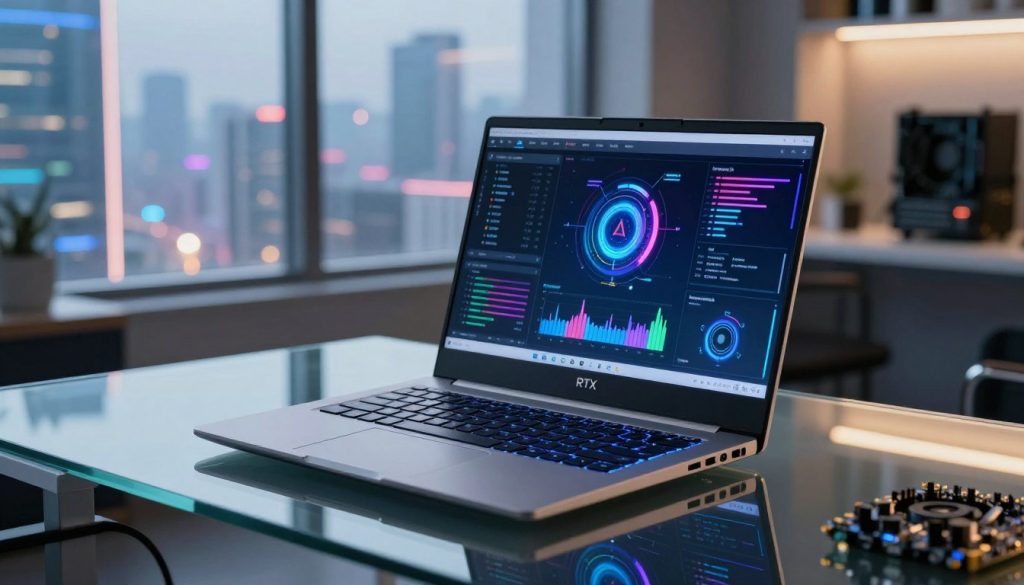
RTX Spark brings large AI workloads onto a laptop
RTX Spark combines a Blackwell GPU with 6,144 CUDA cores and fifth-generation Tensor Cores. Those Tensor Cores support FP4 precision, a format used for AI calculations.
The system pairs that graphics processor with a 20-core NVIDIA Grace CPU. It offers up to 1 petaflop of AI performance and up to 128GB of unified memory.
Unified memory gives the CPU and GPU access to one shared pool. That design can help fit large models and their working data inside the laptop.
NVIDIA says RTX Spark can run large language models with up to 120 billion parameters and up to 1 million tokens of context. A token is a piece of text that a model processes.
RTX Spark laptops are planned for fall 2026 from ASUS, Dell, HP, Lenovo, Microsoft Surface, and MSI. Acer and GIGABYTE models are expected to follow.
The fall 2026 window is a planned release, not proof that every model or configuration is already for sale. Buyers should distinguish announced systems from products they can actually order.
Local agents extend the laptop beyond chat
Local AI agents can handle steps in a task, rather than only answer a prompt. They may work with files, apps, or creative software on the laptop.
Keeping model work on the device can limit how much data leaves it. The actual privacy benefit depends on the apps, settings, and services involved.
RTX Spark laptops are designed for on-device agents, with Windows security features and NVIDIA OpenShell for agent control. These controls help manage what an agent can do.
Agents still need clear limits. A system that can open files or run software should have permissions matched to its job.
Check the exact model and configuration before assuming an announced laptop supports a particular local workload.
How Does NVIDIA’s Robotics Stack Train and Run Robot Models?
A robot model needs large-scale training and a way to test movements before controlling hardware. NVIDIA’s robotics stack splits that work across model training, simulation, and onboard inference.
A robot foundation model must still be tested on the robot and in its real operating conditions. Simulation helps, but it cannot erase a mismatch in data or hardware.
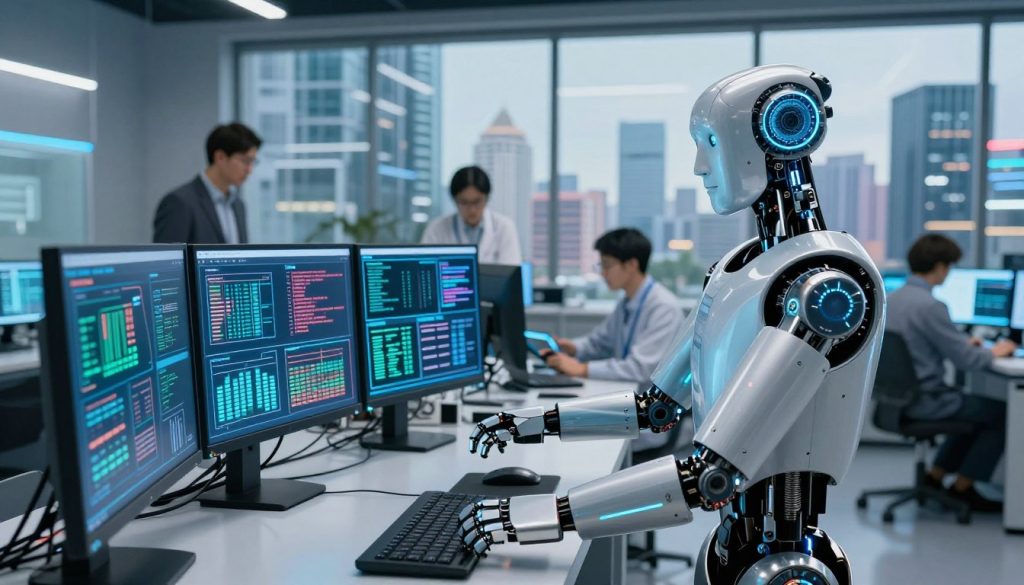
GR00T builds general skills from multimodal data
Isaac GR00T is an open reference platform for humanoid robot models. Its models use language and images to connect instructions with actions.
They can learn from captured movement, synthetic data, and internet-scale video. Robot learning can include imitation, where a model learns from demonstrations, and other training methods.
The aim is to adapt skills across different robot embodiments. A model could learn to pick up an object, place it somewhere, or complete several steps in order.
Such tasks demand more than recognizing words or images. The robot must map a request to movements its body can safely perform.
Isaac Sim and Isaac Lab make training repeatable
Isaac Sim and Isaac Lab serve different roles in simulation and robot learning. Isaac Sim models physical scenes, while Isaac Lab supports training and checking robot policies.
A policy is the set of rules a model uses to choose its next action. Developers can test those choices in repeatable environments before trying hardware.
DGX systems provide computing for model training. NVIDIA Omniverse supports simulation, while Cosmos tools can help create and test simulated environments.
A digital twin is a simulated replica of a facility or system. It can help developers study how a robot might act in a factory or warehouse.
Simulation training data must still match the target robot and the place where it will work. A policy trained on a smooth floor may fail on a cluttered or uneven one.
Jetson Thor runs models on the robot
After training, a robot needs an onboard computer to process sensor data and run models. Jetson Thor modules offer up to 2,070 FP4 TFLOPS of AI compute and 128GB of memory.
They operate from 40 to 130 watts. NVIDIA reports 7.5 times the performance and 3.5 times the energy efficiency of AGX Orin.
The Jetson AGX Thor Developer Kit has a 14-core Arm Neoverse-V3AE CPU and 128GB of 256-bit LPDDR5X memory. Its memory bandwidth is 273GB per second.
The Jetson T5000 delivers 2,070 FP4 TFLOPS and 128GB of memory, using 40 to 130 watts. The T4000 delivers 1,200 FP4 TFLOPS and 64GB, using 40 to 70 watts.
Camera capacity also differs by setup. The developer kit supports up to 20 cameras through Holoscan Sensor Bridge, while the T5000 supports up to six through 16 MIPI CSI-2 lanes.
Match the onboard compute and camera inputs to the robot’s actual sensor setup before settling on a deployment design.
Where Can Humanoid Robots Work, and What Limits Them?
A humanoid’s practical advantage is its human-shaped form, which can make existing workspaces usable without redesigning them around another robot. That is a potential benefit, not proof that humanoids can handle every human task.
Many humanoid robot use cases remain in early research and development. Their ability to work near people depends on the task, the setting, and careful testing.
Possible use-case areas include:
- Manufacturing, such as moving parts between work areas.
- Warehouse and logistics work, including moving goods.
- Healthcare support tasks in care settings.
- Home assistance with selected household tasks.
- Customer service in public or commercial spaces.
Humanoid development uses machine learning, imitation learning, and reinforcement learning. These methods do not remove limits in sensors, motors, balance, or hand control.
A robot also needs enough onboard compute to interpret sensors and respond. Battery energy, training data, and the range of tasks it has practiced affect performance.
Safety includes more than avoiding a collision. Functional safety covers hazards in the machine, robotics safety covers movement, and collaborative safety concerns work near people.
Sensor safety and AI safety also matter. IEC 61508, ISO 13849, and ANSI/RIA R15.606 are safety frameworks; ISO/IEC TS 22440 is an emerging AI-safety standard.
Human collaboration should be validated as a safety requirement, not assumed from a human-like shape.
What Does an NVIDIA-Powered Humanoid Look Like in Practice?
Agile ONE SN makes the demands of a general-purpose humanoid tangible through its compact body, articulated hands, and onboard AI computer. Its design gives developers a concrete platform to study, but its scheduled availability is still in the future.
Agile ONE SN is scheduled to be available in early 2027, which does not show that it is already operating at scale. Product plans and broad deployment are different milestones.
Agile ONE SN combines human-scale movement with onboard compute
The robot is 1.40 meters tall and weighs 40 kilograms. It has 31 degrees of freedom, meaning its body can move through many controlled joints.
Each arm can carry a 3-kilogram payload. Two five-finger WUJI Hand 2 hands give it 20 degrees of freedom per hand.
Its NVIDIA Jetson Thor onboard computer provides 2,070 FP4 teraflops of compute and 128GB of unified memory. That computer must run AI tasks within the robot’s power and heat limits.
Head and wrist cameras capture views from different angles. Lidar sensors measure distance, while inertial measurement units track motion and orientation.
The combination gives developers several types of sensor data to work with. It also raises practical questions about camera placement, data flow, and how quickly the robot can react.
Simulation assets and physics tools expand testing
Isaac Lab 3.0 is generally available with multi-GPU workflows. It includes the Newton and NVIDIA PhysX physics engines for testing robot motion.
Using more than one GPU can support larger or more demanding simulation work. Physics engines help model contact, motion, and forces in virtual environments.
SimReady Central Library contains more than 2,000 simulation-ready robotics and factory assets. Developers can use those assets to build test scenes instead of creating every object from scratch.
A useful simulation still depends on how closely its objects and physics match the intended task. A hand gripping a virtual tool may behave differently from one holding the real tool.
Compare a robot’s payload and hand dexterity with the task it must perform, not just with its human-like appearance.
How Do Developers Move From Simulation to Real-World Deployment?
Start with a specific robot task and the hardware that will perform it, then choose training and simulation tools around those limits. That keeps development focused on what the robot must actually do.
Success in simulation does not replace testing a policy on its target hardware and sensors. Physical robots encounter conditions that virtual scenes may not capture.
Set up the training and simulation workflow
NVIDIA Isaac is an open robotics development platform. It includes simulation and robot-learning frameworks, CUDA-accelerated libraries, AI models, and reference workflows.
A practical workflow has three steps:
- Define the robot and task, then gather data that fits its body, sensors, and work setting.
- Train and evaluate policies in Isaac Sim and Isaac Lab, using reinforcement or imitation learning where suitable.
- Deploy to Jetson hardware and validate the policy with the robot’s real sensors.
DGX systems can support demanding model training. Isaac Sim creates simulated scenes, while Isaac Lab helps train and assess robot policies in those scenes.
NVIDIA Omniverse supports simulation workflows and digital twins. A digital twin can represent a facility or work area, giving developers a place to test robot behavior.
Reinforcement learning can train a policy through rewards and repeated attempts. Imitation learning can use demonstrations, which may suit tasks with clear examples.
Validate the robot policy on its target hardware
Once a policy is ready, developers can run it at the edge, meaning on a computer carried by the robot. Jetson Thor is based on Blackwell architecture and includes a functional safety processor, a high-performance CPU cluster, and 100Gb Ethernet bandwidth.
Those features support onboard computing and data movement, but they do not certify the full robot. Testing must cover the actual sensors, software, and physical task.
Isaac ROS connects NVIDIA’s robotics tools with ROS 2, a common robotics software framework. That link can help developers work with existing robot software.
During trials, record cases where the physical robot acts differently from its simulated version. Then repeat those cases after changing the policy.
Keep a record of failures that appear only on physical hardware so that policy changes can be retested against them.
Which Companies Are Building on NVIDIA’s Robotics Platform?
A real-time robot stack has to move sensor data into perception and control without adding needless processing delays. Companies are building systems around NVIDIA tools to address that need.
A platform integration does not prove certification or safe performance in every deployment. It shows that named tools are part of a company’s work, not that every robot is finished.
Humanoid is integrating a real-time edge runtime
On October 21, 2026, Humanoid described integrating Jetson Thor, Isaac OS, Holoscan Sensor Bridge, and Holoscan SDK into its next-generation robot platform.
The company consolidated two onboard computers into one Jetson Thor system. It also uses GPU-accessible camera data to reduce data copies and CPU workload.
Isaac OS provides a GPU-native runtime, which lets software use the graphics processor for tasks. Multi-Gigabit Ethernet supports up to 100Gb of bandwidth for sensor and control data.
That design aims to move camera information through the system with fewer steps. The result depends on how the full robot handles sensing, processing, and control.
European companies are building on the open platform
NVIDIA named ABB Robotics, Flexion, Hexagon Robotics, Humanoid, KUKA, NEURA Robotics, Sereact, and Universal Robots among European companies building on its open robotics platform.
These names show a broad mix of robotics firms and industrial automation groups. A shared platform can give developers common tools, while each company still builds its own systems.
Robot-learning and safety collaborations widen the ecosystem
NVIDIA named 1X, Agile Robots, Humanoid, Maven Robotics, Mentee, MicroAGI, Rhoda, Sereact, and Skild AI as supporters of open-source robot-learning reference workflows on DGX Station.
Open workflows can give developers a shared starting point for training and testing. They do not ensure that a policy will transfer well to every robot.
Agile Robots, Agility, Dexory, FORT Robotics, and KION are integrating NVIDIA Halos into robotics safety architectures. The work adds safety tools to their systems, but does not establish safe performance in every setting.
Check what a partner has actually integrated before treating a platform relationship as evidence of a finished robot capability.
What Do NVIDIA’s Financial Results Reveal About Its AI Business?
NVIDIA’s fiscal Q2 2027 results show how heavily its business is tied to accelerated computing and Data Center demand. Revenue for the quarter ended July 26, 2026, reached $96.2 billion.
That total was up 106% from a year earlier, while Data Center revenue rose 117%. The figures show strong growth, but each business line has a different role.
Data Center revenue was $89.0 billion in the quarter. Edge Computing revenue was $7.2 billion, up 27% year over year.
The two figures describe separate parts of the business. Data Center revenue was much larger, while Edge Computing grew at a different rate.
NVIDIA reported a gross margin of 75.0% under both GAAP and non-GAAP accounting. Gross margin is revenue left after the cost of goods sold, before other expenses.
Reported results describe a completed quarter. NVIDIA’s fiscal Q3 2027 revenue outlook is a forecast of $108.0 billion, plus or minus 2%.
The forecast assumes no Data Center compute revenue from China. That condition matters because a forecast depends on the assumptions used to set it.
Market value is another measure, but it is not operating revenue. Nasdaq reported NVIDIA’s market capitalization at $5.252 trillion on October 27, 2026.
Market capitalization reflects share price and shares outstanding at a point in time. It can change as investors trade the stock.
Read the Q3 outlook as conditional guidance, especially because its stated assumption excludes Data Center compute revenue from China.
Which NVIDIA Laptop Examples Fit Different AI and Gaming Needs?
Laptop choice starts with the workload: demanding games and creative projects call for a different balance of GPU, display, and portability than everyday use. The best fit depends on the exact configuration, not just its name.
Match the processor, graphics chip, screen, and weight to the apps you plan to run. NVIDIA’s 2026 gaming-laptop guide describes RTX 50-series Blackwell mobile GPUs as its latest laptop graphics generation.
These four examples show different hardware choices:
- Razer Blade 18 (2026): Intel Core Ultra 9 290HX Plus and NVIDIA GeForce RTX 5090 Laptop GPU.
- MSI Katana 15 HX: Intel Core i7-14650HX and NVIDIA GeForce RTX 5050 Laptop GPU.
- Acer Predator Triton 14 AI: Intel Core Ultra 288V and NVIDIA GeForce RTX 5070 in a 3.5-pound laptop.
- Asus TUF Gaming A14: a 14-inch gaming laptop based on AMD and NVIDIA hardware.
The Razer’s 18-inch display has two modes. It can show 3840 by 2400 pixels at 240Hz or 1920 by 1200 pixels at 440Hz.
The higher-resolution mode gives more detail, while the faster mode favors a higher refresh rate. Those settings suit different gaming and creative priorities.
The MSI has a 15.6-inch, 1920 by 1080 display with a 144Hz refresh rate. Its parts offer a different mix from the Razer, without making it a winner for every buyer.
The Acer combines a high-end mobile graphics chip with a 3.5-pound body. That weight may matter to someone who carries a laptop often.
The Asus is a smaller 14-inch option with AMD and NVIDIA hardware. Its exact parts depend on the configuration, so its name alone does not define performance.
Gaming laptops can also support creative software and some local AI tasks. The fit depends on the software, memory, graphics chip, and cooling in each model.
Compare the exact GPU, screen, and weight of the configuration you can buy rather than relying on the product family name.
Conclusion
NVIDIA’s expanding AI opportunity is clearest when its computing platforms are viewed as tools for specific workloads, not as a promise that every use case is already solved. Local computing and robot models connect, but useful physical AI still depends on testing, hardware fit, and safety.
Developers can start with one robot task and identify the data and tools needed to test it. That keeps model development tied to a clear result instead of a broad claim about what robots might do.
To get started, select one robot task and map the data, simulation, and onboard hardware needed to test it safely.




No comments