


Dutch startup targets remote patient monitoring with its smart stethoscope

What to expect from Apple this October and beyond

The Apple product machine continues to whirr, with a host of new products, including Macs, iPads, and iPhone SE, expected to appear this fall.
Some of these new products will represent powerful improvements compared to older hardware, as the intention is to ensure Apple Intelligence runs well on all the company’s devices. That means a big jump in processor power and might also mean a bump in memory — both of which should raise the performance bar, even for those entry-level products you intend to deploy across your business.
In brief, the list of upcoming product upgrades is expected to include:
- MacBook Pros with an M4 chip.
- iMacs with M4 chips.
- A Mac mini upgrade.
- The iPhone SE, with Face ID and Apple Intelligence.
- A new iPad.
- A new iPad mini.
The thinking is these devices will almost certainly appear at about the time as Apple rolls out Apple Intelligence features that have been announced but aren’t yet available — particularly (for business users), the introduction of a more context-savvy Siri in 2025. That alone is likely to tempt consumers to upgrade to iPhone SE, and should also make that device a more viable tool for some roles in the mobile enterprise.
The iPhone SE is expected to ship with an A18 processor (also used in the current iPhone 16 range) and will look more like an iPhone 14, lack a Home button, and have but one rear camera. (It’s not expected to make an appearance until Spring.)
Other upgrades to Apple’s Mac range will arrive sooner, potentially this month. These are expected to include M4/M4 Pro processors and at least 16GB of RAM in the MacBook Pro; a new M4-based iMac; and a redesigned M4-powered Mac mini with five USB-C ports. The other significant take away in the move to M4 chips is that it will place Macs far ahead of competitors when it comes to computational performance per watt, which is a very important consideration when thinking about AI.
A quick run-down of current Mac speculation:
- MacBook Pro: 14- and 16-in. models, M4/M4 Pro/M4 Max chip, 16+GB RAM, 10-core CPU and GPU, three Thunderbolt 4 ports.
- Mac mini: Smaller than the current model, M4 or M4 Pro chip, no USB-A ports, five USB-C ports, an HDMI port, and perhaps an internal power supply.
- iMac: No major design changes in the 24-in. all-in-one, and M4 processors.
Those Mac upgrades could be accompanied by new iterations of the iPad and iPad mini, both equipped with A18 processors capable of handling Apple Intelligence. For many enterprise users, the iPad mini upgrade may seem attractive.
Current iPad expectation:
- iPad mini: Big feature upgrades include Apple Pencil support and updated front and rear cameras, A18 chip, Wi-Fi 6E, Bluetooth 5.3.
- iPad (11th generation): A18 chip, new color options.
Apple watchers envision Apple Pencil support and a landscape front camera, which makes the iPad mini a good fit for deployment in stock control, field operations, industry, warehousing, and in-store ordering. Larger than an iPhone while remaining eminently portable, iPad mini could become a highly utilitarian device for many users. It seems likely to use an A18 chip and both new iPads will support Apple Intelligence.
Not all of the devices Apple is expected to introduce will be available immediately. The new iPad, for example, might ship a little later.
Intelligent Apple
What’s interesting here is that Apple has been criticized for emblazoning much of its in-store iPhone 16 advertising with Apple Intelligence, despite those features not yet being available. That’s a fair criticism to some extent, but what it misses is that Apple Intelligence itself should be seen as its own new product family. New features will be added over time, not just those that Apple has already introduced.
Within that context, it seems wise to anticipate an ever-expanding array of features will be made available, even as developers begin to deploy Apple Intelligence APIs within their own software, further expanding what is available to consumer and enterprise users.
The company’s move to ensure that all its platforms (allegedly in the future also including HomePod, Apple Watch, and Vision Pro) support Apple Intelligence speak to the strategic importance Apple now attaches to building the world’s most private and secure ecosystem for person-centered AI.
Please follow me on LinkedIn, Mastodon, or join me in the AppleHolic’s bar & grill group on MeWe.
Source:: Computer World
TNW Podcast: The tech, market, and culture of videogames with Ilkka Paananen, Supercell
WWW creator Tim Berners-Lee closes down his foundation

The World Wide Web Foundation, the organization whose mission has been to make the web safer and more accessible, has shut down, according to The Register. The foundation, which close its virtual doors Sept. 27, says its mission has largely been fulfilled and other organizations can take over the work.
When the organization was founded in 2009, just over 20% of the world’s population had access to the internet, with few groups working to change that reality. Today, that number has climbed to around 70%, and many organizations are working to raise it higher.
The foundation’s co-founders, World Wide Web inventor Sir Tim Berners-Lee and Rosemary Leith, said in a statement posted on the Foundation’s site that there are other challenges they want to focus on.
In particular, they write, is the social media companies’ model of commoditizing user data and concentrating power on the platforms, which runs counter to Berners-Lee’s original vision for the web. The foundation was wound down so he can focus on decentralized technologies such as the Solid Protocol, a specification that allows users to securely store data in decentralized data storage units known as Pods.
That technology has been under development since at least 2015.
Source:: Computer World
Microsoft Copilot gets Voice and Vision features
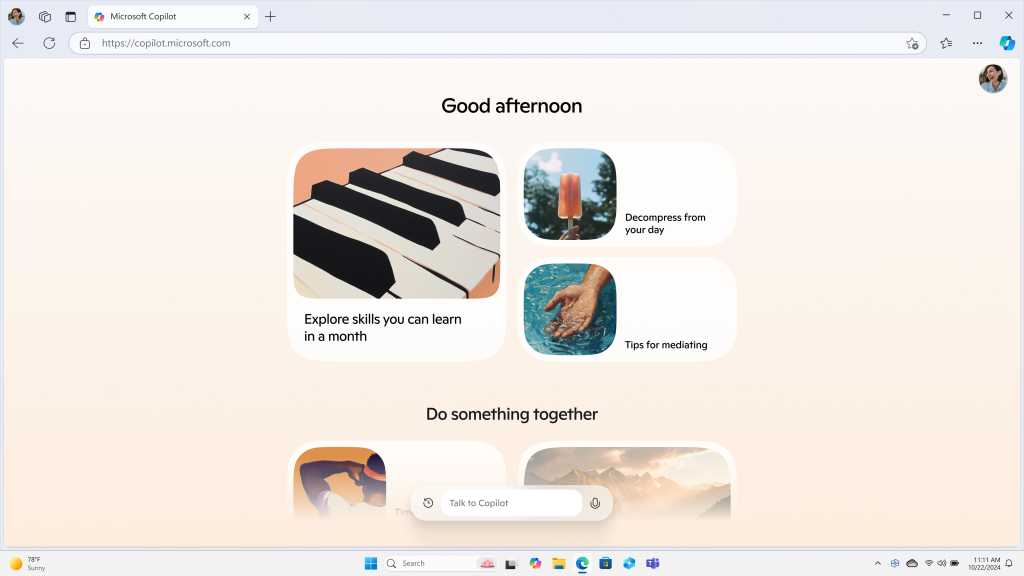
Microsoft on Tuesday announced several updates to its free Microsoft Copilot and paid-for Copilot Pro services aimed at making the personal AI assistant more powerful and easier to converse with.
Among the updates is Copilot Vision. Built natively into Microsoft’s Edge browser, the Vision feature lets Copilot see what a user sees when surfing the web. It can then respond to queries about the contents of a web page in natural language — highlighting reviews to help choose a film on Rotten Tomatoes, to give one of Microsoft’s examples, or assisting with research.
“We believe Copilot can go beyond answering basic questions and generating content, to offering more complete support for you and your tasks,” Yusuf Mehdi, Microsoft’s corporate vice president and consumer chief marketing officer, said in a pre-recorded press briefing.
The service will be limited to a list of pre-approved websites initially, said Microsoft. The company’s AI models won’t be trained on the content Copilot views.
“Increasingly, generative AI assistants are becoming multi-modal (language, vision and voice) and have personalities that can be configured by the consumers,” said Jason Wong, distinguished vice president analyst at Gartner. “We will see even more anthropomorphism of AI in the coming year.”
Mehdi said Microsoft has taken steps to “respect and protect” user privacy when accessing Copilot Vision, which is turned off by default. “You must actively choose to enable the Copilot feature,” he said. “You have clear notification it is on, no conversations or content are stored beyond the active session, and none of the Copilot Vision interactions will be used for training.”
The feature will initially roll out in the United States via Copilot Labs, a new service where paid Copilot Pro subscribers can test upcoming AI capabilities. Copilot Pro costs $20 per month.
Another experimental feature available in Copilot Labs is Think Deeper, which enables Copilot to “reason” and answer more complex questions.
“Think Deeper takes more time before responding, allowing Copilot to deliver detailed, step-by-step answers to challenging questions,” Microsoft’s Copilot Team said in a blog post. “We’ve designed it to be helpful for all kinds of practical, everyday challenges like comparing two complex options side by side. Should I move to this city or that? What type of car best suits my needs? And so on.”
Think Deeper is available now to a limited number of Copilot Pro customers in Australia, Canada, New Zealand, the United Kingdom and the United States.
Microsoft has also announced a refresh of the Microsoft Copilot mobile app, with a UI that is “leaner, simpler, warmer, and all around more approachable,” said Mehdi. The new Copilot app rolls out today.
Conversations with the AI assistant will be more realistic and natural with the introduction of Copilot Voice, Microsoft said. The revamped voice interface promises faster responses and the ability to interrupt when the Copilot is speaking; users can also now select from four different voices to interact with when talking with the Copilot assistant.
“With the new Copilot Voice, you’ll have a smoother and more engaging conversation, because responses are faster and you can easily interrupt and direct your experience,” said Mehdi.
One of the Copilot voices can also be chosen to read out a Copilot Daily news digest — a summary of news from authorized content sources. (Microsoft has partnered with Reuters, Financial Times, German publisher Axel Springer and others.) It will also provide weather forecasts, with a reminder function also in the works.
Copilot Voice is initially available in English in Australia, Canada, New Zealand, the United Kingdom, and the United States. It will expand to more regions and languages soon, Microsoft said. Copilot Daily is rolling out now starting in the United States and the United Kingdom with more countries coming soon.
To help new users get started, Microsoft has released Copilot Discover, which provides guidance on the AI assistant’s features and “conversation starter” suggestions.
Microsoft Copilot’s new Discover feature provides guidance on the AI assistant and conversation starters.
Microsoft
The introduction of realistic AI assistants is part of a wider trend, said Wong. Gartner predicts that, by 2026, 80% of the top 100 consumer brands will offer anthropomorphized generative AI agents to drive consumer loyalty.
It’s not just Microsoft Copilot; Google Gemini, OpenAI’s ChatGPT, and X.ai Grok are all developing multi-modal agents that will “entertain, inform and connect the consumer to relevant services and products,” said Wong. “This is the next frontier — and battleground — of customer experience.”
Source:: Computer World
Chip that steers terahertz beams sets stage for ultrafast internet of the future
What Happens When You Change Your DNS To 8.8.8.8?
AI translation unicorn DeepL launches New York tech hub to boost US expansion
The CHIPS Act money: A timeline of grants to chipmakers

The CHIPS and Science Act provides $52.7 billion for American semiconductor research, development, manufacturing, and workforce development. The Act’ provides $39 billion in manufacturing incentives, including $2 billion for the legacy chips used in automobiles and defense systems; $13.2 billion in R&D and workforce development; and $500 million for international information communications technology security and semiconductor supply chain activities.
That R&D money includes $11 billion in funding to advance four programs: the National Semiconductor Technology Center (NSTC); the National Advanced Packaging Manufacturing Program (NAPMP); the CHIPS Metrology Program; and the CHIPS Manufacturing USA Institute. The Act also provides a 25% investment tax credit for capital expenses for manufacturing of semiconductors and related equipment.
The CHIPS Act’s purpose was to strengthen American supply chain resilience after problems caused by the COVID-19 pandemic and to counter China’s rising share of the market. The US share of global semiconductor fabrication capacity has fallen from about 36% in 1990 to about 10% in 2020, according to a Congressional Research Service report. Meanwhile, China’s share of chip manufacturing has grown nearly 50% over the past two years and now comprises about 18% of the world’s supply.
In 2023, the Department of Commerce, which is administering the CHIPS Act, spent months negotiating with semiconductor designers and fabricators to gain commitments from the companies and to achieve specific milestones in their projects before getting government payouts. For example, negotiations between the federal government and TSMC resulted in the Taiwanese semiconductor designer and manufacturer being promised $6.6 billion in CHIPS Act funding; in return, the company pledged to bring its most advanced 2nm process technology to US shores and added plans for a third fabrication plant to its Arizona site.
The White House has argued that CHIPS Act spending will grow America’s share of the world’s leading-edge chip market to 20% by 2030. But industry experts say more government incentives will be needed to sustain and continue that growth domestically.
According to Mario Morales, a group vice president at IDC, the current CHIPS Act is just the start; he expects the Biden Administration to champion a second CHIPS Act that will spend even more money and likely be approved sometime around 2026 or 2027. There may also be a third CHIPS Act after that, Morales said.
The current CHIPS Act was passed by Congress and signed into law by US President Joseph R. Biden Jr. on Aug. 9, 2022.
Since December 2023, the Commerce Department has allocated about $32 billion in funding among chipmakers, including Samsung, TSMC and Intel. In return, various chip designers and makers have pledged about $300 billion in current and future projects in the US, according to the White House.
Here’s a timeline of where the money is going, with the most recent allocations listed first:
September 2024
Intel is set to receive $8.5 billion CHIPS Act funding. The deal, which has been in negotiation for months, would represent the largest subsidy package awarded to date under the act, which aims to reduce US reliance on foreign chip production and strengthen the country’s semiconductor supply chain.
The deal could be finalized by the end of the year, according to one report, but there’s no guarantee of that.
To date, the CHIPS Act has allocated proposed funding across 17 companies, 16 states, and 26 projects. However, no CHIPS funding has actually been disbursed yet. The Department of Commerce expects to begin disbursing awards over the coming weeks and months.
April 2024
Micron, which plans to build two new fabrication plants in upstate New York and another in Boise, Idaho – where its headquarters is located, got $6.14 billion in funding.
Samsung got $6.4 billion to build leading-edge logic, R&D, and advanced packaging fabs in Taylor, TX, and to expand a current-generation and mature-node facility in Austin, TX.
TSMC got $6.6 billion to support the development of three greenfield leading-edge fabs in Phoenix, AZ.
March 2024
Intel was awarded $8.5 billion in funding, the most of any CHIPS Act allocations to date. Intel expects to use the money to advance its commercial semiconductor projects in Arizona, New Mexico, Ohio and Oregon. The company also said the funds would create more than 10,000 company jobs and nearly 20,000 construction jobs, and would support more than 50,000 indirect jobs with suppliers and supporting industries.
February 2024
NSTC in Albany, NY was promised more than $5 billion in funding. The NSTC is a public-private partnership that will perform research on next-generation semiconductor technologies by supporting the design, prototyping, and piloting of the latest semiconductor technologies.
GlobalFoundries, in Malta, N.Y. and Essex Junction, VT. (GF) is expected to receive about $1.5 billion to help them expand and create new manufacturing capacity and capabilities for automotive, IoT, aerospace, defense, and other markets. GF’s chips are used in everything from blind spot detection and collision warnings in cars, to smartphones and electric vehicles that last longer between charges, to secure and reliable Wi-Fi and cellular connections.
January 2024
Microchip Technology Inc. got $162 million to increase its production of microcontroller units and other specialty semiconductors, and to support the modernization and expansion of fabrication facilities in Colorado Springs, CO, and Gresham, OR.
December 2023
The first of the CHIPS Act allocations, about $35 million, went to BAE Systems Inc., a federal government contractor. BAE was expected to use the money to help modernize an aging Nashua, NH facility and help quadruple the company’s production capacity for chips used in F-35 fighter jets.
Source:: Computer World
Arm, Intel, and the vengeance of Newton

Arm’s attempt to purchase part of Intel’s computer chip business may have been declined, but it once again demonstrates the important role played in the evolution of today’s tech by Apple and its handheld Newton.
While it isn’t quite clear what Arm would gain by buying Intel, Bloomberg claims it tried to do so all the same. (And Apple hasn’t).
What makes this a little confusing is that Arm and Intel have such different businesses: while Arm is a chip design house, Intel is both a designer and manufacturer that uses an architecture cross-licensed with AMD. It is also fair to observe (as The Register has here) that while Intel’s star may be fading, it’s still worth billions of dollars.
Is this a melting point?
All the same, the story reveals something else. It shows the extent to which the tech industry has been transformed by the mobile productivity philosophy articulated in the early days by Newton.
You see, Newton strove to be the perfect assistant for business users. It offered handwriting recognition, natural language support, and though there was no ChatGPT (or even Siri), it hinted at the pervasive AI entering daily existence today.
Newton also used a true mobile processor from Arm (then known as Acorn). This was capable of delivering computational performance for very low energy (at the time) — just like the A-series chips inside iPhones and some iPads, or the M-series silicon inside Macs and iPad Pro.
Getting the team together
The decision to work with Arm reflected Apple’s early recognition that energy consumption and computational performance would be vital if it were to overcome the barriers against next-generation computer design. When Steve Jobs returned to Apple, he closed the Newton project — but in other ways, he continued to lean into what the company had learned. The data detector technology used in Mail arguably owes a debt to the PDA, as does handwriting recognition.
Many of the ideas Newton heralded appeared a decade later in iPhone — eventually, including that Arm-based processor.
The Arm-based Apple Silicon chips now used across Apple’s products are so performant that competitors struggle to keep up. The closest current rival (at least in the low-energy, high-performance stakes) is Qualcomm, which may well be trying to snap at Apple’s heels and has been forced to adopt Arm reference designs to do so. Even Microsoft is moving to Arm, while Intel’s processor design unit is spending more than it makes, prompting pain across the company.
You could argue that all of this illustrates how ahead of its time the Apple Newton was, and the huge influence it still wields today. Because today we have fully networked, high-performing devices in a myriad of different forms (Mac, smartphone, tablet, watch, glasses, more) boosted by AI with user interfaces to match.
Arguably, many of these devices were made possible by design decisions Apple reached when building the Newton. It took decades to accomplish it, but that means we are now living in Newton’s future, and the chutzpah of Arm’s overture to Intel reflects this. While what Arm would gain from any such deal isn’t clear, the alleged attempt illustrates that truth. Several decades later, revenge seems sweet.
Please follow me on LinkedIn, Mastodon, or join me in the AppleHolic’s bar & grill group on MeWe.
Source:: Computer World
Why European startups should consider moving to Dubai
How much are companies willing to spend to get workers back to the office?

With more and more companies wanting to bring employees back to the office, I pointed out last week the ill-kept secret that there’s a widespread aversion to open office floor plans — or activity-based workplaces, as they have often evolved into today — and that it partially explains why many employees want to continue remote and hybrid work.
This is not rocket science. For many years, it has been the consensus in the research community that open office landscapes are bad for both the work environment and employee performance. (There’s really no need for research at all — just talk to workers. They hate it.)
To be honest, open office environments are not downright bad. But it takes the right business, and the right type of people, for them to work. For example, I work in an industry where the ideal image is a teeming newsroom, where creative angles and news hooks are thrown back and forth, just as you see in a movie.
Even so, you don’t have to go back more than two or three decades to a time when most journalists, even in large newsrooms, had their own offices. That’s how Swedish offices used to look, people had their own rooms — not “cubicles,” but real rooms, with a door, and a small Do Not Disturb lamp. There was desk, pictures of the children (and maybe the dog), a plant and a small radio. It was a place where you could feel at home, even at work.
Then real estate development took over and today only 19% of office workers in Stockholm have their own space. The largest proportion, 42%, have no place of their own at all. And, according to researchers, it is the real estate companies that have been driving the transition to open office landscapes.
It’s easy to see why: an open floor plan is, of course, much more surface-efficient than one with walls and corridors; it is much easier to scale up or down based on the tenants’ needs; and you can house more and larger companies in attractive locations in the city rather than large office complexes in the suburbs.
It’s not just the real estate industry’s fault. A little over 10 years ago, “activity-based offices” — otherwise known as hot-desking — arrived. Workers have neither their own room or desk. And here, the tech industry has taken the lead.
When Microsoft rebuilt an office in Akalla in 2012, execs themselves called it one of the first large activity-based offices in Sweden, and it helped spark a trend where even the traditional companies and organizations adopted the “cool” scene from startup environments and Silicon Valley companies. (Puffs! European stools!) The office quickly evolved from cool to corporate.
Researchers actually welcomed the shift, as it at least gave people an opportunity to find a quieter place if they were disturbed or to avoid sitting next to colleagues they didn’t like. Then the COVID-19 pandemic hit and we know what happened next. Many people discovered how nice it is to work in their own room, at their own desk, that picture of the children, with maybe the dog at your feet, a plant nearby and some music. You didn’t need the Do Not Disturb light and there were no chattering colleagues.
As a Stockholm Chamber of Commerce’s survey found: 46% say that permanent workplaces in the office have become more important, and 45% of younger people would come in more if they had better opportunities for undisturbed work. (Whether it’s correlation or causality, I don’t think it’s a coincidence that the most important selling point for headphones these days is how good their noise canceling is. It makes public transportation bearable, certainly, and with headphones, you create your own room — even at work.)
As a result of these recent trends, property owners and companies alike find themselves in a tricky, but self-inflicted, position. To say the least, property owners have begun to see the disadvantages of the open solutions they pushed: vacancies in downtown office buildings are skyrocketing as tenants have reduced office space after the transition to hybrid work.
Yes, companies see the chance to save money by reducing office space, especially if employees aren’t there all the time anyway. But at the same time, they want their workers to be in the office more. And the employees say, “Okay, but then I would like to have my own place, preferably my own room.”
Of course, that equation doesn’t add up. And this is where the whole “return to office” trend is brought to a head. If company culture, creativity and productivity are so critical that employees need to be forced back into the office, how far are companies willing to go?
How big does the office space need to be, if everyone is to be there basically at the same time — if half also need their own desk to be productive, perhaps even a room of their own?
Property owners and landlords would rejoice, but how many companies want to take on that cost? Very few, I would think.
Perhaps that tells us just how important a forced return to offices really is.
This column is taken from CS Veckobrev, a personal newsletter with reading tips, link tips and analyzes sent directly from Computerworld Sweden Editor-in-Chief Marcus Jerräng’s desk. Do you also want the newsletter on Fridays? Sign up for a free subscription here.
Source:: Computer World
HP’s new remote support service can even resurrect unbootable PCs

An unbootable PC is every remote worker’s nightmare. It usually means they need hands-on support that they’re not likely to find in their home office or neighborhood Starbucks.
Now there’s hope that even that catastrophe can be corrected remotely. At its Imagine event in Palo Alto, California on Tuesday, HP announced what it calls the industry’s first out-of-band diagnostics and remediation capability that will enable remote technicians to connect, diagnose, and fix problems, even if the PC won’t boot.
The service, launching Nov. 1, lets a technician, with permission from the user, connect to a virtual KVM (keyboard, video, mouse) under the BIOS/UEFI to run diagnostics and take remedial action. With the service, a tech could have corrected the CrowdStrike issue by replacing the flawed configuration file from the bad update, for example, and could even reimage the machine if necessary.
Marcos Razon, division president of lifecycle services and customer support at HP, said that the goal is to address 70%-80% of issues without requiring a stable operating system.
However, not all PCs will benefit, as the service relies on the Intel vPro chip more typically found in commercial PCs.
“Within the vPro chipset, you have a lightweight processor, a secondary processor that can access what in the past was called BIOS, but now it’s more UEFI,” Razon explained. “What this secondary processor allows us to do is to go under the BIOS before the booting process happens and take control of the machine.”
A security code must be accepted by the PC’s user before the technician can take control. “We don’t want anybody to access a PC without being able to secure that PC,” Razon said.
Constant virtual KVM
“The beauty of it is that we have a constant virtual KVM below the BIOS/UEFI,” he said.
The catch with existing remote-control programs is they need a PC that has successfully booted a stable operating system: “What happens is that if the PC has not booted completely, and the operating system is not running perfectly, you will not be able to take control of that PC,” he said.
Mahmoud Ramin, senior research analyst at Info-Tech Research Group, is impressed.
“Endpoint management tools usually fall short when a user faces serious problems with their hardware, such as boot failures and BIOS errors. Out-of-band technology can revolutionize remote endpoint management through bypassing operating systems and managing endpoints at the hardware level,” he said. “This innovation can help resolver groups seamlessly and immediately provide support to end users, reduce downtime by minimizing onsite visits, and enhance shift-left strategy through increased automation. HP’s out-of-band remediation capabilities can position it as a leader in remote endpoint support.”
The new service will be offered as an add-on to an HP Essential, Premium or Premium+ Support package with the purchase of any new vPro-enabled HP PC, the company said in a release. It will be extended to older HP commercial PCs in the coming months. It will initially be available in North America and the European Union, with rollout to other regions following. Razon said that the cost will be about US$12 per machine, per year, and HP is also working on a version for AMD processors, which it expects to release in the first half of 2025.
Source:: Computer World
Big wave surfer emerges from the barrel with $120M fund for regenerative agriculture
Northvolt suspected of manslaughter in latest blow to flailing battery startup
Apple Intelligence in Europe? You might be waiting for a while

If you or your business happen to be nursing any hopes that Apple Intelligence will launch in Europe sooner rather than later, take a rain check on that AI expectation: Apple has failed to agree to a non-binding European Union pact to control artificial intelligence deployment.
Given the company is apparently in meetings with regulators with a view to clarifying how Europe’s DMA (Digital Markets Act) would be applied to its AI service, the fact it hasn’t (yet) signed on the dotted line suggests we’ll be waiting for it to reach Europe.
The EU AI pact has been inked by many other big tech firms; Adobe, Amazon, Google, Microsoft, OpenAI, Palantir, and Samsung are among 115 companies who’ve signed the document.
The EU AI Pact is a voluntary pledge to develop safe, trusted AI. “Artificial Intelligence (AI) is a transformative technology with numerous beneficial effects. Yet, its advancement brings also potential risks,” the pact explains.
Neither Apple nor Meta have signed up
Interestingly, Apple isn’t alone — Meta hasn’t signed either. Nor have TikTok, Anthropic, or Mistral.
Meta did, however, say it has not ruled out joining the pact down the road, according to Politico: “We also shouldn’t lose sight of AI’s huge potential to foster European innovation and enable competition, or else the EU will miss out on this one-in-a-generation opportunity,” Meta said.
The company has been critical of a lack of harmonization concerning AI implementation on a global scale.
What does the pact do?
The goal here is to put checks and balances in place around how AI is introduced in Europe. Signatories have agreed to comply with new European AI rules (the AI Act) which will be introduced in the coming years.
The pledges include a commitment to:
- Establish AI governance strategies to foster the uptake of AI in the organization and work towards future compliance with the AI Act.
- High-risk AI systems mapping: Identifying AI systems likely to be categorized as high-risk under the AI Act. Those systems might be AI handling infrastructure, safety, or law enforcement, for example.
- Promote AI literacy and awareness among staff, ensuring ethical and responsible AI development.
Additional pledges are voluntary, even within the agreement. These include a commitment to human oversight of AI and to ensure AI-generated content is clearly labeled as such.
Where is Apple Intelligence?
Apple hasn’t said anything about all this, though it seems relevant to note that since it doesn’t yet offer Apple Intelligence in the EU, the company may not feel a need to do so.
In the US, where Apple Intelligence is available, Apple in July agreed to a US presidential order governing AI technology. Elements of that agreement seem to echo those coming from the EU.
On reflection, it is possible that Apple’s acquiescence to the deal depends only on achieving a successful agreement regarding how the DMA will be applied to Apple Intelligence in the region. Apple CEO Tim Cook in August explained that the company is engaged with EU regulators, saying: “Our objective is to move as fast as we can, obviously, because our objective is always to get features out there for everyone. We have to understand the regulatory requirements before we can commit to doing that and commit a schedule to doing that, but we’re very constructively engaged with both.”
Don’t hold your breath?
While it is fair to note that the EU AI pact is different from the implementation of the EU DMA on Apple Intelligence, it’s hard not to think that Apple’s non-appearance as a signatory suggests more discussion is required before Apple launches its service in the region. If it even does.
Please follow me on LinkedIn, Mastodon, or join me in the AppleHolic’s bar & grill group on MeWe.
Source:: Computer World
Arm: AI will turn smartphones into ‘proactive assistants’
Amazon employees don’t want to be back in the office all week — survey

Amazon CEO Andy Jassy last week announced that the company’s more than 350,000 office workers will be required to work in the office five days a week by default. Jassy’s reasoning: the move will result in better work.
But a new survey conducted by Blind, a forum for verified IT workers, asked 2,585 Amazon employees what they think about the change and that fully 91% don’t like the office requirement. And 73% will consider changing jobs because of the edict.
Blind writes that the change can particularly affect Amazon employees who are parents by removing flexibility and independence, as well as workers who were hired to work remotely or received adjustments for more flexible working hours.
The new arrangement is supposed to take effect on Jan. 2, 2025.
Source:: Computer World
UK startup Pact opens factory to grow skin-like leather alternative
All PlayStation Games You Can Play Online Without PS Plus


