


Slack opens up to third-party AI ‘agents’
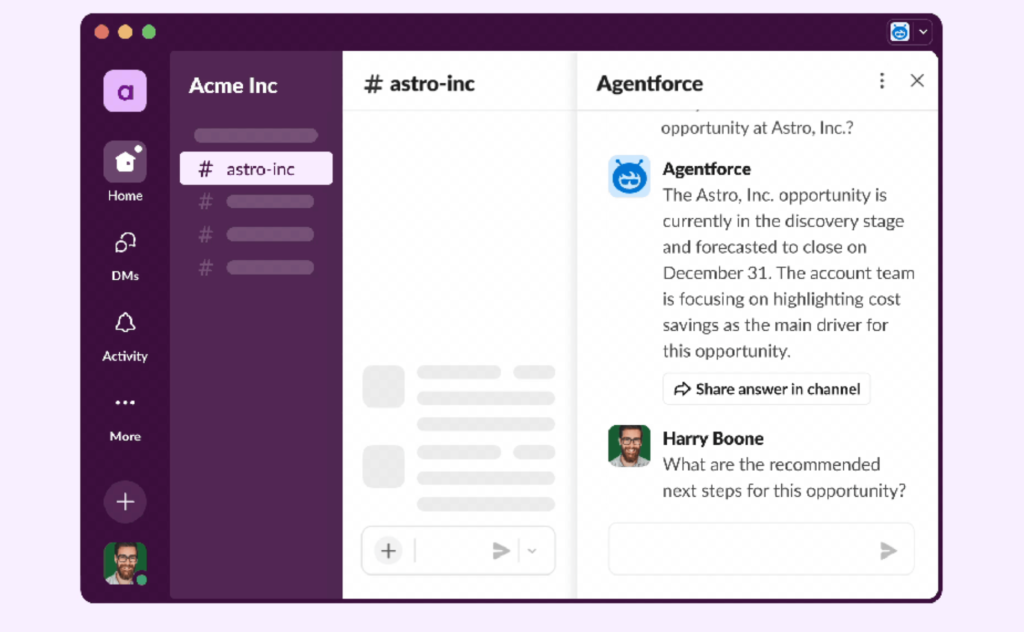
Slack AI customers can now interact with AI “agents” in other apps, including Asana, Box and Anthropic’s Claude.
The AI agents, accessible via a new chatbot interface in Slack, let users perform a range of actions in the integrated app, Slack said Monday.
With the Asana agent, for instance, Slack users can “surface project insights and recommendations, such as status, blockers, next steps, and more,” parent company Salesforce said in a statement. The Adobe Express agent lets users create content such as graphics for social media posts from a prompt without leaving Slack.
Other agents coming to Slack include Amazon Q Business, Cohere, Perplexity, and Writer.
Users can access the third-party agents via the Slack Marketplace or create their own agent with “purpose-built APIs,” Slack said.
A chatbot interface connects with parent company Salesforce’s CRM software. This involves access to Salesforce’s own Agentforce AI assistant, which has been rebranded from Einstein Copilot. From within Slack, the Agentforce AI can provide an update on the status of sales opportunities and cases, recommend next steps, draft emails, and more.
Salesforce’s Einstein Copilot has been rebranded Agentforce AI assistant.
Salesforce
Agentforce in Slack is slated to be available in beta next month.
Other updates to Slack AI — the company’s paid AI service — include note taking in huddles voice and video calls. Here, the transcript of a huddle conversation is used to create a canvas document (Slack’s document editor tool) containing related information such as a meeting summary, action items, and links to relevant files.
In Slack’s Workflow Builder, users can direct the AI assistant to generate a workflow automation using natural language prompts.
The Slack AI search function gets an update, too; users can now surface results based on files uploaded or connected to a Slack workspace. Until now, Slack could only search conversations in the app; now the tool can retrieve information from sources such as canvas documents, Google and Microsoft documents, and files in connected apps, Slack said.
Aside from AI-related features, Slack introduced new templates that can provide a starting point to help users begin a new project. A template for a marketing team could create a Slack channel with a standardized brief in a canvas document, a project plan in a Slack list, and an automated workflow for weekly status updates, the company said.
Templates will be available in October.
Finally, Salesforce channels — available now to Slack Sales Elevate customers and later to Salesforce Starter Suite customers — are a new type of channel that connects Salesforce CRM records to conversations in a Slack workspace, enabling users to update CRM data without switching screens.
Source:: Computer World

How macOS Sequoia can help you at work
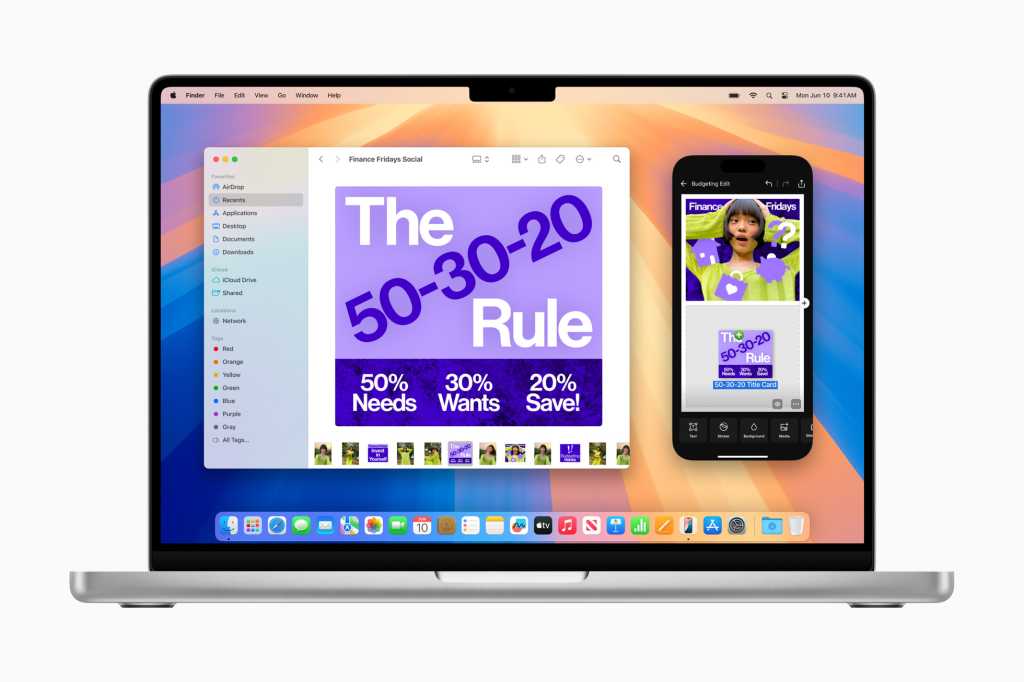
Along with iOS 18, Apple today is releasing macOS Sequoia, iPadOS 18, and the latest update to watchOS. (Apple Intelligence, which isn’t expected to begin to appear until next month, has gotten a lot of attention, but the pre-AI versions of these operating systems offer plenty of useful features and updates.)
Focusing today on macOS Sequoia, should you upgrade immediately? That depends.
There are good things to tempt you, but you might need to wait — particularly if third-party services or applications you use (especially higher-end apps) don’t yet support the new OS.
If Apple Intelligence is the thing you’re most interested in, there’s no need to rush, since those tools won’t available until October in some countries, and next year in others. Global launch (including in Europe) will follow. Apple will also let Mac admins manage access to the service.
So, what’s Sequoia got to make you swoon if you ignore Apple Intelligence?
iOS, Mac, and iPhone: S.W.A.L.K.
What may turn out to be one of the most useful productivity-enhancing features in Sequoia is the increased integration between the Mac and iPhone. While EU customers won’t get this feature yet, iPhone Mirroring lets you use your iPhone on your Mac in a compact mini window. This lets you interact with iPhone apps via your Mac, and also lets you drag-&-drop files between the devices (though, that feature won’t debut until later this year). I think this could get really interesting if you use an iPad and a second Mac, too, as the implication is that you’ll be able to move files and folders around between the machines to your heart’s content in a quite focused way.
A second integration means notifications received on your iPhone can also appear on your Mac.
Manage busy desktops
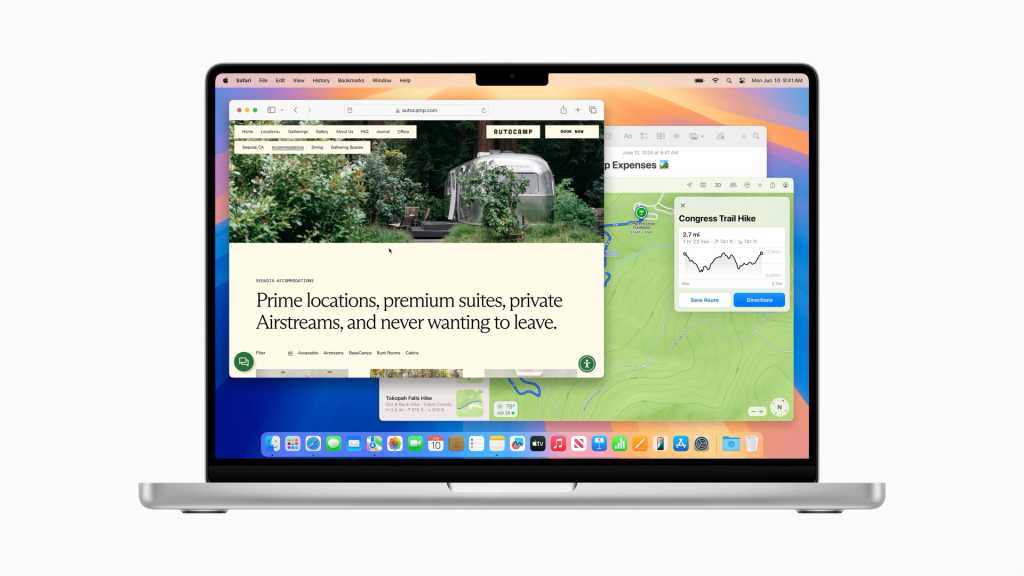
Dragging a window to the edge of the screen will automatically place that window in a tile in the main window. This works across multiple windows, making it much easier to parse information from numerous websites and applications in one clear to the eye view. You can shift windows around, if you like.
Solving the eternal presentation headache
If you use Webex, Zoom, or even FaceTime, Sequoia will show you a view of what will be made visible to other meeting attendees when they share their screen before they actually share it. If you’ve ever unexpectedly needed to share a document during a meeting while other confidential items are open on your Mac, you’ll recognize what a small but handy improvement this is.
Even experienced Zoom hosts can’t help but exhale a little when they share their screen, as this is never quite as certain as you need for comfort. Now, it is.
Safari redesigned to get web clutter out of your way
Safari is smarter than before. You’ll be able to read page summaries or gather together links at the touch of a button. Reader view has been improved with a variety of features, including auto-generated table of contents to make navigating complex pages much easier. If a page features video, Safari will either open the clip in a big window or pop it inside a smaller pop-up window if you decide to navigate to another site while leaving the original site window open.
Finally, Safari will let you hide distracting items such as subscription pop-ups from view when you visit a site.
Notes, Reminders, and Calendar
Just as on the iPhone, Mac users can expect audio transcription and summarization features in Notes when Apple Intelligence appears. The app has also become more capable, with collapsible section headers and different text and highlight colors. Finally, if you record a call taken on your iPhone, a transcript will be created that can also sync with Notes on your Mac.
Calendar and Reminders work more smoothly now, with Reminder tasks showing up in Calendar and a Month view that lets you see both Calendar and Reminder entries at a glance.
Apple
The Password application
Apple’s all-new Password application is a new skin on Keychain, making the information — passwords, passkeys, Wi-Fi passwords — much more accessible and usable than before. The app uses iCloud to sync across all your logged-in Apple devices (and Windows hardware using the iCloud for Windows application).
Better collaboration tools
Freeform remains a really useful collaborative space where teams can work on ideas together from whatever Apple device they happen to use. On the Mac, the latest iteration includes a new diagramming mode to connect different objects and usability improvements when moving around a large board using a mouse.
Some Siri intelligence
Kick the system around and you’ll find a new accessibility tool that lets you make custom voice commands to invoke Shortcuts. You might use this to set up a tool that lets you ask Siri to create a PDF from what you are reading on a Mac, for example. You can find these options in System Settings>Accessibility>Vocal Shortcuts.
Smaller, useful tweaks
A handful of additional system tweaks wipe old annoyances away. You can schedule when messages are sent, for example. Another change allows you to install larger applications (more than 1GB) on external drives, subject to some restrictions. You also won’t need to have double the amount of space for an app on your drive to install it.
In addition:
- An updated Calculator application lets you see mathematical expressions and previous calculations, and integrates with Notes to create what Apple calls Math Notes. The latter is essentially a way to do algebraic equations on your Mac.
- There’s a new Keep Downloaded option that will ensure a local copy of a file is kept on your Mac rather than being stored in iCloud.
One more thing?
Apple has shipped a Chess application with Macs for decades. Yet the last time this got updated was with Mac OS X 10.3 Panther — 20 years ago. The historically important game, probably included in the Mac because Steve Jobs liked Chess so much, clearly isn’t on Apple’s speedy upgrade cycle. In Sequoia, it finally gets a makeover with new graphics, though sadly without a 3D or Kriegspiel mode.
Which Macs does macOS Sequoia work with?
If you ignore Apple Intelligence, the new Mac operating system is compatible with the following devices:
- MacBook Pro (2018 and later).
- MacBook Air (2020 and later).
- Mac mini (2018 and later).
- iMac (2019 and later).
- iMac Pro (2017 and later).
- Mac Pro (2019 and later).
- Mac Studio (2022 and later).
The problem is that not all of the above devices support Apple Intelligence. To use Apple Intelligence, you need to be working with a Mac running an M1 or later Apple Silicon chip. No Intel Macs will run Apple Intelligence.
Finally, on security — once macOS Sequoia is available, it will be the only version to receive full security updates in the next 12 months. The two most recent versions (Sonoma and Ventura) will get some updates, but Monterey and earlier versions will get none. This means that if you rely on Macs, it’s worth ensuring you know which machines you run, what version of the OS they use, and what data they have access to.
Please follow me on LinkedIn, Mastodon, or join me in the AppleHolic’s bar & grill group on MeWe.
Source:: Computer World
Finland’s IQM has now produced 30 full-stack quantum computers
What Does “ML” Mean in Texts?
Science is breeding a new generation of booming deeptech startups in Estonia
September’s Patch Tuesday update fixes 4 zero-days

Addressing four zero-days flaws (CVE-2024-38014, CVE-2024-38217, CVE-2024-43491 and CVE-2024-38217), this month’s Patch Tuesday release from Microsoft includes 79 updates to the Windows platform. There are no patches to Microsoft Exchange Server or the company’s development tools (Visual Studio or .NET). And Microsoft addressed a recently exploited vulnerability in Microsoft Publisher with two critical updates and nine patches rated important for Microsoft Office.
Significant testing will be required for this month’s Microsoft SQL Server patches, which affect both server and desktop components — with a focus on application installations due to a change in how Microsoft Installer handles changes and installation rollbacks.
The team at Readiness has crafted a useful infographic outlining the risks associated with each update.
Known issues
Microsoft always publishes a list of known issues that relate to the operating system and platforms included in each update, including the following two minor issues for September:
- After installing the Windows update released on or after July 9, 2024, some Windows Servers may experience intermittent interruptions to remote desktop connections. Those using RDP over HTTP while employing a Remote Gateway server are most likely to experience this issue. Microsoft is working on a resolution and published a knowledge article (KB5041160) to assist with mitigations.
- As a result of the recent updates to Microsoft SharePoint Server, some users are reporting an issue in which SharePoint workflows can’t be published because the unauthorized type is blocked. The issue also generates the event tag “c42q0” in SharePoint Unified Logging System (ULS) logs. In addition, recent changes could cause the deserialization of custom types that inherit from IDictionary to fail. For more information, see KB5043462 on these issues. (Sounds like something from the Succession TV series.)
Due to recent changes to Windows Installer, User Account Control (UAC) does not prompt for credentials on application installation repairs. Once this update (September 2024) has been installed, UAC will again prompt properly. Your scripts will need to be updated if you have not already accounted for this change.
Though Microsoft has provided documentation on avoiding the issue by disabling this feature in UAC, we think this is a much-needed change and recommend following this latest best practice.
Major revisions
This month, Microsoft published the following major revisions to past security and feature updates, including:
- CVE-2020-17042: Windows Print Spooler Remote Code Execution Vulnerability. This print spooler update was first released in November 2020. This is an information update to reflect that Windows Server 2022 (Core) is now affected.
- CVE-2024-30077: Windows OLE Remote Code Execution Vulnerability. This two-month-old patch from Microsoft has been updated to include support for the ARM platform.
- CVE-2024-35272: SQL Server Native Client OLE DB Provider Remote Code Execution. First released in July, the affected software table has been updated to include entries for Visual Studio 2019 and 2022. No further action required.
- CVE-2024-38138: Windows Deployment Services Remote Code Execution Vulnerability. This is a documentation update to a patch released last month to include support for all supported versions of Windows Server. No further action required.
Unusually, we have a patch revision that is not strictly documentation related. This month, it’s CVE-2024-38063 (Windows TCP/IP Remote Code Execution Vulnerability). Unlike other revisions, this latest version of a critical network patch will require testing as if it were a new update. System administrators need to take this latest patch revision seriously and test before (re)deployment.
Testing guidelines
Each month, the Readiness team analyzes the latest Patch Tuesday updates and provides detailed, actionable testing guidance based on a large application portfolio and a detailed analysis of the patches and their potential impact.
For September, we have grouped the critical updates and required testing efforts into separate product and functional areas including:
Microsoft SQL Server
Microsoft released several updates to the Microsoft SQL Server platform that affects both Windows desktops and SQL Server installations, including:
- A significant update to all supported versions (2016-2022) of Microsoft SQL Server that will require a full installation test.
- An updated core Windows library (SQLOLEDB) that helps Windows applications communicate with SQL Server databases and tools. Though Microsoft rated this change low-risk, Readiness recommends a portfolio analysis that highlights all apps that depend on this data-bound communication approach and a full test cycle for each one identified.
Due to the nature of this September SQL Server update, we highly recommend testing the patch itself and the patching process — with a view to the patch REMOVAL process. We understand that this will require time, skill, and effort — but it will be better than a full restore from backup.
Windows
Microsoft made networking and memory handling security issues a focus this month with the following changes to Windows:
- Due to an update to 64-bit to 32-bit memory handling in Windows (called thunking), 32-bit Camera applications will require testing on 64-bit machines this month. Using Microsoft Teams or playing a video from a USB drive would provide good testing coverage for this change.
- Virtual Machines (VMs) that require a VPN will require connectivity testing. In addition, the following protocols — PPP, PPTP, SSTP — will require a basic connectivity test.
- A minor update to Windows defender will require basic testing for endpoint security.
- A minor update to core networking functions will require a test of high network traffic this month. The focus should be on the transfer of large files using applications such Teams, Outlook and Microsoft Edge.
Microsoft delivered a significant update to the MSI Installer (application installer) sub-system that will require application install level testing for a portion of your portfolio. Part of this update relates to how shell links are handled in the storage subsystem, which might cause redirected folders or shortcuts to behave unexpectedly during an installation — particularly on secure or locked-down configurations.
We suggest that installations, rollbacks, un-installations and UAC checks be validated this month. Checking for “zero” exit codes on the MSI Installer log is always a good start.
Windows lifecycle and enforcement updates
This section contains important changes to servicing, significant feature depredations, and security related enforcements across the Windows desktop and server platforms.
- Enforcements: Microsoft Entra now requires TLS 1.2 (using the latest Microsoft cryptographic libraries) as defined by RFC5246. Microsoft has published several scripts to assist with assessing whether your clients are using the latest libraries and protocols (they’re found here).
- Lifecycle: General support for Microsoft SQL Server 2019 ends in January 2025. Given the large number of updates to this aging server, it might be time to upgrade.
Mitigations and workarounds
Microsoft did not publish any mitigations or workarounds this month.
Each month, we break down the update cycle into product families (as defined by Microsoft) with the following basic groupings:
- Browsers (Microsoft IE and Edge).
- Microsoft Windows (both desktop and server).
- Microsoft Office.
- Microsoft Exchange Server.
- Microsoft Development platforms (ASP.NET Core, .NET Core and Chakra Core).
- Adobe (if you get this far).
Browsers
Microsoft’s Edge browser no longer synchronizes exactly with Patch Tuesday; there were several updates to Microsoft’s version of the Chromium browser that address the following reported vulnerabilities:
- CVE-2024-41879: Adobe PDF Viewer (Gotcha!)
- CVE-2024-38208: Edge for Android updates.
- CVE-2024-38207: Microsoft MSHTML Memory Issues.
- CVE-2024-38210 and CVE-2024-38209: Microsoft Remote Code Execution.
Once we are done with the Microsoft updates, we can focus on these Chromium patches:
- CVE-2024-8636: Heap buffer overflow in Skia.
- CVE-2024-8637: Use after free in Media Router.
- CVE-2024-8638: Type Confusion in V8 (JavaScript).
- CVE-2024-8639: Use after free in Autofill.
After checking for compatibility or suitability challenges presented by these changes, we have not seen anything in the Edge or Chromium update that could affect most enterprise deployments. Add these browser updates to your standard release schedule.
Windows
Microsoft released two critical rated updates to the Windows platform (CVE-2024-38119 and CVE-2024-43491) and 43 patches rated important. The following Windows features have been updated:
- Windows Update and Installer.
- Windows Hyper-V.
- Windows Kernel and Graphics (GDI).
- Microsoft MSHTML and Mark of the Web.
- Remote Desktop (RDP) and TCP/IP subsystems.
The real concern is that three of these vulnerabilities (CVE-2024-38014, CVE-2024-38217, CVE-2024-43491 have been reported as exploited. In addition, another reported vulnerability in the Windows HTML subsystem (CVE-2024-38217) has been reported as publicly disclosed. Given these four zero-days, we recommend that you add these Windows updates to your Patch Now release schedule.
Microsoft Office
Microsoft addressed two critical vulnerabilities in the SharePoint platform (CVE-2024-38018 and CVE-2024-43464) that will require immediate attention. There are nine other updates rated important that affect Microsoft Office, Publisher and Visio. Unfortunately, CVE-2024-38226 (which affects Publisher) has been reported as exploited in the wild by Microsoft. If your application portfolio does not include Publisher (many don’t) then add these Microsoft updates to your standard patch release cycle.
Microsoft SQL (nee Exchange) Server
This month brings a significantly larger update to the Microsoft SQL Server platform with 15 updates (all) rated as important. There are no reports of public disclosures or active exploits, and these patches cover the following broad vulnerabilities:
- Microsoft SQL Server Native Scoring Remote Code Execution Vulnerability.
- Microsoft SQL Server Native Scoring Information Disclosure Vulnerability.
- Microsoft SQL Server Information Disclosure Vulnerability.
- Microsoft SQL Server Elevation of Privilege Vulnerability.
Though there will be a significant testing profile this month, affecting both server and desktop systems, we suggest you add these SQL Server patches to your standard release schedule.
Microsoft development platforms
No development tools or features (Microsoft Visual Studio or .NET) have been updated this month.
Adobe Reader (and other third-party updates)
Things are a little different this month for Adobe Reader. Normally, Microsoft releases an Adobe Reader update to the Windows platforms. Not so, this month.
Adobe Reader has been updated (APSB24-70) but has not been included in the Microsoft release. This month’s Adobe Reader update addresses two critical memory-related security vulnerabilities and should be added to your standard app release cycle.
Source:: Computer World
In pictures: Heart Aerospace unveils 30-seater electric aircraft prototype
Is AI killing fantasy football? To find out, I let it manage my team
What Does “WTV” Mean In Texts?
What Does “LFG” Mean in Texts?
German startup secures $62M for ‘carbon negative’ biogas power plants
Ukrainian startup plans to defend companies from disinformation with AI
Parallels 20 turns Macs into cross platform DevOps powerhouses

Here’s an exciting development that almost got missed during Apple’s heady week of iPhone news: Parallels has hit version 20 and now provides a series of powerful features designed to streamline artificial intelligence (AI) development.
If you run Windows on your Mac, you’re likely already familiar with Parallels Desktop. It is, after all, the only solution authorized by Microsoft to run Windows in a virtualized environment on Apple Silicon.
If you think back to when Apple introduced the M1 Macs, you might recall the entire industry was impressed by the performance Apple Silicon unleashed. One tester went on the record to say running Windows for ARM on an M1 Mac using Parallels Desktop 16 was “the fastest version of Windows” they’d ever used. “Apple’s M1 chip is a significant breakthrough for Mac users,” Nick Dobrovolskiy, Parallels senior vice president of engineering and support, told me at the time.
Parallels now says its software can run in excess of 200,000 Windows applications quite happily on Macs. With M4 Macs on the horizon, you can anticipate further performance gains — and with Parallels, Apple Intelligence has now come to Windows.
Apple Intelligence meets Windows?
If you are running a virtualized Windows environment on your Mac using Parallels, you will be able to use Apple’s AI-powered Writing Tools once macOS Sequoia ships.
Parallels hasn’t told us whether we’ll also be able to access other AI features from within the Windows environment, but it has said we’ll be able to sign into Apple ID across multiple macOS virtual machines on the same Mac. What this means is that developers can fully leverage virtual Macs for building and testing software in an isolated environment.
But the big hook for Parallels in this release is the AI development tools packed inside. The new Parallels AI Package is designed to make building AI models more accessible. To do so, it offers a virtual machine pre-loaded with 14 AI development tools, sample code, and instructions. The idea is that people who want to build AI solutions can install the package and run third-party small language models inside the virtual environment, even while they are offline.
This is included free in Parallels Desktop for Mac Business and Enterprise editions and is free to install in the Desktop for Mac Pro Edition for the rest of the year.
Why did Parallels do this?
“As PCs become more AI-capable, we believe AI will soon be standard on every desktop,” said Prashant Ketkar, CTO at Parallels. “This shift challenges developers to update their applications to fully leverage AI-enabled PCs.
“That’s why we created the Parallels AI Package: to equip development teams, whether experts or beginners, with accessible AI models and code suggestions. This enables ISVs to build AI-enabled applications in minutes, significantly boosting productivity for every software development team using a Mac.”
What else has improved?
Parallels, now owned by Corel Corporation, might have put a lot of effort into support for the AI wave, but the company has also delivered additional features that should improve the experience of running Windows on a Mac.
One big change: you might experience up to 80% better performance while running legacy Windows apps using the Prism emulator on Arm.
Another enhancement comes with a new shared folders technology, which makes it much easier to work across Mac and Windows files on apps. This feature also supports Linux virtual machines, which in combination with the power of Macs and the new AI toolkits from Parallels makes for a powerful DevOps machine. The Visual Studio Code extension lets you manage multiple machines, and even lets you access Microsoft Copilot when you do.
The enterprise connection
Lots of people working with Windows on a Mac work at companies in which both platforms are used. For IT, this can raise challenges around licensing and deployment of operating system licenses.
For them, Parallels now offers a new enterprise portal that IT can use to manage virtual machines, licensing issues and more. To achieve this, Parallels built new tech to make it possible to deploy Parallels Desktop without resorting to complex scripts.
“These advancements mark a significant milestone in our ongoing commitment to improving the IT admin experience. With these new features, deploying Parallels Desktop across a network of Macs is simpler and more flexible than ever before,” the company said in a blog post.
You’ll also find GitHub Actions to transform CI/CD workflows. In a related move, the software has attained a SOC Type 2 report, which means it is undergoing regular aggressive tests to ensure it remains secure.
Smart for business
I’ve been watching Parallels since it first appeared on the Mac, and I’m liking the direction in which the company is going. While it remains a solid option for consumers who just want to run a few Windows apps (including games) on their Mac, it is becoming a powerful adjunct for developers, enterprise pros, and (with version 20), a useful passport to enable AI development as well. This edition builds on the many enhancements introduced in 2023.
That’s not bad for something that costs from $99 to $149 per year (Windows licenses extra).
Please follow me on LinkedIn, Mastodon, or join me in the AppleHolic’s bar & grill group on MeWe.
Source:: Computer World
Mistral releases ‘Pixtral 12B,’ its first multimodal AI model

French AI startup Mistral has released its first multimodal model, the Pixtral 12B, which can handle both text and images, according to Techcrunch. The model uses 12 billion parameters and is based on Mistral’s Nemo 12B text model. Pixtral 12B can answer questions about images via URLs or images encoded with base64 such as how many copies of a certain object are visible.
Most generative AI (genAI) models have been partially trained on copyrighted material, which has led to lawsuits from copyright owners. (AI companies claim that the tactic should be classified as fair use.)
It is unclear what image data Mistral used to develop the Pixtral 12B.
The multimodal model checks in at about 24 gigabytes, can be downloaded via Github and the Hugging Face machine learning platform, and can be used and modified under an Apache 2.0 license without restrictions.
Source:: Computer World
25 startups enter UK late-stage accelerator on the journey to IPO
How iOS 18 can help you at work

Beyond the Writing Tools coming in Apple Intelligence, significantly faster processors, and the luxurious look of the iPhone 16 Pro models, there was little of explicit interest for enterprise users at Apple’s Monday product launch. Sure, the new iPhones are better in a multitude of ways, but it’s the platform — in this case, iOS 18 — that remains the key selling point for business professionals.
Here’s a rundown of some of the ways iOS 18 will help users get more done.
For many, iPhone 16 is a software story
We now know Apple will introduce iOS 18, the software that runs Apple’s devices and supports iPhones, on Monday, Sept. 16. When it does, it will also ship an iOS 17.7 update for customers who don’t yet want to upgrade to the new mobile operating system.
With interest in Apple Intelligence running high (even though it won’t arrive til later this fall), enterprise purchasers should note the products removed from sale as Apple introduced its new iPhones. These include the iPhone 15 Pro, iPhone 15 Pro Max, and iPhone 13. (The company still sells the iPhone 14, iPhone 14 Plus, iPhone 15, and iPhone 15 Plus.) It’s likely Apple will add additional models (such as the iPhone XR) to its vintage and discontinued products list in the coming months.
This is a fairly standard cadence, but it is important to note that only the iPhone 15 Pro devices and iPhone 16 range will run Apple Intelligence. Apple usually provides service and parts for five to seven years, but the move to Apple Intelligence means some users (including enterprise customers) will find they must invest in more recent devices to use it.
They might want to bite the hardware bullet. Apple Intelligence provides several useful business tools, including powerful writing tools and contextual intelligence applied in useful ways (in Mail or Calendar, for example) to help busy professionals stay on top of things. Some may choose to use these tools on other Apple devices, as they are just as useful on a Mac.
Otherwise, iOS 18 provides a grab bag of enterprise-useful improvements that don’t require the latest hardware. As it usually does, Apple has tweaked a feast of items across its operating system, and published a PDF containing 250 of these improvements.
Better for calls
While many younger employees may prefer messaging, phone calls remain critical in business, and iOS 18 has a range of improvements that can help:
Available for the iPhone 12 or newer, live audio transcription makes it possible to record audio within Notes or during a Phone app call from within the app. When you record a call, a warning message will let others know you are doing so. The conversation will be automatically transcribed and made searchable.
You can also search call history, dial smarter, and switch SIM cards more easily. If you use AirPods Pro you’ll benefit from much improved voice isolation through advanced computational audio. Finally, if you use messages for business communications, you can now also schedule messages as well as emails for despatch at a certain time. And RCS is now supported.
Better for missed calls
It would be nice if operators would expedite support for Live Voicemail. When you miss a call, this generates a real-time transcription of the message someone is leaving you as they speak – you can physically see it on your iPhone screen. It helps you stay focused while remaining responsive to important communications.
With iOS 18, Live Voicemail will gain support for additional languages and countries, including English (UK, Australia, India, Ireland, New Zealand, Singapore, South Africa, Puerto Rico), Spanish (US, Mexico, Spain, Puerto Rico), French (France), German (Germany), Japanese (Japan), Mandarin (China, Taiwan, Macao), Cantonese (China, Hong Kong, Macao), and Portuguese (Brazil).
Cross-platform password management
The new Passwords app essentially revamps a service already available on iOS, surfacing it to make it easier. The app will sync and be made available across all your devices, including Windows systems. Combined with MDM tools, this facilitates provisioning, while maintaining the secure end-to-end encryption for which Apple is famous. The Passwords app makes it easy to search for the right account, while passwords will automatically be added to the app. Developers also gain an automatic passkey upgrade API to create a passkey when someone signs in to your app to let then know the passkey was saved.
Because some apps need to be secret
One feature that might be useful to some business users lets you lock and hide apps. A locked app gains an additional verification step that requires a passcode, FaceID or TouchID authorization before it can be opened. That’s good, but for enterprise app developers it’s important to note that information from a locked app cannot then be surfaced for use elsewhere on the system, including in search. You can also hide apps from view.
What time was I meant to be where?
While Apple Intelligence promises some excellent contextual AI features, Apple has also looked to the basics of its Calendar app. This now provides a redesigned month view to help you achieve a better overview of what’s coming up. Integration between Calendar and Reminders has also improved, so you can create Reminder app interactions from inside Calendar. This small but significant improvement should help dramatically reduce the number of missed appointments.
A Lock Screen that works for you
While users might enjoy swapping out the flashlight or Camera app triggers from the Lock Screen for other apps, developers will want to tweak their apps for easier use from that screen using Apple’s new Controls API. App Intents will enable Siri to handle many more actions, so your enterprise warehousing app might end up being fully voice-controlled, for example, enabled by a single tap on that Lock Screen button.
Please follow me on LinkedIn, Mastodon, or join me in the AppleHolic’s bar & grill group on MeWe.
Source:: Computer World
What does Qualcomm’s interest in buying Intel’s chip design business mean for the future of PCs?

Qualcomm, Intel, AMD, and Apple have been in a fierce battle for domination of the chip market for AI PCs, which are touted as the future of computing.
Further ramping up competition in this fiery landscape, Qualcomm has reportedly explored buying portions of Intel’s design business, most notably client PC design, as Intel looks to spin off units ahead of an upcoming board meeting, anonymous sources told Reuters.
While it is said to have been considering an acquisition for months, Qualcomm has not formally approached Intel, the sources said.
“If Qualcomm makes this move, it could mark a significant shift in the balance of power in the PC chip market, potentially setting the stage for a more competitive landscape driven by AI-focused innovation,” said Scott Dylan, founder of NexaTech Ventures.
It would ultimately be a win for Qualcomm’s strategy to diversify beyond mobile chipsets, he added, “but it may also signal Intel’s retreat from its once-dominant position in the semiconductor market.”
Moving beyond a ‘saturated’ smartphone market
Qualcomm is most known for its smartphone chips, serving some of the biggest names in the market, such as Samsung, but it has continued to push hard into the chip market for AI PCs, and is taking direct aim at Intel as the company continues to struggle. Unlike Intel and AMD, with their x86-based architectures, Qualcomm offers ARM-powered chips, which are said to have better power efficiency and battery life — somewhere between 18 and 20 hours.
The company recently announced its PC processor, Snapdragon X Plus 8-core, which it said is designed for PCs as inexpensive as $700. It also entered into an exclusive partnership with Microsoft, with the computer giant’s Copilot+ PCs featuring Qualcomm’s X Series chips. Intel and AMD are not yet featured in these PCs.
“That gives Qualcomm a couple quarters of lead,” said Mario Morales, IDC’s group VP for enabling technologies and semiconductors. Still, he emphasized, “Qualcomm has an early lead, but it’s a long race.”
In an interview with CNBC, Qualcomm CEO Cristiano Amon said that the PC market is changing “fundamentally” due to the convergence of AI and desktop devices, and also because people expect the same performance from their computers as they get from their phones.
The company is probing the space because the smartphone market has become so saturated, Morales explained. Qualcomm is dominant in that market and is seeking out areas for growth and diversification. AI PCs are becoming increasingly important and “you cannot be a key semiconductor player and not get into the space,” said Morales.
Intel continues to struggle
Just last week, Intel announced its Core Ultra 200V line of processors, formerly Lunar Lake, to help keep Qualcomm and AMD at bay and maintain its share of PC chips and the laptop market. The processor line is designed to meet Microsoft’s requirements for powering a Copilot+ PC. Microsoft has said Core Ultra 200V, as well as AMD’s Ryzen AI 300, will likely be able to run apps on the PC as early as November.
“That way they can be AI PCs, not just AI-enabled,” Morales explained.
However, Intel’s stock is approaching record lows, and it has reduced staff by 15% and paused dividend payments. Its CEO, Pat Gelsinger, and other top execs are looking to trim operations, which could include the sale of its programmable chip unit, Altera. Morales explained that Intel has also recently gone through restructuring, splitting its design and products business from its manufacturing business.
“This is why you’re seeing the rumors going, because of that split,” said Morales.
Battery life has been a significant hurdle for Intel’s laptop chips, but in testing, the company said the Core Ultra 200V performs better than both Qualcomm’s and AMD’s chips. Intel calls the series the “latest evolution of AI PCs.”
ARM taking aim at x86
x86 (the architecture used by Intel and AMD) is the standard in the PC space today, comprising about 90% of the market (the remaining 10% is ARM-based), Morales explained. With this architecture, most components have separate chips (controllers), allowing them to be changed without impacting connectivity or the larger platform.
ARM (Qualcomm’s architecture), in contrast, does not have a separate CPU. The benefits of this architecture are lower power consumption and a longer battery life. This is “pretty compelling,” said Morales. However, x86 architecture has supported the PC market for decades.
“ARM Is still fairly new,” Morales explained. “What separates x86 from ARM is that legacy; x86 architecture will continue to play an important role in data centers and PCs.”
Yes, there have been gains for ARM, he noted, but those have so far been minimal. The architecture is “more pervasive” in other markets, including networking, storage, and embedded technologies.
It’s unclear what Qualcomm’s intentions would be around architecture: Should it acquire parts of Intel’s design business, would it seek to dominate both ARM and x86, or attempt to stifle the latter?
Morales, for his part, said: “Both architectures could have a position in the market. That’s been the case for the last few years.”
A fundamental pivot in the semiconductor space
Morales pointed out that Intel has a “very strong play in the enterprise. That enterprise play is what Qualcomm lacks today,” he said.
It’s highly unlikely that these rumors will come to fruition, he forecast — but if Qualcomm is eyeing Intel, it would more likely be interested in the company’s data center and networking segments than its design units.
In any case, it could signal a “broader strategic pivot” taking place in the semiconductor space, said Dylan.
“This move isn’t just about Qualcomm bolstering its existing portfolio; it’s a sign that the market is moving towards a more fragmented and specialized approach to chip design,” he said, pointing out that Intel’s struggles to generate cash and the 8% decline in its PC client business indicate that its PC division isn’t as central to its future as it once was.
“Qualcomm could potentially accelerate its move into the PC space, especially in AI-driven computing, which both companies are eyeing as the next frontier,” Dylan said.
Source:: Computer World
Depop taps AI to generate listings for clothes from just 1 photo
TNW Podcast: The finances of OnlyFans, quantum accelerators, WeTransfer cuts
What Does CFS Mean on Instagram?


