


Netherlands hits Uber with €290M fine for transfer of ‘sensitive’ driver data to US

Facebook and Spotify warn Europe could lag in AI due to complex regulations

In a stark warning to policymakers, Meta CEO Mark Zuckerberg and Spotify CEO Daniel Ek have emphasized that Europe could fall behind in the global race for AI leadership due to its fragmented and inconsistent regulatory landscape.
“With more open-source developers than America has, Europe is particularly well placed to make the most of this open-source AI wave,” Zuckerberg and Ek said in a joint statement. “Yet its fragmented regulatory structure, riddled with inconsistent implementation, is hampering innovation and holding back developers.”
According to the two tech leaders, while AI holds the potential to transform industries and drive economic growth worldwide, Europe’s current regulatory environment could impede its ability to innovate and compete on the global stage.
“Instead of clear rules that inform and guide how companies do business across the continent, our industry faces overlapping regulations and inconsistent guidance on how to comply with them. Without urgent changes, European businesses, academics, and others risk missing out on the next wave of technology investment and economic growth opportunities,” the joint statement read
It can be recalled that in June, Meta had to postpone the launch of its Meta AI models in Europe as the Irish privacy regulator, Data Protection Commission (DPC), had asked it to delay harnessing Facebook and Instagram user’s data, to train its models.
“We’re disappointed by the request from the Irish Data Protection Commission (DPC), our lead regulator, on behalf of the European DPAs, to delay training our large language models (LLMs) using public content shared by adults on Facebook and Instagram — particularly since we incorporated regulatory feedback and the European DPAs have been informed since March,” Meta said in a statement in June. “This is a step backwards for European innovation, competition in AI development and further delays bringing the benefits of AI to people in Europe.”
The Irish DPC’s move came after NOYB, a Vienna-based digital rights advocacy group, complained to DPAs (data protection authorities) in 11 countries including Austria, Belgium, Spain, France, Germany, Greece, Italy, Netherlands, and Norway, to “immediately stop Meta’s abuse of personal data for AI.”
“Regulating against known harms is necessary, but pre-emptive regulation of theoretical harms for nascent technologies such as open-source AI will stifle innovation. Europe’s risk-averse, complex regulation could prevent it from capitalizing on the big bets that can translate into big rewards,” the joint statement by Meta and Spotify said referring to the Irish regulator’s decision.
Europe’s regulatory challenges and their global impact
Despite Europe’s strong tradition in open-source development, Zuckerberg and Ek argue that the region’s inconsistent regulatory framework is stifling innovation. They cite the uneven application of the EU’s General Data Protection Regulation (GDPR) as a prime example of regulatory uncertainty that is hindering progress.
“This landmark directive was meant to harmonize the use and flow of data, but instead EU privacy regulators are creating delays and uncertainty and are unable to agree among themselves on how the law should apply,” the two CEOs said in the statement.
Both the companies are of the opinion that these regulatory challenges are not just a European issue but have global implications. Restrictive policies in Europe could lead to a fragmented AI landscape, where innovations and technologies developed in other regions may not be easily integrated or adopted in Europe.
“Given the current regulatory uncertainty, Meta won’t be able to release upcoming models like Llama multimodal, which has the capability to understand images. That means European organizations won’t be able to get access to the latest open-source technology, and European citizens will be left with AI built for someone else,” Zuckerberg warned in the statement.
“The stark reality is that laws designed to increase European sovereignty and competitiveness are achieving the opposite,” the statement added.
Balancing innovation and regulation
To address these challenges, Zuckerberg and Ek called for a more streamlined and harmonized regulatory approach that balances the need for innovation with the necessity of protecting user rights and privacy. “With the right regulatory environment, combined with the right ambition and some of the world’s top AI talent, the EU would have a real chance of leading the next generation of tech innovation,” Zuckerberg stated.
“In short,” the joint statement pointed out, “Europe needs a new approach with clearer policies and more consistent enforcement. With the right regulatory environment, combined with the right ambition and some of the world’s top AI talent, the EU would have a real chance of leading the next generation of tech innovation.”
Source:: Computer World
How to Test Apple Intelligence Features with iOS 18.1
Independence Day: how Ukraine’s tech sector is fuelling the fight for freedom
This autonomous yacht is a mobile green hydrogen factory
Character.ai founder to co-lead Gemini AI, says report

Google has reportedly put Character.ai founder Noam Shazeer in charge of its Gemini AI.
Shazeer worked in software engineering roles at Google for almost 18 years before leaving to found his own company. Now he’s returning to co-lead Google’s Gemini AI efforts alongside Jeff Dean and Orial Vinyals, The Information reported, quoting an internal memo.
The move follows the signing of a deal between Google and Character.ai earlier this month.
Google provided the startup with more funding in return for a non-exclusive license for its current LLM technology.
Shazeer and Daniel De Freitas — with whom he cofounded Character.ai in 2021 — were expected to join Google as part of the deal.
Other Character.ai employees were expected to stay with the company, though, expanding on the startup’s products, with the company’s general counsel, Dominic Perella, stepping in the role of interim CEO.
LexicaArt co-founder Sharif Shameem resurfaced an old anecdote about Shazeer’s hiring interview with Google during which he reportedly described a better way to correct spellings than the one Google was then using.
Shazeer is well respected in the field of AI, and has co-authored several research papers on the topic including important ones on LaMDA, PaLM, and ST-MoE.
Both LaMDA and PaLM have been heavily used by Google in its products and the company further expects to integrate Gemini into its products.
Google is not the only one courting expertise from startups. Rival cloud service providers such as Microsoft and AWS have also signed deals with smaller AI companies to either acquire the team behind their products, or their technology.
One of the biggest examples is Microsoft’s investment into OpenAI, following which Microsoft started integrating GPT-powered Copilots into all its products.
AWS and Oracle, too, have heavily invested into Anthropic and Cohere respectively in order to better their generative AI services on offer.
Source:: Computer World
Meta, Spotify CEOs slap down European officials for ‘stifling’ AI innovation
5 steps to repair Microsoft Office
We’ve all been there. You’re working on a document or a spreadsheet, or using email, and BAM! One of your Microsoft Office applications starts acting weird or stops responding.
Please relax, and don’t give in to panic or upset. This sort of thing does occur from time to time, and it is often quite easy to repair.
Common issues with Microsoft Office apps
Whether you have a Microsoft 365 subscription or a perpetual-license version of Office (such as Office 2019 or 2021), these are some typical problems you might encounter that would necessitate a repair operation:
- App won’t launch, or hangs shortly after launch (e.g., Word, Excel, PowerPoint, etc.)
- App reports an error after attempting an update, or update won’t work
- App runs sluggishly or on-screen updates don’t match keyboard inputs
- Styles or formatting doesn’t work properly or can’t be changed
- File save (or “Save as…”) doesn’t work
- Excel doesn’t provide access to or recognize some/all formulas
Indeed, there are lots of ways Office components can — and sometimes do — go wrong. When such things happen, that’s when repairs can help.
How to repair Microsoft Office
In this story, I’ll take you through a series of progressively aggressive (and more time-consuming) repairs for Windows-based Office apps. At each step in the path, I assume the preceding items in the sequence haven’t worked.
Spoiler alert! The absolute worst case requires running a cleanup tool on the current Office installation, followed by a clean install of a new copy of Office. That has never failed in my experience, any time I’ve had to go that far.
That said, let’s start with Step 1. In many cases, this will be the only step in the sequence. Why? Because it fixes many of the ails and gotchas that can occasionally bedevil Microsoft Office.
Step 1: Close all apps and reboot your PC
This technique usually fixes one of the most common causes for Office issues: updating Office while apps or applications in the suite are open. The installer/updater can get hornswoggled when this happens, and Office instability can result.
If you decide to update Office, the best thing to do is to exit all Office apps or applications first, apply the updates, then reboot the PC when the updates are finished. Then you can be relatively sure that everything will work as it should when you next open Office apps for continuing use. For an illustrative “war story” on this topic, see my July 9, 2024 blog post Word Gets Seriously Weird.
Step 2: Run the Office Quick Repair tool
All Office installations include a built-in repair tool. That’s a good place to go if a simple reboot doesn’t fix what ails Office.
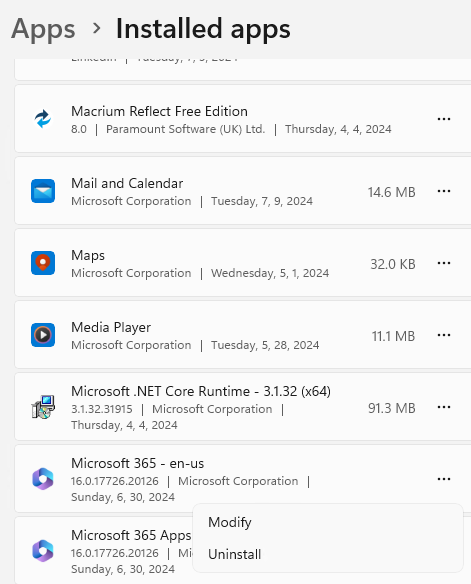
Subscription-based versions of Office may be accessed through Settings > Apps > Installed apps. Find your Microsoft 365 or Office 365 installation in the list. If you click on the ellipsis at its right, as shown in Figure 1, you’ll see two options: Modify and Uninstall.
Figure 1: In the Installed apps list, click the ellipsis to the right of a Microsoft 365 or Office 365 item and select Modify.
Ed Tittel / IDG
Select Modify, and the Microsoft Office repair dialog will open, as shown in Figure 2.
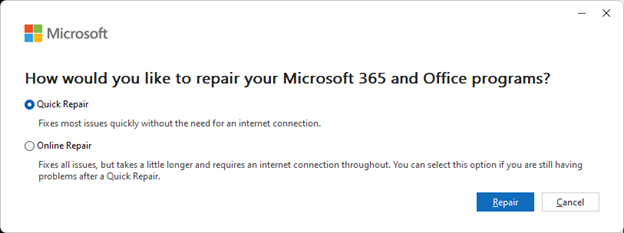
Figure 2: The Office repair dialog offers two options: Quick Repair and Online Repair.
Ed Tittel / IDG
For perpetual-license versions of Office (e.g., Office 2021, 2019, or something older) you’ll need to start in Control Panel > Programs and Features and right-click on any Office component. Then select Modify from the pop-up menu, at which point the same Microsoft Office repair dialog shown in Figure 2 will open.
As you can see, there are two radio buttons in the Office repair tool: Quick Repair and Online Repair. You’ll want to try them in that order. (Online Repair is the subject of the next step in this sequence.)
For the record, Quick Repair uses local files from your PC to attempt its fixes (no download required). As its name suggests, Online Repair downloads known, good, working files from Microsoft servers to do likewise. Online Repair takes longer but uses a guaranteed source that may overcome local file issues that could otherwise stymie repairs.
However you get to the Microsoft Office repair dialog box, you should attempt its Quick Repair first. Select the Quick Repair radio button and then click the Repair button at the bottom right. The tool will ask you to confirm that you’re ready to start, as shown in Figure 3.
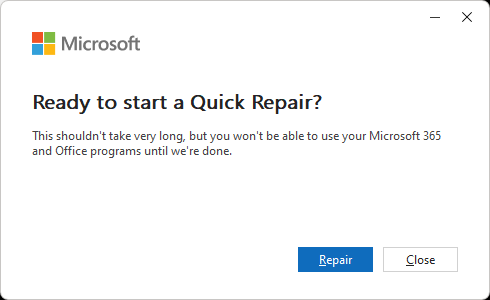
Figure 3: You must click Repair one more time to actually start that process.
Ed Tittel / IDG
When permission is explicitly granted, the repair tool grinds through its paces to attempt repairs using local files. While this process is underway, the progress bar shown in Figure 4 will cycle back and forth.
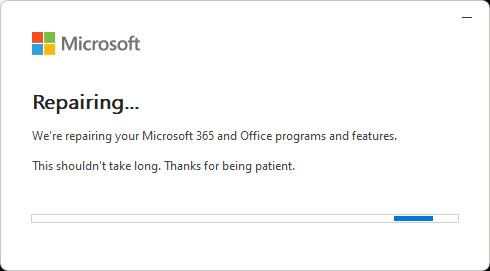
Figure 4: As repairs are underway, you’ll see the blue segment cycle back and forth inside the progress bar at the bottom of the window.
Ed Tittel / IDG
When the Quick Repair tool is finished, a completion notice (or an error message) will appear on your PC. Figure 5 shows a successful completion.
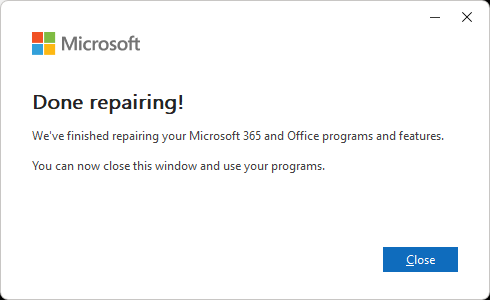
Figure 5: If the repair completes without errors, you’ll see a simple “Done repairing!’ at its conclusion.
Ed Tittel / IDG
Although the status information in Figure 5 says “You can now close this window and use your programs,” you may instead decide to reboot your PC before returning to work inside Office.
If you received an error message or the Quick Repair doesn’t result in a working Office installation, you can re-run the Microsoft Office repair tool using the Online Repair option instead. In that case, proceed to Step 3.
Step 3: Use the Office Online Repair Tool
I won’t go through every step of the Online Repair tool’s progression. Why? Because it’s essentially the same as the Quick Repair sequence shown in Figures 2 through 5.
On my Lenovo ThinkPad X1 Extreme laptop (8th Gen/Coffee Lake CPU, 32 GB RAM, Samsung OEM PCIe Gen3 x4 NVMe SSD, Wi-Fi LAN connection 802.11ax), Quick Repair took between 3 and 4 minutes. On that same machine, Online Repair took nearly 6 minutes. (It took 150 seconds just to get to the “Please stay online…” notification shown in Figure 6.)
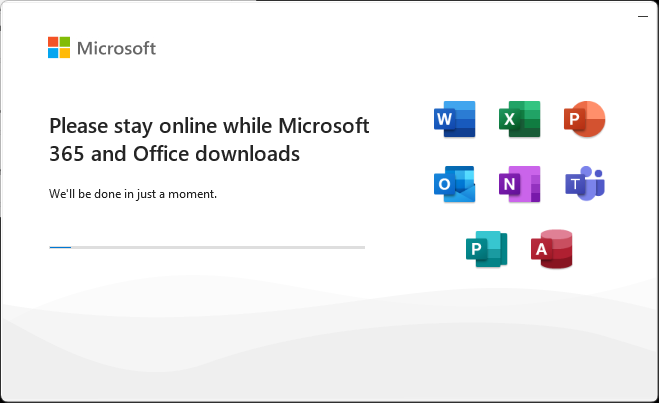
Figure 6: The Online Repair tool shows progress during its download process.
Ed Tittel / IDG
When the Online Repair is complete, it shows an “all set” message and flashes a notification that you can return to work using Office apps as well. The former appears in Figure 7.
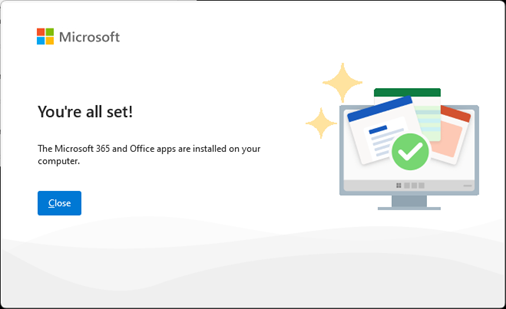
Figure 7: The Online Repair tool announces successful completion with “You’re all set.”
Ed Tittel / IDG
If running the Online Repair tool doesn’t result in a working Office environment, or if it emits an error message instead of the foregoing status, you’ll need to move onto Step 4. In my experience using the Quick and Online Repair tools, only 1 in 5 or so Office troubleshooting incidents have required another step.
Step 4: Try Microsoft SaRA
Microsoft SaRA is the shorthand name for the Microsoft Support and Recovery Assistant. Microsoft itself uses this program for troubleshooting. Indeed, if you call Microsoft Support or engage with them via online chat, they may ask you to run this web-based tool (or run it for you, as circumstances may dictate).
The basic web UI for SaRA for Office appears in Figure 8. As you can see, it also supports tabs for Outlook, Teams, and Advanced Diagnostics as well. If you’re still troubleshooting, you will know which one(s) to explore. There are five Outlook buttons, three Teams buttons, and five Advanced Diagnostics buttons (of which the ROI Full Scan is probably the most helpful) in addition to the seven general Office buttons visible in Figure 8.
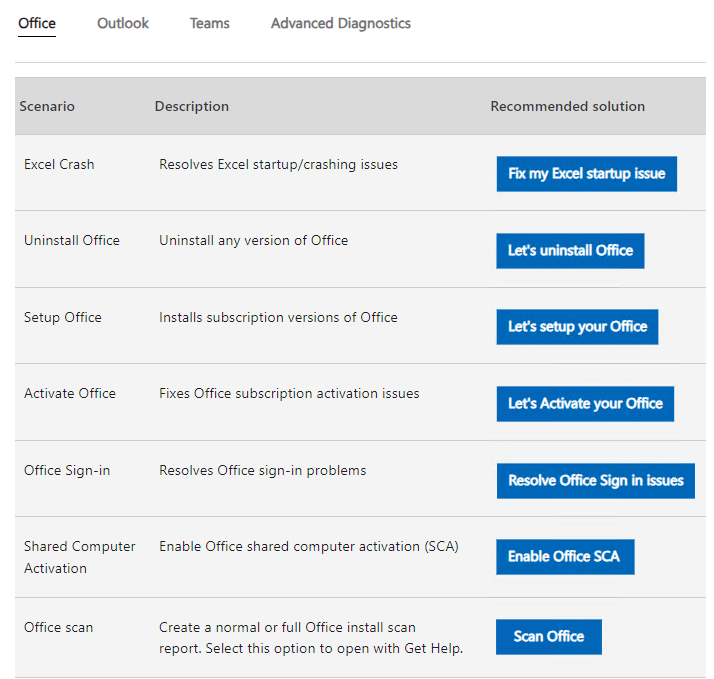
Figure 8: The Office tab for SaRA offers options for Excel startup and general Office issues.
Ed Tittel / IDG
Please note: this tool helps only with issues related to Office installation, set-up, removal activation and sign-in, along with more focused checks for Excel, Teams, and Outlook issues on the other tabs. If none of these fit your situation, move along to Step 5.
Otherwise, work your way through the various Office buttons in the SaRA UI shown in Figure 8, and explore the other tabs (Outlook, Teams, and Advanced Diagnostics) as well. If some particular button’s text addresses your specific issue, SaRA can probably help. If not, you’ll need to advance to Step 5.
Step 5: Wax off, wax on (remove and replace Office)
If you have to go this far during actual Office repairs, my condolences. You’re probably feeling pretty frustrated by now. Be of good cheer! We’re going to download and run a tool that completely obliterates your current Office installation. Then you’ll download and install a fresh, new installation from the Microsoft Office download page.
First, a precautionary detour
Whenever you make major changes to a Windows PC — and what we’re about to do surely counts — it’s a good idea to back up your current installation and know how to restore it. That is, unless you already have a current image: I make a fresh one at 9:00 every morning using Macrium Reflect, and I always keep the Macrium Rescue Disk (a bootable flash drive that knows how to find and restore Macrium image files) handy.
Even so, if it were late in the day, I would make a fresh backup myself at this point. On my systems, this typically takes under 15 minutes, so it’s not a huge wait. (It just took 7 minutes on my test PC.) YMMV.
One more thing: if you’re running an older version of Office — namely Office 2016 or older — you’ll need to save a copy of your Office key in case you need it upon reinstallation. WinAero.com has a handy script you can use to retrieve such keys: make sure you get it, write it to a file, and put it on a USB drive before you go any further down the “wax off, wax on” path described here. Then you’ll be able to access it later on, should you need it.
Newer versions (and subscriptions) are registered with Microsoft activation servers online, so those keys can find themselves, as it were.
Download and run OffScrub
First, download Microsoft’s automated tool for Office clean-up from the Support page named Uninstall Office automatically. It’s named SetupProd_OffScrub.exe, so I’m in the habit of calling it “OffScrub.” Once you install and run that file, you’ll see it uses an older, .exe-based incarnation of the SaRA tool to do its specific thing — namely, to remove all traces of any existing Office installations on the PC where it’s run.
The first thing it does is to install a slimmed-down version of SaRA. It asks for permission to install before commencing, then asks again for agreement when the installer gets up and running, as shown in Figure 9.
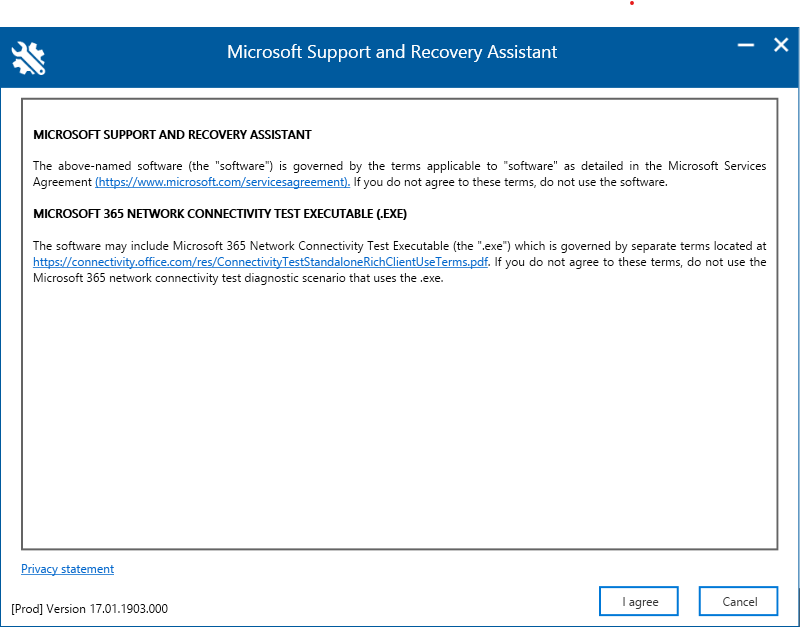
Figure 9: Before you can run any SaRA tools, you must agree to its license terms.
Ed Tittel / IDG
Click I agree as shown above, after which Windows may request permission to install a supporting DLL. Agree to that if it appears. (It will not if the DLL is already present on the target PC.)
Finally, the SaRA interface for OffScrub appears, as shown in Figure 10. This particular PC is running a subscription version (type = “Click to Run”); perpetual versions will appear as Office 2019 or 2021 (or something older, if that’s what you’ve got). Click the checkbox to remove the corresponding Office installation, then click the Next button (lower right) to proceed, as shown in Figure 10.
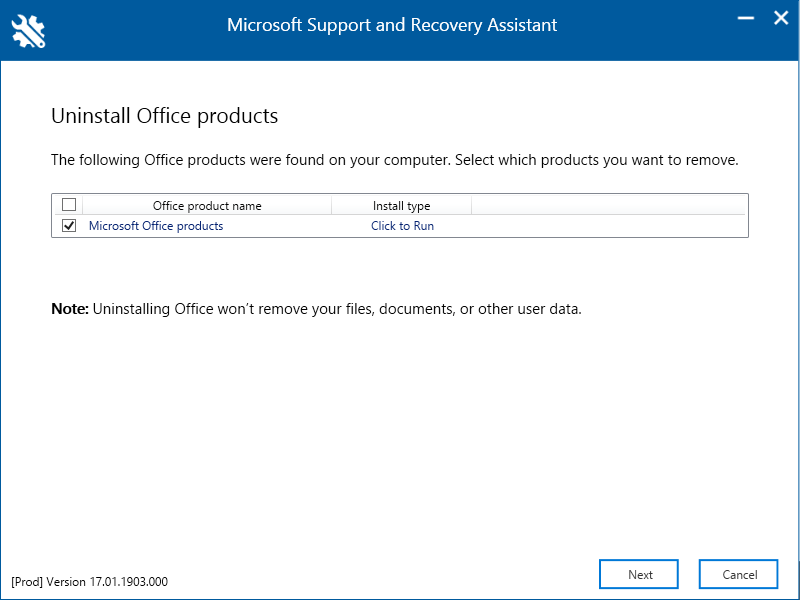
Figure 10: Check the Office installation you wish to remove, then click Next to proceed.
Ed Tittel / IDG
When you click Next, OffScrub gets to work. First, it detects the chosen installation (this took under a minute on the X1 Extreme), uninstalls the chosen Office files (10 minutes or so), and cleans up everything related it can find in the registry and in the Windows file system (12+ minutes). Then, finally, your old install of Office is gone, gone, gone.
Once OffScrub has finished, you must then reinstall Office. If you’re running a subscription or current perpetual edition, you can visit the Microsoft support page “Download and install or reinstall Microsoft 365 or Office 2021…” and follow its instructions.
If you’re running an older version of Office, you’ll need to lay hands on the right installer. If you don’t have it, you can use the HeiDoc.net Microsoft Windows and Office ISO Download Tool to grab the version you need. I just checked: it still works for Office versions from 2010 through 2019.
The end of the Office repair road?
If Office still doesn’t work after the “wax off, wax on” maneuver, you’ve got bigger problems than you thought. That means it’s time to think about an in-place upgrade install for the Windows OS itself as your next move. I wrote a step-by-step story on that very topic for Computerworld in 2018: see “How to fix Windows 10 with an in-place upgrade install.”
Here’s hoping this step-by-step guide has helped you solve your Office problems as simply as possible. You don’t want to walk this whole road unless you must. (I know, from bitter experience.) Good luck!
This article was initially published in April 2021 and updated in August 2024.
Source:: Computer World
How to Transfer Data from iPhone to iPhone in 2024
How Mike Lynch took on the US Justice Department and HP — and won
Download our remote IT support tools enterprise buyer’s guide

From the editors of Computerworld, this enterprise buyer’s guide helps IT staff understand what the various remote IT support tools can do for their organizations and how to choose the right solution.
Source:: Computer World
Space collisions are a growing threat. Europe’s techies want to help
Microsoft to release AI feature Recall in October for Windows Insiders

Microsoft announced on Wednesday that it will begin testing its controversial “Recall” AI search and recall feature for Windows Insiders in October. Earlier, it was slated for launch in June.
“As previously shared on June 13, we have adjusted our release approach to leverage the valuable expertise of our Windows Insider community prior to making Recall available for all Copilot+ PCs,” Microsoft said in a blog post. “With a commitment to delivering a trustworthy and secure Recall (preview) experience on Copilot+ PCs for customers, we’re sharing an update that Recall will be available to Windows Insiders starting in October.”
The Recall feature captures screenshots of on-screen activity, allowing users to search for information they saw or searched previously.
However, it immediately raised concerns among security researchers that automatically capturing images without explicit user consent violates user privacy and could make sensitive personal information more accessible to attackers.
In response to these concerns, Microsoft stated in June that the Recall feature would be disabled by default and pledged to implement additional security enhancements.
“We are adjusting the release model for Recall to leverage the expertise of the Windows Insider community to ensure the experience meets our high standards for quality and security,” the software major said in June.
“For features such as Recall, ideally the data should be stored and processed completely ‘on device’ locally and data shouldn’t leave the laptop,” said Neil Shah, VP for research and partner at Counterpoint Research. “This will drive the real on-device, privacy-centric AI promise. If the model has to learn from user’s data and habits, it should also reside locally with the flexibility to encrypt the data and the model on-device.”
Microsoft has not specified a timeline for a broader release of Recall to all Windows PCs that meet the system requirements for Copilot+ PCs.
Copilot+ PCs are a new class of Windows devices from various manufacturers that can run AI workloads. Microsoft unveiled Recall running on these devices at an event in May.
The timing of the Recall feature’s wider release could be critical, particularly with the upcoming holiday season. Consumers may be more inclined to purchase new devices if Recall is made available across all compatible PCs by then.
Why is Recall a concern?
Windows Recall is a new feature that is designed to come with new Copilot+ PCs, which Microsoft announced in May. This AI-powered tool takes screenshots of your screen every five seconds allowing you to search through a log of your past activities for up to three months.
The screenshots are stored and processed on your device, secured with encryption. You have the option to exclude specific apps and websites from being recorded, and you can pause the Recall feature whenever needed.
The concerns arise from two aspects. First, it is “turned on” by default, as per the initial announcement, and can record and store user data without obtaining explicit consent. Second, it does not conceal or hide sensitive data including passwords or financial data, that might appear on your screen.
Device makers are keen to demonstrate that users can run AI models on their local PCs, bypassing the need for cloud-based services from companies like OpenAI. Apple has similarly equipped its latest MacBooks with the ability to run AI models locally.
“However, some generative AI-centric features for CoPilot will require cloud-based processing for tasks like information retrieval, search, or querying,” Shah said. “Ensuring that data remains secure—whether on the device, in transit, or in the cloud—will be a key challenge. This aspect will also be a critical focus and differentiator for companies like Microsoft compared to Apple in the PC space.”
Security has become an increasing priority for Microsoft, especially after a Department of Homeland Security report in April raised concerns about China’s breach of US government officials’ Microsoft-based email accounts.
As Microsoft moves forward with the testing and potential rollout of Recall, the company will need to balance innovation with user privacy and security concerns, especially as it positions itself in the competitive AI and PC markets.
Source:: Computer World
How to Install Fortnite on your iPhone using AltStore?
Redmi Buds 5C Review: Amazing sound on a budget
Survey: Apple Vision Pro fails to ignite business interest

More than half a year since its launch, Apple’s Vision Pro has attracted only muted interest from businesses. The augmented reality headset holds greater appeal to large firms, however, as well as in particular industry sectors.
That’s according to a recent International Data Corporation (IDC) survey report, which polled 402 US-based IT managers and employees with responsibility for purchasing AR/VR devices.
The survey, conducted in June this year, showed that 35% of the repondents were “very interested” or “somewhat interested” in the device.
The level of interest interest from businesses to date can be described as “mediocre,” according to Lewis Ward, senior research analyst at IDC. “I think Apple has a lot to do on both a software and hardware front before the Vision Pro will become a ‘must have’ device, even at a pilot level, at the typical US business,” Ward said.
The Vision Pro is a new device category for Apple and a work in progress in many ways.
If rumors are to believed, Apple is already working on a cheaper version of the headset aimed at consumers, though this is likely to be at least a year away from release, with a proper follow-up Vision Pro device taking even longer.
Meaningful software improvements may arrive in the interim, Ward said. This could make the headset more attractive to business users.
As part of the VisionOS 2.0 preview release at WWDC this summer, Apple, which has talked up enterprise adoption of the Vision Pro in recent months, announced new developer tools that aim to increase the headset’s utility for certain business use cases. It has also added enterprise-friendly features such as support for mobile device management software since the headset launched to US customers in February.
Vision Pro appeals to finance and healthcare orgs
There were indications that the Vision Pro resonates more with certain types and sizes of business, according to the IDC survey.
Large organizations (over 2,500 employees) showed the highest levels of interest in the device, for example, with 42% “very” or “somewhat” interested. This is likely due to the availability of more resources to try out new technologies such as the Vision Pro, said Ward, alongisde a wider set of potential use cases in comparison with smaller and more focused organizations.
The two industry sectors that displayed the highest levels of interest were healthcare and social assistance (54%), and finance and insurance (52%). A separate survey report from March of this year by electronic health record provider Tebra also highlighted the positive perceptions of the Vision Pro among healthcare professionals.
Ward suggested that organizations in these sectors see potential for the device to solve well-defined problems for certain employees or customers, and may have developed custom software that makes use of the Vision Pro’s strengths.
Manufacturing and retail organizations showed lower interest levels comparatively, below 30%. “This is also an interesting — and, in some ways, counterintuitive — finding, because these are two verticals that have been discussed as being decent fits for Vision Pro,” said Ward.
The IDC survey also indicated that Apple’s entrance into the market has had a “moderately positive” effect on business attitudes towards the use of AR/VR in the workplace more generally.
Source:: Computer World
Tallinn startup bags €2.3M to turn CO2 into ‘critical’ graphite for EV batteries
Should we deport Musk to Mars? We asked 17th-century philosopher Spinoza’s AI twin
UK ends Apple and Google app store scrutiny, but not for long

Apple and Google can take a moment to breathe, as the UK’s competition regulator has decided to end its investigation into their app stores — but not for long.
The UK Competition and Markets Authority (CMA) today confirmed it is closing its ongoing investigations into both Apple’s App Store and Google Play, but only because a much tougher set of regulations is about to come into effect.
Breathing space, but trouble’s coming
Passed into law in May, the UK’s Digital Markets, Competition, and Consumers Act (DMCCA) will give the CMA more powers and more flexibility in how its powers are applied. Principally, these powers include the ability to impose requirements on the conduct of firms in digital markets where those firms have been designated as having Strategic Market Status, and to impose significant fines against firms if those requirements are breached. The intention of these laws is similar to Europe’s Digital Markets Act (DMA).
The DMCCA sets up the Digital Markets Unit (DMU), a new regulatory body within the CMA that will police large technology companies.
Will Hayter, Executive Director for Digital Markets at the CMA, said: “Once the new pro-competition digital markets regime comes into force, we’ll be able to consider applying those new powers to concerns we have already identified through our existing work.”
In 2022, the regulator’s market study of the UK mobile ecosystem found that Apple and Google held an effective monopoly over app distribution in the UK. The CMA then commenced investigating both companies for alleged anti-competitive behavior, but the investigations took place within the framework of a previous set of laws that will be superseded by the DMCCA.
Concerning Apple, in a statement, the CMA said the closure of the investigations “should not be understood” to mean the concerns it was investigating had been resolved. “The decision does not affect any other action that the CMA may wish to take in relation to Apple’s conduct in this area in the future,” it said.
Commenting on the decision, Hayter added:
“It’s critical that tech businesses in the UK, including app developers, can have access to a fair and competitive app ecosystem, helping to grow the sector, boost investment and result in better outcomes for UK consumers. These are all factors we are considering before launching our first investigations under the new regime.”
The UK regulator now has more power
There are numerous new powers within the DMCCA.
Like Europe’s DMA, the law means some companies with a global turnover of more than £25b or UK turnover of £1b+ may be designated as having Strategic Market Status (SMS).
Companies given such status will be required to follow requirements on their conduct imposed by the CMA, though the CMA does say it wants to build “productive relationships” with those firms.
Perhaps so, but as a Linklaters legal blog explained earlier this year, “The scope of permitted conduct requirements is incredibly broad, giving the DMU very wide discretion to decide what obligations should be imposed on each firm.”
The CMA has previously said it expects the first companies to be designated as such will be revealed in July 2025, but this date may now slip a little in consequence of the recent UK election.
Those requirements will allegedly be developed with the intention of opening up competition and consumer choice in digital markets. That likely extends to app stores and payment systems being opened up, as they are being in the EU under the DMA. The CMA can also impose big fines on companies that fail to comply.
It may be instructive to note that the CMA recently rejected commitments made by Google in response to its concerns.
Google had given app developers some additional flexibility in the use of alternative payment systems. Similar to those Apple has proposed in the EU, Google’s proposals included a commission and pop-up screens to warn users when they were about to use a third-party payment system.
Open markets seem inevitable
While the CMA hasn’t yet said which companies may be investigated for possible SMS designation, it’s unlikely Apple, Google, or other Big Tech firms will be able to avoid it.
After all, the regulator does state that it “anticipates that its early work under the new digital markets competition regime will build on and leverage its experience in areas it has already studied, such as mobile ecosystems, which includes app stores.” (Italics mine.)
The latest UK news around tech regulation follows similar announcements in the EU, Japan, and South Korea and potential incoming investigations in Apple’s second biggest market, China.
Please follow me on Mastodon, or join me in the AppleHolic’s bar & grill and Apple Discussions groups on MeWe.
Source:: Computer World
UK proposes giving digital workers the ‘right to switch off’

Britain’s new Labour government is the latest legislature to consider how it might make it easier for digital workers using always-on technologies to turn them off at the end of the working day.
In Labour’s Plan to Make Work Pay, published before it won the UK’s July general election, it promised to address the issue, saying “We will bring in the ‘right to switch off’ so working from home does not result in homes turning into 24/7 offices.”
And this week it brought the issue back into the spotlight, with a government spokesperson telling the BBC, “Good employers understand that for workers to stay motivated and productive they do need to be able to switch off, and a culture presenteeism can be damaging to productivity,” a government spokesperson told the BBC on Monday.
Source:: Computer World


