


GenAI is to data visibility what absolute zero is to a hot summer day

CIO.com (a sister publication) had an intriguing story about ChatGPT and a potential conflict with the European Union’s GDPR rules. The sad reality is that although the story accurately describes the EU issue, the GDPR kerfuffle amounts to barely a rounding error when it comes to generative AI (genAI) and how it is obliterating all compliance rules — especially those involving privacy.
Enterprise IT leaders have never had an especially strong mastery of IT visibility for apps, data and tools. But the instant a company welcomes genIA tools into its environment — an event that for most enterprises happened last year — they can kiss any beliefs that they still control their assets good-bye. And without comprehensive data control and strong data visibility, regulatory compliance is impossible.
Let’s start with the GDPR situation. As CIO.com explained it: “The EU’s strict privacy rules require that companies allow individuals access to personal information held about them, as well as ensuring that such data is accurate. This requires a long audit trail to every piece of information stored about European citizens. When it comes to AI-generated content, such trails often go cold. With regard to information generated by ChatGPT, (the entity suing) alleges there is no legal redress for so-called hallucinations when it comes to personal information.”
That’s true, but hallucinations are just the most obvious examples. The part of GDPR at issue here is the Right To Be Forgotten. If an EU citizen (5 million of whom live in the US) officially asks for something personal about them to be removed, companies are supposed to comply.
Long before genAI, including the large language models that underpin it, became popularized, enterprise IT teams were already struggling to comply with such rules. The usual culprits for enterprise IT visibility issues are cloud, IoT, mobile, third-parties, remote sites including home offices and all manner of Shadow IT.
The Right To Be Forgotten is simply not compatible with how modern enterprises function, especially in the United States. Let’s consider a typical scenario: you’re an analyst working for the marketing department and trying to make sense of some unusual customer patterns. It’s getting late, so you decide to finish number-crunching at home. So you back up the data to a personal cloud account for easy access at home later when you resume working.
The next morning, on the train heading to the office, you remember something you wanted to try with the data. You access that cloud folder on your phone, do a little more analysis and then save the files.
When you get back to your desk, you download that file to your work desktop machine and continue working on the latest files.
Think of the ways that data can go astray and be out of reach for IT. Your home computer uses a consumer-grade backup service, and overnight, those files were copied to that service. That consumer-grade backup service has its own offsite backup mechanisms, along with a separate disaster recovery service. That file with sensitive PII about customers is now in all those locations.
That sensitive data was also on your phone. That data also gets automatically backed up to that handset manufacturer, which also has its own backup and disaster recover arrangements.
Two days later, an EU citizen (who happens to be one of your customers) submits a right to be forgotten request and your team eventually learns of it. They delete the references they can locate on key enterprise systems, including a half-dozen corporate cloud environments they know about.
But what about all of those other locations?
That example involves just an employee trying to get work done. Let’s try one with a customer or a prospect. One of your senior sales representatives is working with another company on $1 billion sales deal. They start discussing sensitive contract points in text threads between them and will likely also review preliminary contract drafts.
Once the draft gets to a late stage, it goes to the legal department and everything is hopefully captured. But what about all of those text discussions between two personal smartphones? Compliance is not only about regulatory issues. What if the deal later goes bad and there is litigation? The opposing counsel will seek discovery, including all discussions about contract terms. Are you even remotely able to fully comply? (I’ll save you time: No, there is no way you can fully comply.)
That was all true back in 2019. In 2020, the pandemic hit and cloud and remote activity soared. In 2023, genAI tools — which had been around in various forms since the 1960s — grabbed headlines and was suddenly on the must-have list of every enterprise board member. The less about AI decision-makers knew, the more they wanted genAI.
Full data visibility was difficult in 2019, virtually impossible in 2020, and now, with genAI cropping up in just about every division and working group, it’s crossed the line into fully impossible
Why does it so fully obliterate data control? There are five relevant elements, all distinct, :
- What enterprise data can genAI access?
- Who (among employees, contractors, customers and anyone with any level of privileged access) can access that data? Is there some attempt, any attempt, to limit who can access what segments of that data?
- How was the genAI system trained? What information did it examine to answer queries? Did any of that training information include data about EU citizens? (Yes, EU data was almost certainly within the training set.)
- Is the genAI training on new data you share? Will it try and learn from your queries and potentially share that information with competitors?
- What about the massive databases behind genAI tools. Can enterprises that license that system review the database? Can they delete details from it? If not — and the answer will almost always be “No” — how is GDPR compliance even possible? How is any compliance possible?
With arrival of genAI virtually everywhere, the compliance genie is already out of the bottle.
Compliance, Data Privacy, GDPR, Generative AI
Source:: Computer World

Tilburg’s Mr. Winston raises €600K for its hospitality POS system
Swedish startup wins EU funding to print organic indoor solar panels
Apple earnings: About that iPhone ‘slump’ in China

If he hasn’t already, it’s past time for Apple CEO Tim Cook to gain a reputation for dry wit when it comes to handling preconceived opinion — he ladled out several helpings of this during Apple’s second-quarter fiscal call on Thursday. Though the company’s financials were down, they were still ahead of what Wall Street had anticipated.
Revenue for the quarter was $90.8 billion, down 4% from the same quarter last year, but Apple’s gross margins increased to 46.6%, mainly on the strength of solid services increases.
Cook states the facts
For me, one of his best lines during the presentation was captured in this exchange during analyst questions:
Wells Fargo analyst: “I guess I’m going to go back to the China question. I guess at a high level, the simple question is, when we look at the data points that have been repeatedly reported throughout the course of this quarter, I’m curious, Tim, what are we missing? Where do you think people are missing Apple’s iPhone traction within the Chinese market?”
Tim Cook: “I can’t address the data points. I can only address what our results are. And we did accelerate last quarter and the iPhone grew in mainland China. So that’s what the results were. I can’t bridge to numbers we didn’t come up with.”
Translation: The analyst is confused because all the industry data points (IDC, Counterpoint, Gartner, Ming Chi Kuo) seem to have been inaccurate. Cook simply dismisses those estimates with the company’s actual results.
What happened in China?
What’s confusing here is that the company’s management report confirms weak iPhone sales in every segment — but in part this reflects one of those “difficult comparisons” the company likes to state.
Think back to this time last year, when Apple was just emerging from what had been a very difficult time operationally. In the run up to this quarter a year ago, COVID-19 had closed the iPhone factories, meaning lots of smartphones weren’t being made, and order fulfillment was delayed. Apple told us then that it realized about $5 billion in iPhones sales in the quarter that would have been made in the preceding one.
That’s not the case this year. “If you remove that $5 billion from last year’s results, we would have grown this quarter on a year-over-year basis,” Cook said. “And so that’s how we look at it internally from how the company is performing.”
If that’s true, it explains why Apple doesn’t seem especially concerned that its iPhone sales internationally did decline by 10% in revenue in the quarter. After all, the iPhone was the top-selling smartphone model in the US, urban China, Australia, UK, France, Germany, and Japan. The device also achieved 99% customer satisfaction according to Changewave.
Managing change
Even though Cook told us that iPhone sales grew in China, both the Wall Street Journal and Nikkei insist sales fell there. In fact, the two best-selling smartphones in mainland China during the quarter were the iPhone 15 and 15 Pro Max, Apple confirmed during the presentation.
Apple did concede that it has work to do on its other products, and iPhone sales were down in contrast to this time last year. Weakness was felt across multiple markets, and with the iPhone Apple’s biggest product, the impact of this and softening iPad sales contributed to revenue decline.
What is interesting is that in Japan and elsewhere in the APAC region, Apple sales seemed weak. That doesn’t mean there isn’t an appetite for the company’s products. Cook sees enthusiasm across the region: “Everywhere I travel, people have such a great affinity for Apple, and it’s one of the many reasons I’m so optimistic about the future,” he said. He also expressed his confidence in the long-term Apple market in China.
What about enterprise use?
Apple made a handful of references to enterprise sales, the majority of which pertained to its latest device, the Vision Pro headset. The company reported that over half of the world’s Fortune 100 companies have already bought Vision Pro units to explore what the device can do for their business.
“We are seeing so many compelling use cases, from aircraft engine maintenance training at KLM to real-time team collaboration and immersive kitchen design at Lowes,” said Apple CFO Luca Maestri.
Apple also confirmed the ongoing rise of Macs in the enterprise. “More and more enterprise customers are embracing the Mac,” said Maestri.
In healthcare, Epic Systems, the world’s largest electronic medical record provider, recently launched its native app for the Mac, making it easier for healthcare organizations like Emory Help to transition thousands of PCs to the Mac for clinical use. “I think there’s a great opportunity for us around the world in enterprise,” said Cook.
A note on Europe
Two points seemed interesting:
- Apple anticipates solid services growth (which includes Europe) in the current quarter, despite the EU’s DMA act which is forcing it to change its App Store business model.
- With those changes, Apple said it’s too early to tell whether consumers or developers will migrate outside the App Store; its focus for now is on complying with the EU law while “mitigating the impacts to user privacy and security” of doing so.
One step beyond
Apple also discussed emerging markets.
Maestri: “…When we start looking at places like India, like Saudi, like Mexico, Turkey, Brazil, Mexico and Indonesia, the numbers are getting large. And we’re very happy because these are markets where our market share is low. The populations are large and growing. And our products are really making a lot of progress within those markets. The level of excitement for the brand is very high. So, it is very good for us.
“And then and certainly the numbers are getting larger all the time. And so the gap as you compare it to the numbers in China is reducing. And hopefully that trajectory continues for a long time.”
The takeaway from those statements tells me that, like any farmer, Apple is investing in future business growth and most certainly sees rapidly emerging markets as the bedrock for tomorrow’s success as mature markets atrophy.
What happens next?
Looking forward, Apple warned of low single-digit growth in the June quarter, with services predicted to continue to grow and the iPad to see double-digit growth. The company is expected to ship a new iPad as soon as next week.
That iPad may also introduce some new AI-driven tools, perhaps as a taster of what to expect at WWDC and their expected spread across the company’s products this fall. Discussing generative AI, Cook described it as a “very key” opportunity, stressed his confidence that the company has advantages to bring such tech to market, and promised “we will be talking more about it as we go through the weeks ahead”. So, there’s a lot to look forward to.
Apple’s data points
So, having established that there’s no data about Apple better than Apple’s own data, what data points did Apple share? You can review its press release here and financial statements here and here. What follows are some details cherry-picked from within the company’s analyst call:
- Apple reached revenue records in more than a dozen countries and regions, including in Latin America and the Middle East, as well as Canada, India, Spain, and Turkey.
- It also achieved an all-time revenue record in Indonesia, “one of the many markets where we continue to see so much potential,” said Cook, who recently visited the nation.
- Services hit an all-time revenue record, up 14% YoY at $23.9 billion. (It’s worth noting that recent data indicates Apple TV+ is the fastest growing streaming service in major markets.)
- Mac sales by revenue grew 4% YoY. (Cook described the MacBook Air as “the best consumer laptop for AI”, which I take to mean “watch this space.”)
- iPad revenue fell 17%, ahead of next week’s expected refresh.
- Wearables, home, and accessory sales fell 10%.
- Apple nodded toward CSR, confirming its plan to be completely carbon neutral across its business by 2030 and celebrating that it has reduced overall emissions by over 50% even while revenue (and therefore sales) increased 65% since 2015.
- Apple expects gross margins in the June quarter of 45.5% to 46.5% (which is really high, even for Apple).
- Apple predicts single-digit growth in comparison to last year in the upcoming June quarter. In 2023, it booked $81.8 billion in revenue for that period.
- If you own Apple shares, you’ll get 25 cents per share on May 16.
Please follow me on Mastodon, or join me in the AppleHolic’s bar & grill and Apple Discussions groups on MeWe.
Apple, iMac, iPhone, Mobile
Source:: Computer World
This week in Dutch tech
Uber rival Bolt secures €220M in prep for IPO
Microsoft begins to phase out ‘classic’ Teams

Seven years after the launch of Teams, Microsoft has outlined plans to retire the initial, “classic” version of the team chat app. Support for Teams classic will end on July 1 and it will be discontinued a year later; atthat point, users will be unable to access the legacy client.
Microsoft released the new 2.1 version of Teams last October after several months in preview, claiming the new app is twice as fast and uses around 50% less memory than its predecessor.
The move represents the biggest change to the collaboration application since it arrived in 2017 to take on rival Slack. Since then, Teams has reached 320 million monthly users, according to recent data, having capitalized on the big uptick in video meetings during the COVID-19 pandemic. That said, it hasn’t alwaysbeen well-liked by users.
While the two Teams versions have coexisted in recent months, Microsoft recently outlined its schedule to phase out classic Teams on its admin site. With the end of support coming, no new features will be added going forward and Microsoft will cease to help customers resolve support issues. At this stage, customers will start to receive in-app messages informing them that their version of Teams is out of date. End of support was initially planned for March 31 before being pushed back.
Users will be unable to access or use the classic Teams as of July 1, 2025. Those using classic Teams on Windows 7, 8, 8.1, and macOS Sierra will see the end of availability occur earlier, on Oct. 23, 2024.
While there are advantages with the new version of Teams, some capabilities will disappear, too.
Earlier this week, Microsoft outlined a host of changes that users might notice once they move to the new Teams. Some involve new ways to access existing tools, as well as several smaller features that will no longer be available: the activity tab in Teams chat, and Adaptive Card-based tabs in personal app tabs, for example.
The timeframe for retiring the classic Teams app seems abrupt, according to Raúl Castañón, senior research analyst at 451 Research, part of S&P Global Market Intelligence, and Microsoft appears to be pressuring customers to update to the new version.
“Some business might be slow to move to the new app because they may have planned to update at a later date, or because they might want to wait until Microsoft has worked out software bugs from the initial versions,” he said.
Classic Teams is one of several Microsoft products heading toward end of support. Windows 10 users will no long receive security or technical support as of Oct.14, 2025, as Microsoft encourges users to migrate to Windows 11. Microsoft will also end support for Office 2016 and 2019 application suites, and related productivity servers, on the same day.
Collaboration Software, Microsoft Teams, Productivity Software
Source:: Computer World
Instead Of Rabbit R1 Or Humane AI Pin, Try These 4 AI Apps
AI-powered ‘deep medicine’ could transform healthcare in the NHS
Apple confirms it will open up the iPad in Europe this fall

In the latest set of tweaks to bring itself into compliance with a new European Union law, Apple has confirmed significant changes to the deal originally offered to developers in the EU. Not only will it open up the iPad in the same way as it is opening up the iPhone in Europe, but it is making significant changes to its Core Technology Fee that should benefit smaller developers.
Europe’s iPads will be opened up this fall
iPadOS will be opened up in Europe starting this fall, the company said in a statement on its developer website. “This week, the European Commission designated iPadOS a gatekeeper platform under the Digital Markets Act,” Apple said. “Apple will bring our recent iOS changes for apps in the European Union (EU) to iPadOS later this fall, as required. Developers can choose to adopt the Alternative Business Terms for Apps in the EU that will include these additional capabilities and options on iPadOS or stay on Apple’s existing terms.”
Of course, once developers do choose to adopt Apple’s alternative terms, they can become liable to pay the company a Core Technology Fee (CTF).
Improvement to the CTF
The fee is designed to compensate Apple for the value it provides developers in terms of tools, tech, and services. There is good news for developers here in that Apple won’t double charge for this, which means users who install the same app on both iOS and iPadOS within a 12-month period will only generate one first annual install for that app.
While company critics continue to castigate this so-called “Apple Tax”, the company points out that under current data over 99% of developers in the EU will not be liable to any kind of CTF fee. Which rather implies that the 1% of developers who do pay the fee are able to make the most noise because they can afford the best marketing.
But let’s not dwell on that. Instead, let’s look at two additional changes the company has made to its approach. The first change is quite significant.
Helping sudden success
When Apple’s teams appeared in front of what seemed to be an EU kangaroo court to explain how it was approaching the DMA, one question from one developer rang true. That person spoke about how an app they made had become hugely successful overnight and explained that under Apple’s originally proposed CTF deal he would have been bankrupted by the fees at that time. Apple responded pretty quickly with a range of tweaks.
At first, it introduced a new loophole developers in that situation could use to return to the original terms of business, which I saw as a kind of lifeboat. Today, it introduced a new tweak I think serve to blunt the pain of unexpected success:
As of now, small developers generating under €10 million in global annual business revenue that adopt the alternative business terms receive a three-year free on-ramp to the CTF to help them create innovative apps and rapidly grow business.
What that means is that within those three years, if a developer who has not previously exceeded one million first annual installs crosses the threshold for the first time, they won’t pay the CTF — even if they continue to exceed one million first annual installs during that time. “If a small developer grows to earn global revenue between €10 million and €50 million within the 3-year on-ramp period, they’ll start to pay the CTF after one million first annual installs up to a cap of €1 million per year.”
This sounds incredibly complicated, but basically means that if you are a small developer and happen to introduce an app that generates millions of installs they will not need to pay a fee until they scale their business so they can afford to do so.
No revenue? No fee
Obviously, this doesn’t apply to those wealthy developers whose business has already scaled in that way — rightly, they still need to shoulder the burden to help nurture new dev talent. The one big caveat is that the developer must declare their revenue before their first app surpasses one million first annual installs in order to receive these benefits. Leave it too late and you’ll have missed the chance.
The other improvement is that developers who create free apps won’t suddenly be bankrupted because millions download the app. Apple explains:
“No CTF is required if a developer has no revenue whatsoever. This includes creating a free app without monetization that is not related to revenue of any kind (physical, digital, advertising, or otherwise). This condition is intended to give students, hobbyists, and other non-commercial developers an opportunity to create a popular app without paying the CTF.”
It is also important to point out something else. Only developers who achieve over one million first annual installs per year in the EU need to pay Apple’s Core Technology Fee. Not only that, but non-profit organizations, government entitles, and educational institutions approved for a fee waiver don’t pay it at all.
While Apple’s well-resourced critics will continue to attack the company’s approach, it’s hard to avoid the feeling that the company is making it crystal clear that it is not now (and probably never was) the small developers who propped up App Store profits, but the large developers now making the loudest complaints.
And that seems to me to be food for thought. I doubt those larger entities have any plans to give their apps away for free. Why should Apple be made to do so?
Please follow me on Mastodon, or join me in the AppleHolic’s bar & grill and Apple Discussions groups on MeWe.
Apple, iOS, iPad, Mobile, Mobile Apps
Source:: Computer World
Udacity offers laid-off US workers free access to its courses for 30 days

Citing the surge in layoffs nationwide, particularly within the IT workforce, online technology learning platform Udacity is offering a free trial to access its entire catalogue of courses for the next 30 days. The courses includes certifications in skills such as programming, data science, artificial intelligence, digital marketing.
“Layoffs have affected hundreds of thousands of people in the United States in the past year,” Udacity COO Victoria Papalian wrote in a blog post. “Unfortunately, the unsettling trend continues. According to the Challenger Report, US job cuts in March 2024 were the highest since January 2023, up 7% over February.”
Udacity, which was founded as the outgrowth of free computer science classes offered in 2011 through Stanford University, said its free courses are part of its “Nanodegree” credential program. They’re available to anyone laid off over the past year.
In its announcement, the company placed a particular emphasis on highly desired industry skills, such as generative artificial intelligence (genAI). According to a recent study led by the Oxford Internet Institute, “AI skills are particularly valuable as they have high levels of skill complementarity, increasing worker wages by 21% on average,” the company said in a statement.
“To capitalize on the [genAI] opportunity — for business as well as individual benefit — learning about various genAI techniques is not sufficient; professionals must be inspired by the many use cases for genAI in the business, and must gain experience in putting that knowledge into practice within organizational contexts,” Papalian said.
Online instructors include educators from various tech companies, such as Advocate Networks, Cape Analytics, DeepMind, LanceDB, Meta, NVIDIA, SoFi, and UC Berkeley, as well as Udacity’s own instructors. The topics covered include AI, data science, analytics, project management, digital marketing, cloud computing, web development, and mobile development, as well as genAI for business leaders.
Students studying genAI will also have the opportunity to complete projects modeled on the realworld tasks and challenges in professional contexts.
The free courses are available for all levels of IT experience and take about 4 weeks to complete during an average of 10 hours a week. These are examples of some of the courses being offered:
- Introduction to Python (Beginner)
- Introduction to SQL (Beginner)
- Digital Project Management (Beginner)
- Generative AI Fundamentals (Intermediate)
- Intro to Data Science (Advanced)
Students who can spend 20 hours a week learning can complete the following courses in 60 days:
- Business Analytics Nanodegree program (Beginner)
- AI Programming with Python Nanodegree program (Beginner)
- Programming for Data Science with Python Nanodegree program (Beginner)
- AI for Business Leaders Nanodegree program (Intermediate)
- AWS Cloud Architect Nanodegree program (Advanced)
By spending 40 hours a week, the following Nanodegree programs that typically take four months to complete can be finished in a month:
- Introduction to Programming Nanodegree program (Beginner)
- Digital Marketing Nanodegree program (Intermediate)
- Generative AI Nanodegree program (Intermediate)
- AI for Trading Nanodegree program (Advanced)
- Data Scientist Nanodegree program (Advanced)
Udacity students will also have the opportunity to receive feedback on their projects from mentors. The program, including all of Udacity’s tech projects, is now available to All Access subscribers.
“The experience of being laid off is stressful to say the least. And the subsequent job hunt is often no less stressful,” Papalian said. “Knowledge and training are critical to capturing the opportunities.”
Education and Training Software, IT Jobs, IT Skills, Technology Industry
Source:: Computer World
Europe is falling behind in the race to develop space-based solar power
Top 5 Emulators Coming Soon To iOS
Workers with AI skills are getting these pay cash premiums

As companies are scramble to get ahead in the artificial intelligence (AI) arms race, one problem the face is finding and retaining AI talent.
For example, Meta has been extending job offers to candidates with AI experience without even interviewing them, and CEO Mark Zuckerberg went so far as to email researchers at Google’s DeepMind unit to recruit talent.
According to a recent study led by the Oxford Internet Institute, “AI skills are particularly valuable as they have high levels of skill complementarity, increasing worker wages by 21% on average.”
Foote Partners, a recruitment, consulting and research firm, recently published its latest IT skills and pay index, which found, not surprisingly, that companies are paying premiums for workers with AI-related abilities.
Foote Partners recognizes 47 “critical A.I. skills,” and on average, employees who obtain those skills get a pay premium of 7% to 21%. Those premiums can come in different forms, including bonuses and cash compensation.
“This is cash paid out, not as a salary increase but in addition to salary,” said David Foote, chief analyst at Foote Partners. “In fact, 28 of these core AI skills can add between 15% and 21% in pay, well above the 9.6% average premium across all 632 non-certified skills we report. They are very hot right now.”
Cash premiums for skills such as AI chatbot app developer and large language model (LLM) tuning are paid out separately from salaries so that as needs are met and the value of those talents declines, the payouts can be reduced or eliminated.
“Perhaps the main difference with skills pay is, unlike a bonus, skills pay premiums are typically paid out at every pay period — same as salary — instead of a lump sum at the end of year, which is more common with bonuses,” Foote said.
In addition, more than a dozen AI-related certifications “are showing real market value strength,” he said. Those skills include prompt engineering, neural networks, AI engineer, AI scientist, and AI model optimization.
According to Foote, a Certified Artificial Intelligence Scientist earns the highest pay premium, ranging 8% to 12%, with the average being 10% of base salary equivalent,. The next highest cash pay premium in this cluster is for a Microsoft Certified: Azure AI Engineer Associate, who can earn 9% of base equivalent in skills premium pay.
Averaging 8% of base salary equivalent in skills pay premium are: SAS Certified Professional: AI and Machine Learning; IBM Certified Specialist — AI Enterprise Workflow V1; Artificial Intelligence Engineer (AIE – all tracks); and Google Professional Machine Learning Engineer certifications.
“We’ve been tracking some of these AI-related skills for many years, updating every 90 days,” Foote said. “Others have been recently added. So, given all the volatility in the marketplace for skills cash pay premiums, there have been remarkable changes over time ,including most recently.”
Foote Partner’s findings are echoed elsewhere. Freelance work platform Upwork, which recently published its 2024 list of most in-demand skills, found that the rise of AI — especially generative AI in the last couple of years — has changed the top skills businesses seek from independent professionals. In particular, generative AI modeling, machine learning and data analytics are the top three fastest-growing data science and analytics skills, as well as among the most in-demand skills.
“In particular, skills in key programming languages commonly used in the development of AI — Python, Java, and SQL — rank among the top five most sought-after skills on the technical side in the US,” Ya Xu, head of data and AI at LinkedIn, said in a blog post.
Machine learning skills can command at least a 10% premium compared to the average tech worker, according to a survey conducted at the end of 2023 by tech staffing firm Dice. “But this is a fast-moving market where the demand is growing rapidly,” said Art Zeile, CEO of Dice. “I predict that this premium will only continue to grow as the gap between supply and demand for AI talent grows, and offering benefits such as continuous professional development and training will be key to retaining this top talent.”
A key differentiator in the job interview process now involves how a tech professional has upskilled themselves in the face of the growing demand for AI, Zeile noted.
“Now is the time to ensure that their skill sets encompass [LLM] theory and programming architecture, areas that may have been overlooked or haven’t been delved into fully,” he said. “Recruiters are looking for tech professionals who are quick on their feet and able to adapt to changes with agility and curiosity.”
In January 2023, AI or machine learning-related skill sets were referenced on 9% of tech job postings. Just over a year later, in February 2024, that figure had climbed to nearly 14% of all tech job postings, according to Zeile.
“As AI continues to evolve, its impact on organizations will be most prominent in key departments such as research and development, data analytics, and operations,” Zeile said.
To secure top AI talent in these areas, Zeile advised that companies:
- Invest in comprehensive recruiting strategies that show a full understanding of what a particular AI role actually requires — whether it’s machine learning, Python, or data science skills for tech jobs, or other content-centric skills such as copy writing and graphic design.
- Establish competitive salaries and provide opportunities for professional growth and development.
- Offer flexibility in the form of hybrid/remote work environments. Dice’s 2023 Tech Sentiment Report noted that remote work remains very important to tech professionals: 73% of those surveyed said it is “extremely” or “very” important to have the opportunity to work remotely at least three days a week.
While Amazon, Google, Meta and Microsoft are among the top 15 companies hiring for AI talent right now, according to Dice, there are a variety of factors tech pros must consider determining if Big Tech is right for them.
“While these Big Tech companies offer many opportunities for individuals with AI skills, candidates should also consider startups and other industries that align with their career goals and work/life balance preferences that would also still give them the ability to learn and flex their AI muscles,” Zeile said. “Ultimately, it is up to tech professionals to decide what companies most align with their values and what kind of industries they want to work in.”
Startups, Zeille said, often provide more room for innovation and growth, but may have less rigorous AI programs in place. At the same time, compensation at Big Tech companies might be higher, but work/life balance lower. Once a candidate has decided what is important to prioritize in their future role, they can job search accordingly.
Generative AI, IT Jobs, IT Skills
Source:: Computer World
Dutch minister fears ‘national security risk’ from Chinese ownership of Anteryon
Atlassian Rovo brings AI smarts to enterprise search
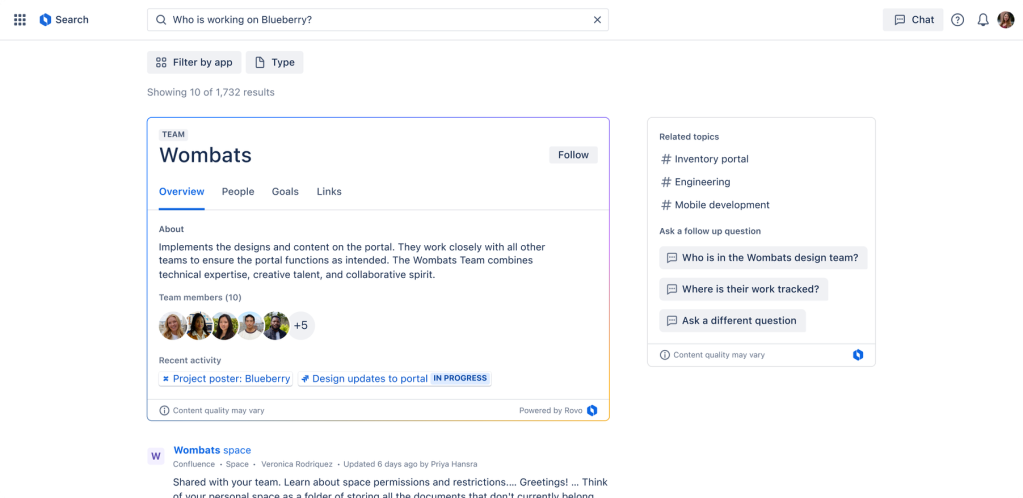
Atlassian has developed a new search tool — Atlassian Rovo — that can surface data from a variety of third-party apps. Rovo, currently in preview, provides a chatbot interface to help workers access information across their organization,and even decipher workplace jargon.
“Atlassian Rovo is designed to unlock knowledge discovery and accelerate action across the organization,” said Jamil Valliani, head of product AI at Atlassian. “Think of Rovo as a large knowledge model for your company that allows team members to move and act faster.”
There are three key elements to Rovo: Search, Chat, and Agents.
Rovo Search expands on existing search functions in Atlassian apps, with the ability to access documents from a range of external sources in addition to data held in tools such as Jira and Confluence. This means surfacing information in third-party productivity tools such as Slack, Microsoft Teams, Figma and GitHub, as well as file storage platforms such as Google Drive and Microsoft SharePoint.
Atlassian Rovo can help surface information and answer questions about technical jargon based on access to coporate documents.
Atlassian
Atlassian also plans to let Rovo access data from in-house applications, including finance or HR apps.
One way to access Rovo search is via the search bar in various Atlassian apps. A list of search results containing related documents is presented, as well as more detailed “knowledge cards” that present information relating to a project, for instance, or a team. Here, the knowledge card might contain links to related files, as well as information on project status, listed contributors, and more.
Rovo Search can also learn and explain unfamiliar jargon specific to an industry or individual business based on the organization’s documents. This enables Rovo to provide definitions for acronyms and terms that appear within a Confluence document, for exam-le. It’s proved to be a popular feature, Atlassian said, and is used by three-quarters of staff testing Rovo.
A semantic search function helps teams “connect with what they are looking for,” said Julie Mohr, principal analyst at Forrester, as well as “knowledge they didn’t know existed.” This helps employees “work the way they want to work with a comprehensive set of expressive tools — from video to pages, structured and unstructured, it is all knowledge,” she said.
Another way to search for information is via Rovo Chat. Similar to the conversational interfaces in Microsoft’s Copilot, OpenAI’s ChatGPT, and others, the chatbot responds to user questions in natural language, with answers based on data held in documents across an organization. Links are provided to the original source.
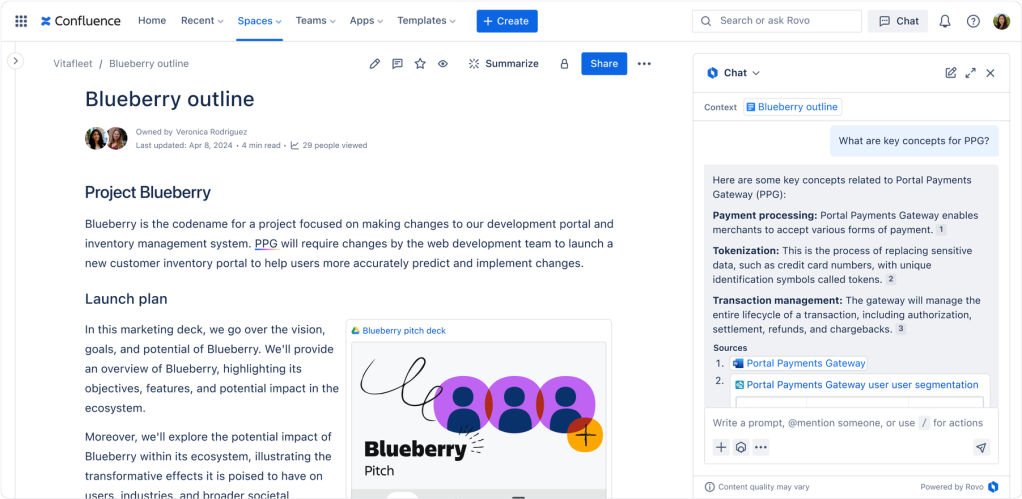
Atlassian Rovo Chat uses genAI and a chatbot interface with natural language processing to deliver information to users.
Atlassian
Another aspect of Rovo that relies on generative AI is the addition of workflow automation “agents.” Accessible via the Rovo Chat sidebar, the Rovo Agents are tailored to a specific task. For instance, Rovo Agents can be designed to generate and review marketing content, collate feedback from various sources, or streamline processes such as clearing up Jira backlogs and organizing Confluence pages.
Users can create their own Rovo Agents using a no-code text interface or Atlassian’s Forge app development platform. Atlassian expects there will be around 20 pre-built agents available when Rovo launches.
Canva’s design software is an example of an Atlassian partner building its own agent. “There’s going to be a Canva agent that helps with generating simple artwork for social media posts, things that you don’t need an expert designer to do,” said Valliani.
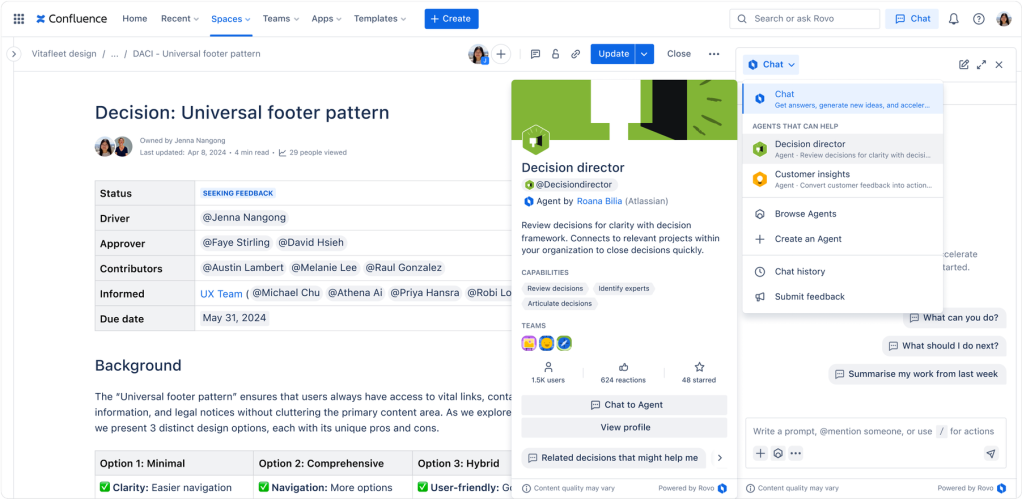
Atlassian Rovo agents are tailored to specific tasks and can include agents built by third-party vendors.
Atlassian
“Generative AI has so much potential in knowledge management,” said Mohr. “Atlassian is taking the power of Confluence and improving those capabilities with sound knowledge management practices combined, with new features that take advantage of genAI.”
Making it easier to access information across an organization also means there’s potential for users to access sensitive documents. Atlassian said Rovo will respect permissions around the content it has access to, with restricted data in third-party apps remaining private.
As with any API or integration, businesses should assess risks when connecting to external systems and ensure that adequate permissions are in place around documents, said Mohr. But those risks shouldn’t put businesses off from widening access to information held across their organization, she said.
“[T]hink of all the undiscovered knowledge, all the ideas that are locked up in folders and private stores,” said Mohr. “There is a cultural change that needs to take place, where people as well as the systems understand the value of free access to knowledge.”
Opening employee access to a wider range of information can “empower more collaboration and learning,” said Mohr, with businesses able to restrict access “when it is genuinely needed for regulatory or compliance purposes.”
Atlassian customers can join a waitlist to access Rovo in beta. The general availability date hasn’t yet been announced.
Rovo will be sold as an add-on alongside cloud editions of Atlassian products, with a flexible pricing model based on unique users. More details will be announced at the general availability launch.
Atlassian, Chatbots, Generative AI, Productivity Software, Vendors and Providers
Source:: Computer World
Dutch startup to bring robotic blood drawing to hospitals
Amazon Q Business now available with new app-builder capabilities

Amazon Web Services (AWS) on Tuesday said its generative AI-based assistant for business applications — Amazon Q Business — is now generally available.
Introduced at re:Invent last year, Amazon Q Business can be used to have conversations, solve problems, generate content, gain insights, and take action by connecting to a company’s information repositories, data, and enterprise systems, AWS said.
To use Q as an assistant for business apps, enterprises first need to configure the generative AI (genAI) assistant by connecting it to existing data sources, which can include AWS’ S3 storage service as well as applications from vendors including Salesforce, Microsoft, Google, and Slack.
Q currently supports connectors for more than 40 tools and applications.
Additionally, AWS has added a new app-building capability to Amazon Q Business, which is a web-based application.
Named Amazon Q Apps and currently in preview, the feature will allow enterprise users, including business users, to develop applications based on their enterprise data using natural language.
“With Q Apps, employees simply describe the app they want, in natural language, or they can take an existing conversation where Amazon Q Business helped them solve a problem, and with one click, Q will instantly generate an app that accomplishes their desired task that can be easily shared across their enterprise,” said Mai-Lan Tomsen Bukovec, vice president of technology at AWS.
Q Apps could include HR or marketing apps designed either to onboard employees or to automate tasks. They can be accessed via the Amazon Q Business application environment, the company said; Q Apps is enabled by default and can be switched off from the Amazon Q Business console.
Bukovec said a Q App is made up of a collection of cards, with each card serving as a user interface element that can be combined with other cards to generate an application.
“Cards take in user input, support file uploads, connect to other cards, generate text output, and allow actions through Amazon Q Business plugins,” the company said in a blog post.
Enterprise users can add to the Q app, edit it, or delete a card, AWS said.
At a more basic level, text output and plugin cards contain prompt instructions that determine how Amazon Q Business is queried to generate a response.
“When enterprise users use the Amazon Q Apps Creator, relevant cards are automatically generated with prefilled prompts. Users can further refine these prompts using simple, natural language,” the company said.
“When writing or editing a prompt for a card, your users can reference other cards using ‘@’ mention to select from the list of cards in the app. Users can also instruct in the prompt to reference your enterprise data already in Amazon Q Business,” AWS said.
Amazon Q Apps developed by one enterprise user can be shared with other users across the company via the Amazon Q Apps library.
Q Apps can also be copied and customized by other users to create a new version.
Amazon Q Business is available in two subscription models — Lite and Pro — which are priced at $3 and $20 per user, per month, respectively. The Pro subscription offers Amazon Q Apps, extended capabilities via custom plugins, and the ability to gain insights via Q in QuickSight. These capabilities are not available in the Lite subscription pack.
Additionally, the Pro subscription allows enterprise users to receive responses in a conversational interface up to approximately seven pages compared to the Lite pack’s limit of one page.
Amazon Web Services, Enterprise Applications, Generative AI, Productivity Software
Source:: Computer World
CHIPS Act is working as billions of dollars in payouts is divvied out to semiconductor makers

More than a year and a half after the CHIPS and Science Act was signed into law, the Biden Administration has begun divvying up $52.7 billion in funding and tax incentives meant to spur semiconductor production on US soil, though the actual funding has yet to be dispersed.
Over the past several months, the administration, which championed the legislation, has allocated about $29 billion in funding among chipmakers, including Samsung, TSMC and Intel. In return, various chip designers and makers have pledged about $300 billion in current and future projects in the US, according to the White House.
The most recent announcement last week was for $6.14 billion toward Micron’s plans to build new fabrication plants in upstate New York and perform upgrades elsewhere. To date, Intel has reaped the most in promised funds: $8.5 billion.
The Department of Commerce, which is administering the CHIPS Act, has spent months negotiating with semiconductor designers and fabricators to gain commitments from the companies and to achieve specific milestones in their projects before getting government payouts.
For example, negotiations between the federal government and TSMC resulted in the Taiwanese semiconductor designer and manufacturer being promised $6.6 billion in CHIPS Act funding; in return, the company bringing its most advanced 2nm process technology to US shores and adding plans for a third fabrication plant to its Arizona site.
An artist’s rendition of Micron’s proposed fabrication plant, to be located in Onondaga County, NY. The plant will be the size of 40 football fields and is expected to provide close to 50,000 jobs for the region.
Micron Technologies
At the beginning of 2023, TSMC, the world’s largest chip maker, began construction on its second chip fabrication plant near Phoenix, AZ. For Biden, TSMC’s three plants represented the flagship of the CHIPS Act incentive program. The TSMC project, however, stalled, and the company announced it had pushed back its completion date to 2025 due to problems finding skilled labor.
TSMC had promised to make a $40 billion investment in its US chip production plant. The investment represents the largest ever foreign investment in Arizona and one of the largest in US history.
Micron said it might spend up to $100 billion over the next 20 years to expand its US facilities, including a $15 billion memory chip plant in its home base of Boise, ID.
Industry analysts say the CHIPS Act is having its desired effect — the largest semiconductor designers and makers are investing in the US. By 2030, research firm IDC expects that 30% of the leading edge chip techology will be produced in the US, Western Europe, and Japan.
“Today, the semiconductor supply chain is concentrated in Asia,” said Mario Morales, a group vice president at IDC. “In fact, 100% of the global leading-edge chip capacity — 5nm and below — is only available in Taiwan and Korea. This will change dramatically by the end of the decade as leading-edge manufacturing is reestablished in the western hemisphere and in Japan.”
The latest round of CHIPS Act funding will support Micron’s construction of the first two fabs of a planned four-building “megafab” focused on leading-edge DRAM chip production. Each fab will have 600,000 square feet of cleanrooms, totaling 2.4 million square feet across the four facilities — the largest amount of cleanroom space ever announced in the US and the size of nearly 40 football fields.
The CHIPS Act’s purpose was to strengthen American supply chain resilience after the pandemic and counter China’s rising share of the market. The US share of global semiconductor fabrication capacity has fallen from about 36% in 1990 to about 10% in 2020, according to a Congressional Research Service report. Meanwhile, China’s share of chip manufacturing has grown nearly 50% over the past two years and now comprises about 18% of the world’s supply.
More CHIPS Acts to come?
The White House has argued that CHIPS Act spending will grow America’s share of the world’s leading-edge chip market to 20% by 2030. But experts say more government incentives will be needed to sustain and continue that growth domestically.
“The first CHIPS Act is just the start, there will be more funds needed to sustain and include other parts of the supply chain like materials, OSAT, design, and tools,” Morales said. “I expect that a second CHIPS Act will likely be higher in value than the first and will be approved sometime in the second half of this decade — in 2026 or 2027.”
Gaurav Gupta, a vice president analyst at Gartner Research, agreed with Morales that more funding is needed, and that while the current funding closes the capital cost gap, it does not do much for future operational costs. “Various factors will continue to make it expensive for fabs to be competitive here, like the regulatory and compliance framework that causes delays, labor compensation, higher utility rates, etc,” he said.
“So, if the US government really wants the needle to move and make this current CHIPS Act have a real impact, I expect version 2.0, 3.0 and onwards to come. When and what amounts they would be is hard to predict for now,” Morales said.
The current CHIPS Act includes $39 billion in subsidies for chip manufacturing on US soil along with 25% investment tax credits for costs of manufacturing equipment, and $13 billion for semiconductor research and workforce training.
In December, Computerworld contacted the Department of Commerce to discover why funds from the CHIPs Act had yet to be distributed. The Department said at the time it was still in “complex negotiations” with chip manufacturers to ensure the money is wisely spent.
In February, the Administration announced $1.5 billion for GlobalFoundries to support the development and expansion of facilities in Malta, NY, and Burlington, VT.
Last month, more multi-billion-dollar distributions were announced, including $8.5 billion for Intel to support investments across four states, (Chandler, AZ; Rio Rancho, NM; New Albany, OH; and Hillsboro, OR) to construct logic fabs, modernize advanced packaging facilities, and invest in R&D.
Along with Micron this month, $6.4 billion was allocated for Samsung to build an R&D facility, and advanced packaging fabs in Taylor, TX, and to expand a current-generation and mature-node facility in Austin, TX. And $6.6 billion was earmarked for TSMC to support the development of three greenfield leading-edge fabs in Phoenix, AZ.
Chip production, the supply-chain crisis, and the new law
In 2021, the decline in domestic chip production was exposed by a worldwide supply-chain crisis that led to calls for reshoring manufacturing to the US. After more than a year of work from the Administration to respond to acute semiconductor shortages, Congress in August 2022 passed the measure. With the CHIPS Act spurring them on, semiconductor makers including Intel, Samsung, Micron, TSMC, and Texas Instruments unveiled plans for a number of new plants on US soil. (Qualcomm, in partnership with GlobalFoundries, also said it would invest $4.2 billion to double chip production in its Malta, NY facility.)
Companies became eligible In February 2023 to apply for the first round of CHIPS Act incentives totaling $39 billion for the construction of large-scale fabrication facilities. Last September, a second funding opportunity for small-scale fabrication projects opened.
The Commerce Department said the CHIPS ACT has moved extremely fast for a government program. For example, as part of the funding application process, the agency has received over 530 statements of interest from companies in 42 states. The department also received 120 pre-applications and full applications for funding.
CPUs and Processors, Government
Source:: Computer World
Vinted posts first-ever annual profit after 61% revenue growth in 2023


