


Once again, AI industry employees warn the tech could lead to ‘human extinction’

More than a dozen current and former AI industry employees have signed an open letter warning that the technology’s dangers could result in “human extinction.”
The letter was written by 13 people who have worked at OpenAI, Google DeepMind, and Anthropic, all leading providers of generative AI (genAI) technology. Specifically, they raised alarms about a series of risks from AI, ranging from “further entrenchment of existing inequalities, to manipulation and misinformation, to the loss of control of autonomous AI systems potentially resulting in human extinction.
“AI companies themselves have acknowledged these risks, as have governments across the world and other AI experts,” the letter says. It also calls for assurances that employees that do raise concerns will not be retaliated against by their companies.
The letter also received the endorsement of AI scientist Yoshua Bengio, British-Canadian computer scientist and psychologist Geoffrey Hinton, and University of California Computer Science professor Stuart Russell.
The latest missive echoes an open letter released In March 2023, when more than 150 leading AI researchers and others called on genAI companies to submit to independent evaluations of their systems, the lack of which has led to concerns about basic protections. Later that same month, more than 1,000 signatories including industry experts, scientists, ethicists and others, posted an open letter warning about a possible “loss of control of our civilization” from unchecked AI.
And in a May 2023 open letter, many of the technology’s most prominent AI creators called controlling it “a global priority alongside other societal-scale risks such as pandemics and nuclear war.”
The new letter noted there is no effective government oversight of corporations creating and selling AI solutions. “Current and former employees are among the few people who can hold them accountable to the public. Yet broad confidentiality agreements block us from voicing our concerns, except to the very companies that may be failing to address these issues,” the signatories said.
“Ordinary whistleblower protections are insufficient because they focus on illegal activity, whereas many of the risks we are concerned about are not yet regulated. Some of us reasonably fear various forms of retaliation, given the history of such cases across the industry. We are not the first to encounter or speak about these issues.”
The employees laid down four specific measures they want from companies to ensure the safety of genAI technology:
- The company will not enter into or enforce any agreement that prohibits “disparagement” or criticism of the company for risk-related concerns, nor retaliate for risk-related criticism by hindering any vested economic benefit.
- The company will facilitate a verifiably anonymous process for current and former employees to raise risk-related concerns to the company’s board, to regulators, and to an appropriate independent organization with relevant expertise.
- The company will support a culture of open criticism and allow its current and former employees to raise risk-related concerns about its technologies to the public, to the company’s board, to regulators, or to an appropriate independent organization with relevant expertise, so long as trade secrets and other intellectual property interests are appropriately protected.
- The company will not retaliate against current and former employees who publicly share risk-related confidential information after other processes have failed.
“We accept that concerns should be raised through such a process initially. However, as long as such a process does not exist, current and former employees should retain their freedom to report their concerns to the public,” the letter said.
Earlier this year, more than 200 companies and organizations agreed to participate in the AI Safety Institute Consortiumto create guidelines ensuring the safety of AI systems. But participation to date has been voluntary, and the US is well behind other efforts to curb AI’s potential problems. For example, the European Union finished writing the EU AI Act more than a year ago; it was approved in June 2023.
The EU AI Act required genAI systems to meet transparency standards to help regulators and others distinguish deep-fake images from real ones. The measure also prohibited social scoring systems and manipulative AI.
In the United States, there have been several efforts to curb AI, but no meaningful legislation from Congress. For example, in October 2023, US President Joseph R. Biden Jr. issued an executive order that hammered out clear rules and oversight measures to ensure AI is kept in check, while providing paths for it to grow. Among more than two dozen initiatives, Biden’s “Safe, Secure, and Trustworthy Artificial Intelligence” order was a long time coming, according to AI industry experts who’ve been watching the rise of genAI tools and platforms since late 2022.
Source:: Computer World
The PC industry has a lot to thank Apple for

One day when we look back at the last few decades in tech, we will realize that one of the most influential products ever released was, in fact, one that failed. Years ahead of its time, the Apple product unleashed many of the technologies that define consumer electronics today.
What is it? The Apple Newton.
Now, hear me out.
What was the Apple Newton?
Developed by Apple, the Newton was one of the first personal digital assistants ever made. A handheld gadget capable of understanding handwriting, it was years ahead of its time when it appeared in 1993. But cost and limited functionality meant it was eventually canned when Apple co-founder Steve Jobs returned to the company and closed the loss-making Newton product division down in 1998 (as he struggled to rescue Apple from extinction).
Part of the original Newton team, Albert Chu, spoke with me about the Newton in 2003. “Newton was good technology,” said the then-vice president of business development at Palm. “It had a lot of great features, but when we launched it, it was not launched as part of Apple.
“Yes, it was ahead of its time and was a great exploration, but it was just not ready for primetime: handwriting recognition did not work, for example.”
It also suffered from a lack of connectivity, which blunted its potential.
While it didn’t succeed, Newton still casts a shadow over today’s tech industry, not least because its designers included many key members of the iPhone design team, including Jony Ive and a who’s who of luminaries who helped craft the Mac. (Newton even throws a little shade across generative AI as it had its own intelligent assistant tech that attempted to let you perform tasks using natural language.)
But perhaps the most important contribution to today’s tech world is something you can’t easily see.
From the acorn grows
While developing Newton, Apple was forced to search high and low for a suitable processor. That story had a few twists and a couple of turns, but in the end a small UK firm called Acorn was selected. That company had created a processor that delivered excellent computational performance at low power. Apple invested $3 million in Acorn to help it build a new revision of its Acorn RISC Machine chip. That chip ended up powering Newton, and also became the name of the company: Arm.
You should be in no doubt about the importance of the chip reference designs Arm continues to create. These reference designs are then tweaked and adopted by other companies, including Apple, which uses Arm-based chips across iPhones, Macs, and iPads. Arm CEO Rene Haas, recently explained how Apple’s move to use its reference designs in Macs, “woke up the industry on the art of the possible.”
This acorn grew.
…And fell a little further from the tree
Arm’s designs are also the processor reference designs emerging in Apple Silicon competitors, including Qualcomm’s current hot hope, the Snapdragon X series, which is arguably of fundamental importance to the future evolution of the wider PC industry.
What matters about these processors is that they deliver computational performance at low energy — precisely the challenge Apple had to solve with the Newton. It’s a challenge that seems even more relevant today, as both energy security and climate change demand a reduction in energy use, even while the ongoing AI revolution poses ever larger strains on energy supply.
Computational power at lower performance was relevant for the world’s first PDA at the close of the last century; these days it is becoming a more complex and existential problem that impacts every industry and every person.
A moral debt
To this day, the PC industry carries a moral debt to Apple for the development of the graphical user interface (GUI), and adoption of keyboard and mouse. That tomorrow’s PC industry now seems to rely on Arm chip designs shows us the influence of Apple’s failed product was — and remains — incredibly important.
It is hard to ignore that if robust mobile internet had been available at the time the Newton appeared, we would almost certainly still be using these devices today. To some degree, we do.
Think of the many Newton technologies adapted and improved by Apple for use in iPhone, and the extent to which competitors also chose to emulate that device in their own smartphones.
Think of the processor inside these devices and the importance of their progeny to the future of the big PC firms. Think of the user interface and ideas pertaining to mobile productivity the Newton first explored (albeit replacing the stylus with a finger).
Think of all these things and it should be clear that this important and influential product deserves a very special place in tomorrow’s history of today’s technology. Now, spend a few minutes watching Apple’s early 90’s promo video for Newton and think how many of the technologies it championed are driving your day today.
Please follow me on Mastodon, or join me in the AppleHolic’s bar & grill and Apple Discussions groups on MeWe.
Source:: Computer World
Airbus’ stealth drone could assist human fighter pilots in combat
Popular Discord Slangs & Their Meanings In 2024
Microsoft plans to accelerate AI in the Nordics, commits $3.2B to Sweden
What we’re expecting from iOS 18, Siri, and genAI

While the constant clamor masks it, there is life beyond generative AI (genAI) for Apple at next week’s WWDC 2024 — where its operating systems will ne getting a make-over. Here’s what to expect from the company’s most widely used platform, iOS 18.
I’ve focused here on improvements designed to help users get things done. It’s also important to bear in mind that not every rumored feature appears; some show up later, and as of now there’s speculation some AI features will require an iPhone 15 series (or newer) device.
Developers first
Naturally for a developer-focused show, Apple will want to show what it has done to make life easier for them. The star could be genAI support wrapped up within Xcode to help developers build code swiftly and accurately. (Think GitHub Copilot for the Apple ecosystem, only with better privacy and security protection.) These tools will be of great use, which is potentially why one of the WWDC 2024 taglines is “Swiftly Developing.”
What’s coming in Siri — a summary
After months of leaks, we can surmise the next iPhone OS will offer easier navigation, improved interfaces, additional security and privacy features, as well as a more contextually capable Siri that will be able to do more for you than before (called internally, “Grey matter”).
- Catch Up
The feature lets Siri provide a summarized overview of all a user’s recent notifications. I imagine this will be user-defined, so it means you’ll be able to review incoming messages from people and apps you want to hear from more than summarizing everything.
2. Smarten up
Siri also gains the capacity to automatically identify when a response is required. As you use your device Siri will identify important people, companies, events, locations, dates and other data to hone the options it provides. I think that means Siri should become capable of identifying whether you should attend a meeting or speak to a person, even if you have not made a note of it. The Journal app might be part of this, creating smart reminders and alerts about important notifications, emails and other items you might have missed.
3. Summarize
Apple has developed its own Ajax large language model (LLM) AI that can do useful things like summarize text, provide a summary of website content, or provide transcription services (such as by transcribing audio recordings).
4. Search
Searching the web using Spotlight is expected to improve as a consequence of Apple’s move to license ChatGPT tech from OpenAI.
5. Chatter
Siri also turns into a better and more responsive chatbot if you want to spend time chatting with your iPhone.
6. More control
Bloomberg tells us Apple is also working to give Siri the power to send and delete emails, open documents, move items between folders and other complex tasks — but warns these may not appear until 2025.
Messages improves
While I think enterprise users will be most pleased that Apple is expected to introduce RCS support in Messages with iOS 18, other improvements include new in-message Tapback icons to give users a wider selection of potential reactions, and the capacity to animate individual words. You’ll also be able to share higher quality videos and images with Android-using colleagues than beforeS.
Making Mail more useful
Mail needs far more attention than it gets. It really should integrate more effectively and in a more GUI-led way with applications, documents, and tools. I want Mail to become the ultimate PIM for any user, as capable for enterprise use as for anyone else. Apple took strides toward this last year with the introduction of email reminders, scheduled sending and an “unsend” function. This year, it plans additional functionality, including potential email responses you can automatically use. Calendar will also integrate with the Reminders app, so you can create reminders from within Calendar.
Settings – simplified
If you get lost while attempting to manage critical Settings on your iPhone, you’re not alone. Identifying the relevant setting isn’t always so straightforward, and the nesting of these doesn’t necessarily conform to your personal subjective opinion of where they should be. Why is Apple’s tool to collect your “significant locations” data hidden right at the bottom of the last page in Privacy & Security>Location Services>System Services, for example?
The good news (hopefully) is that Apple intends on overhauling Settings in favor of a cleaner, easier to search and explore interface. Settings on the Mac (and iPad, presumably) will get the same treatment.
Accessibility — the keys to new futures
Apple seems to be taking a really close look at how AI can augment existing accessibility tools across its systems. That’s what’s so important about the eye-tracking tools it says will appear on iPhones and iPads later this year. These will let you navigate what’s on screen and activate on-screen elements with your glance. In combination with Siri, this could make for a powerful user interface advance that’s just as useful on a Mac or visionOS device.
App-specific improvements
It will be possible to record and transcribe audio directly into the Notes app. This feature will also enable AI-created summaries. Photos gains powerful new image editing workflows and LLM-boosted commands and Control Center gets better controls for music and smart home devices.
Smarter everything
Apple devices work well together but don’t always work as well as you need. Why can’t you use your Apple Watch to easily get other devices to play music or otherwise handle content? This could change with iOS 18, which is now expected to be better able to handle tasks across devices.
The other stuff
You’ll be able to create a more harmonious Home screen with the capacity to change app icon colors. You’ll also be able to arrange icons as you wish on that screen, rather than being confined to the traditional grid layout.
One more thing – switch better
You can also expect improved tools to help Android users migrate to iPhone and iPhone users move to the other mobile platform. Apple has already committed to introducing such tools as part of its efforts to comply with the EU’s DMA. This extends to Live Photos support, which will be converted to Motion Photos when migrated to Android.
The new features are expected to appear first as a developer beta at or around WWDC and ship with the final iOS 18 release this fall.
Please follow me on Mastodon, or join me in the AppleHolic’s bar & grill and Apple Discussions groups on MeWe.
Source:: Computer World
Dutch startup BioBX bags €80M to turn plastic waste into hydrocarbons
How to Make and Manage a Public Profile on Snapchat?
A Complete Guide to Faking GPS Location on Mobile Apps
Within two years, 90% of organizations will suffer a critical tech skills shortage
A growing IT skills shortage is impeding organizations from completing digitization projects and adopting new technologies including generative artificial intelligence (genAI), and it’s hitting the bottom line in several ways.
In a recent IDC Research survey of more than 800 North American IT leaders, nearly two thirds said that a lack of skills has resulted in missed revenue growth objectives, quality problems, and a decline in customer satisfaction.
And the situation is not expected to get any better. IDC predicts that by 2026, more than 90% of organizations worldwide will feel the pain of the IT skills crisis, amounting to some $5.5 trillion in losses caused by product delays, impaired competitiveness, and loss of business.
Sixty-three percent of more than 800 IT leaders surveyed said a lack of skills has delayed digital transformation initiatives, most by an average of three to 10 months.
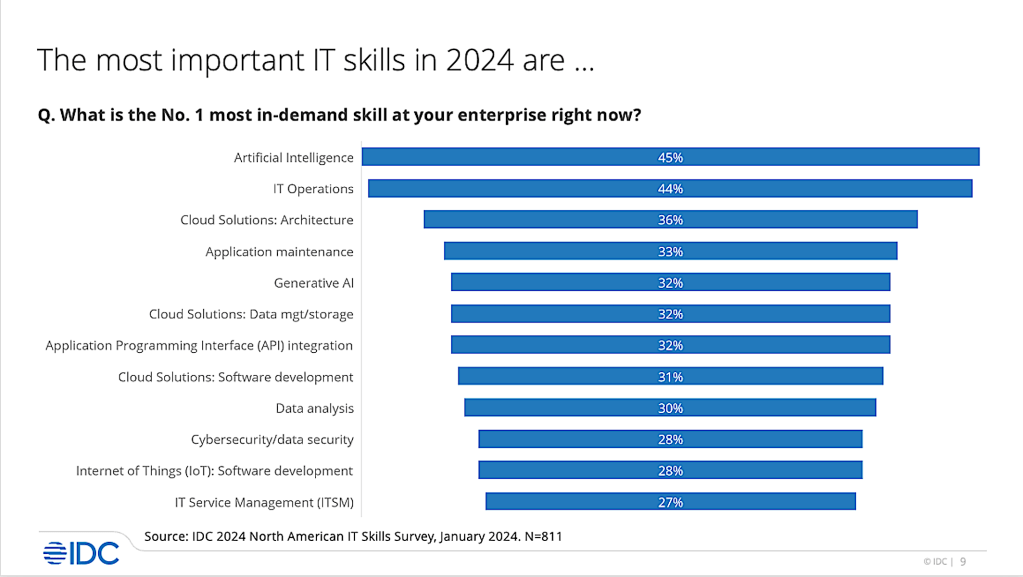
While it’s no surprise that artificial intelligence (AI) skills are currently the most in-demand skill for most enterprises, IT Operations are a close second. Additionally, a variety of cloud skills, including architecture, data management and storage, and software development, are among the ten most needed skills identified by survey respondents.
IDC
This situation is further compounded by the need for additional, non-technical skills, such as digital business skills, human skills, and leadership skills, according to Gina Smith, PhD, research director for IDC’s IT Skills for Digital Business practice.
“Getting the right people with the right skills into the right roles has never been so difficult,” Smith said in a statement. “As IT skills shortages widen and the arrival of new technology accelerates, enterprises must find creative ways to hire, train, upskill, and reskill their employees. A culture of learning is the single best way to get there.”
The IDC report Enterprise Resilience: IT Skilling Strategies, 2024 presents a framework for how enterprises can address the IT skills shortage. It includes data from IDC’s 2024 North American IT Skills Survey as well as best practices for cultivating a culture of learning in the enterprise.
With AI ‘sucking the air out of almost all non-AI investments in the whole tech world,’ companies are cutting what they believe are unnecessary jobs — and replacing them with AI-skilled workers. In the first quarter of 2024, US companies announced plans to cut 257,254 jobs, up 120% over the final quarter of 2023, according to a report by outplacement firm Challenger, Gray & Christmas. The surge in layoffs was led by the tech sector, followed by government positions.
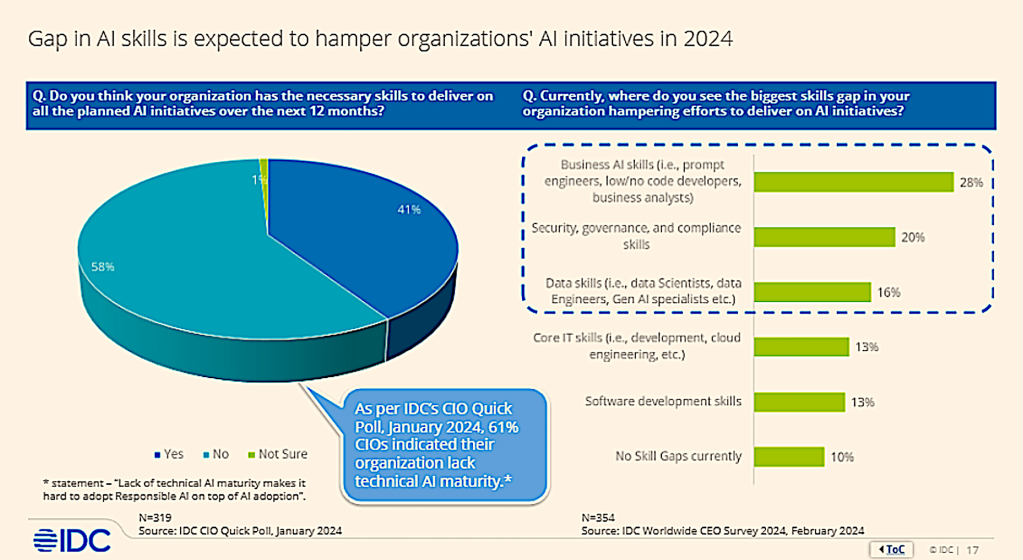
Ironically, genAI — one of the most critical skills workers lack — is likely to play a critical role in addressing skills shortages in today’s marketplace, according to a recent study by London-based Kaspersky Research. It showed that 40% of 2,000 C-level executives surveyed plan to use genAI tools such as ChatGPT to cover critical skills shortages through the automation of tasks.
“If there’s a desire to delegate critical activities and functions to genAI, it is essential that senior management first develops a deeper understanding of the data management processes, including what data can and cannot be used to train these systems,” said David Emm, Kaspersky’s principal security researcher.
IDC
A common concern among employees is that genAI will replace job positions. However, both anecdotal evidence and research has shown that like other tech advances in the past, genAI is likely to create more jobs than it replaces. And employees who are replaced by genAI are more likely to be replaced by someone who knows how to use AI as part of their skill set.
According to Forrester Research’s 2023 Generative AI Jobs Impact Forecast, the technology will influence 4.5 times more jobs than it replaces. The technology will also make up nearly 30% of the jobs that are lost to automation by 2030.
“We forecast that generative AI will replace 90,000 jobs in 2023, growing to 2.4 million by 2030,” the study said. While 2.4 million jobs replaced by genAI sounds high, Forrester notes that automation and AI overall will replace just 4.9% of US jobs by 2030. And job losses over the next two years will remain modest until questions about intellectual property rights, copyright issues, plagiarism, model refresh rates, model bias, ethics, and model response reliability are resolved, the research firm said.
The latest report from the International Monetary Fund (IMF) on the impact of genAI reads like a “best of times, worst of times” tale. The study found as much as 60% of jobs will be exposed to the effects of AI. About half of the jobs affected by AI and genAI could benefit from enhanced productivity. For the other 50%, however, genAI tools could be used to execute tasks now done by humans, which could lower labor demand, lead to lower wages, and reduce hiring.
“Many studies have predicted the likelihood that jobs will be replaced by AI,” the study said. “Yet we know that in many cases, AI is likely to complement human work.”
But that requires employees who know how best to work with AI. Rick Villars, group vice president for research firm IDC, said his analysts have seen that enterprises are “again and again” increasing budgets for genAI and other forms of AI, including building out infrastructure, services, and software platforms.
“The one thing they’re not increasing at the same level is the investment in training and upskilling their own teams,” Villars said. “That’s about the IT teams and the subject-matter experts. But it’s also just training their employees on better AI behavior and practices so they can protect their information.”
Training workers to utilize AI and big data (huge amounts of structure and unstructured information) ranks third among company skills-training priorities over the next five years, and it will be prioritized by 42% of companies, according to a survey by the World Economic Forum.
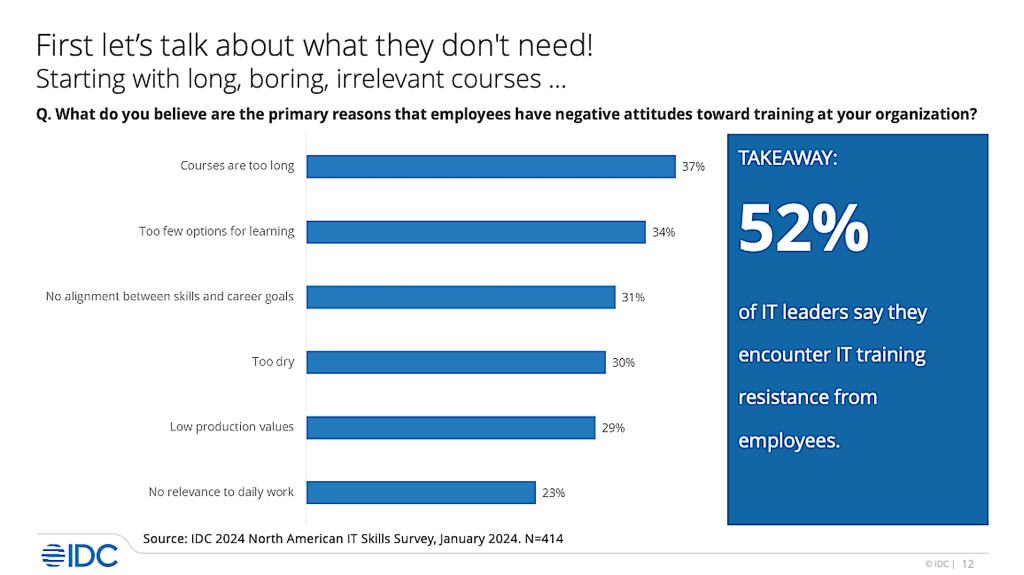
Among the challenges organizations face when trying to expand the skills of their employees is resistance to training. Employees complain that the courses are too long, the options for learning are too limited, and there isn’t enough alignment between skills and career goals, according to IDC’s survey.
IDC
To overcome these challenges, IT leaders need to employ a variety of strategies to encourage a more effective learning environment within their organization. That includes everything from classroom training to hackathons, hand-on labs, and games, quests, and mini-badges.
But fostering a positive learning environment in an organization requires more than just materials, courses, and challenges. Culture change begins at the top, and leaders need to demonstrate why learning matters to the organization.
“This can be done by aligning employee goals with business goals, promoting continuous learning throughout the employee’s journey, and creating a rewards program that recognizes process as well as performance,” IDC’s report stated. “It also requires the allocation of adequate time, money, and people resources.”
Training that engages employees also translates to “experiential learning” or hands-on training. More than eight in 10 IT executives surveyed by IDC indicated they’re either already using experiential learning techniques or plan on implementing them this year.
Nearly three out of four (70%) IDC survey respondents said they are already utilizing experiential learning methods, which includes labs, games, and hackathons. And genAI has also found its way into the current training environment, with more than half the organizations surveyed using or piloting it for IT training.
Most, but not nearly all of those surveyed said they also reward employees with project or role-based mini-credentials to encourage continued skills development.
Source:: Computer World
Google partners with Magic Leap on mixed reality development

Google has struck a partnership with Magic Leap to develop mixed reality products, the companies announced on Thursday.
The aim is to combine Magic Leap’s optics hardware IP and manufacturing expertise with Google’s own immersive technologies and developer ecosystem to collaborate on extended reality (XR) technologies, the companies said in a blog post. The term XR encompasses augmented reality, virtual reality, and mixed reality technologies.
“We look forward to bringing together Magic Leap’s leadership in optics and manufacturing with our technologies to bring a wider range of immersive experiences to market,” said Shahram Izadi, vice president and general manager of AR/XR at Google, in a press release statement. “By combining efforts, we can foster the future of the XR ecosystem with unique and innovative product offerings.”
Aside from the apparent plan for Google to focus on software and Magic Leap on optics and other hardware, there are few details on what products might result from the partnership, said Avi Greengart, lead analyst at research firm Techsponential.
“[It] could mean that Magic Leap is planning new enterprise AR glasses running Google XR software,” said Greengart, “or perhaps Google will be using Magic Leap optics in its own smart glasses, or…something else entirely.”
Computerworld asked both companies for further information but didn’t receive a response.
The partnership is an extension of a longstanding relationship between the two firms: Google led a $542 million investment in Magic Leap in 2014. (Google CEO Sundar Pichai joined the board at that time, before he reportedly stepped down in 2018.) Magic Leap has received around $4 billion in total funding to date.
The company, which initially sought to gain traction with consumers, switched its focus to enterprise sales in recent years amid reports of low sales.
While it has struggled to gain traction, Magic Leap’s optics technology is attractive to multiple companies in the AR market, said Anshel Sag, principal analyst at Moor Insights and Strategy. That includes Meta, which was reportedly in talks with Magic Leap to license its IP last year.
“Optics are not easy, and Magic Leap had to overcome a lot of challenges to deliver its unique display technology,” said Sag.
Google has developed its own AR/VR products too, notably the augmented reality headset Google Glass that launched in 2014. Like Magic Leap, Google also eventually pivoted to focus on enterprise customers after Glass failed to connect with a wider audience. Glass was discontinued last year.
Google has continued to develop various AR/VR technologies, such as Project Astra — an AI agent accessed via smart glasses, as highlighted to a demo at this year’s Google I/O. Google also struck a partnership with Samsung in 2023 with a view to develop mixed reality devices. A Google spokesperson told Reuters on Thursday that the deal with Samsung will not be affected by its collaboration with Magic Leap.
Source:: Computer World
Why Spain just banned Meta’s new EU election voting features
This week in Dutch tech
Swiss AI startup saving Swiss chocolate secures $16M
Netherlands, France, and Germany lead ‘largest ever’ botnet sting
Mistral AI Launches Codestral: AI Code Generation Across 80 Programming Languages
China unveils ambitious three-year plan to dominate AI and computing standards

China has launched an ambitious three-year plan to establish itself as a global leader in AI and computing standards. The initiative, “Action Plan for Information Standard Construction (2024-2027),” outlines a comprehensive strategy to strengthen China’s position in the ongoing tech race with the US and other nations.
The plan, spearheaded by China’s Central Cyberspace Affairs Commission, the Ministry of Industry and Information Technology, and the State Administration for Market Regulation, focuses on strengthening research and developing standards for advanced chips, computing power infrastructure, quantum technology applications, brain-computer interfaces, and AI, according to an official document published by Central Cyberspace Affairs Commission.
“The Action Plan emphasizes that information technology standards are an important part of the national standards system and an important support for high-quality development driven by information technology,” the Commission said.
“By 2027, the information technology standard working mechanism will be more sound, the layout of the information technology standard system will be more complete, a batch of high-quality information technology standards will be released, the quality of standards will be significantly improved, the implementation effect will be significantly enhanced, the role of information technology standards in leading technological innovation and driving economic and social development will be fully played, and the contribution and influence of international standards will be significantly improved,” the Commission added.
The plan places AI at the center of this mission, recognizing its role as a game-changer.
A key component of the plan is the development of “general, foundational, ethical, security and privacy standards” for large AI models and generative AI, the document added. It also aims to promote the construction of blockchain standards and the development of cross-chain interoperability and smart contract technology standards. Besides, advanced standards in important application and service fields such as cloud computing, cloud-native, distributed cloud, edge cloud, cloud-network integration, cloud applications, intelligent service, and other areas are also in focus.
The plan also intends to “promote the standardization of quantum computing, quantum communication, quantum measurement, and other key technologies, develop standards for brain-computer interfaces, enhance research on input-output, brain information decoding algorithms, brain information security, privacy protection, and related technologies and applications.”
The move is intended to address the current gaps and inefficiencies in applying standards within various government agencies.
From the information technology standards perspective, the statement said that the government faces a series of “shortcomings” such as “lack of coordination across departments and fields, and conflict of standards.”
The implementation of standards is not effective, and the phenomenon of focusing on research and development and neglecting application is still obvious; the influence of international standards work is insufficient, and the professional level, depth of participation, and quality of contribution need to be improved,” the commission added.
The action plan calls for the creation of a cohesive system that integrates computing, storage, telecommunication, and operational capabilities, reflecting the need for seamless technological integration.
China’s push for high-tech self-reliance is seen as a crucial step in transforming its economy due to mounting economic challenges and ongoing US sanctions on key technologies. Last week, the country established a massive $47 billion fund to bolster its chip industry, which is seen as a countermeasure against US efforts to limit China’s access to advanced chip technology.
China’s ambitious plan to set the global agenda for technology standards represents a significant step in the ongoing global competition for technological dominance.
Source:: Computer World
Microsoft reportedly unhappy about Apple’s OpenAI iPhone

I don’t think NBC ever considered a show called ‘Frenemies,’ but if the broadcaster had done so, the script could echo imminent tension as Apple and Microsoft both cozy up to OpenAI and ChatGPT. It’s an open relationship that doesn’t appear to be making the Windows maker happy.
According to The Information, Microsoft has been meeting with OpenAI to express some concern that Apple has reached a deal with the ChatGPT publisher to use generative AI in its products.
Microsoft Copilot’s Apple copilot
Microsoft is apprehensive because it has now sewn ChatGPT tightly within Microsoft Copilot — and the company’s entire ecosystem. Microsoft partners such as Orange Business are also in the picture, offering their own services around Copilot. Like ‘that’ episode of Friends, this ménage à trois is already a little crowded.
Disapproval comes straight from Microsoft’s C-suite. CEO Satya Nadella has reportedly met with Altman to discuss his concerns, particularly around QoS (Quality of Service) levels. Microsoft is worried that OpenAI’s servers will be unable to handle the quantity of requests generated when hundreds of millions of Apple users query ChatGPT, and that this may impact its own customers.
Microsoft has cause to feel protective. The company has pumped billions ($13b) into its Sam Altman-led AI partner, despite growing concerns about “safety and processes” at the firm. Apparently, the PC OS vendor now wants a slice of any revenue OpenAI generates as a result of the not-so-secret deal it has allegedly reached with Apple.
Zooming out
At the same time, OpenAI benefits from offering its services via all established platforms, as failing to do so could easily be construed as anti-competitive — even though Apple and Microsoft effectively compete using ChatGPT-like services, frenemy style. Microsoft fears it will lose its competitive edge, and Apple meanwhile continues to develop its own unique AI approaches, particularly around vision intelligence, spatial computing, and (of course) data privacy.
OpenAI is expected to drive some, but not all, of the AI features Apple plans to introduce — improved contextual understanding in Siri may be one of those. It is therefore quite telling that The Information claims Apple wants to make it transparent to customers when they are making use of OpenAI.
We also believe Apple is working to introduce unique AI tools that work entirely on the device, as well as server-side solutions heavily protected by iCloud privacy and encryption technologies.
Rocks in the road
There are some challenges that may yet sour the relationships Apple and Microsoft have with OpenAI, not least the frequently voiced claims that safety, security, and potential baked-in bias are not being correctly managed by the AI company.
That’s a concern professionals across the AI industry have always understood. Even Apple’s former senior director of machine learning and artificial intelligence, Carlos Guestrin, warned that poorly managed data can deliver very bad results.
This is likely why Apple, which has been working in AI far longer than so many reporters seem to believe, has been proceeding slowly and deliberately. Tech is meant to make things better, not worse. You only need to look at the impact of the dark side of social media to see what happens when strong controls are not in place.
Chef’s kiss
All that aside, Apple’s response seems to have been to work in partnership with OpenAI, and — if the report is to be believed — to put transparency guards in place so people know where responses come from.
The company may also be working to offer users a choice of genAI service providers, but nothing to that effect has been strenuously claimed.
And always in the background, Apple’s own AI teams are working on something of their own, designed to capitalize on what noted financial analyst Keith Fitz-Gerald says will be “another iPhone moment” as Apple puts AI inside the iPhone.
Microsoft, of course, is concerned that as mobile devices become smarter, its much vaunted Surface Pro recovery could fizzle out before the brand really pops. There’s a lot at stake, which is why there will be so many people glued to the next Apple keynote on June 10.
Please follow me on Mastodon, or join me in the AppleHolic’s bar & grill and Apple Discussions groups on MeWe.
Source:: Computer World
What is Snapchat Plus? Every Feature Explained For 2024
In two years, 100% of enterprise PC purchases will be AI computers

Global revenue from AI semiconductors is expected to grow to $71 billion this year, an increase of 33% over 2023, according to the latest forecast from Gartner.
By the end of 2025, AI chip industry revenue is projected to top $91.5 billion, and that revenue will continue to see double-digit growth through at least 2028, according to the report released today.
By the end of 2026, 100% of enterprise PC purchases will be AI PCs, which are computers that include a neural processing unit (NPU) enabling on-computer AI operations. Those PCs run longer, quieter, and cooler and have AI tasks running continually in the background, creating new opportunities for leveraging AI in everyday activities, according to Gartner’s report. The firm predicts that AI PC shipments will reach 22% of total PC shipments in 2024.
This year, nearly half of all AI chips revenue is expected to come from the sale of AI-enabled personal computers. By the end of this year, AI chips revenue from computer electronics is projected to total $33.4 billion, which will account for 47% of total AI semiconductors revenue, according to Gartner.
“Today, generative AI (genAI) is fueling demand for high-performance AI chips in data centers. In 2024, the value of AI accelerators used in servers, which offload data processing from microprocessors, will total $21 billion, and increase to $33 billion by 2028,” said Alan Priestley, a vice president analyst at Gartner.
This year, AI chips revenue from automotive electronics is also expected to reach $7.1 billion, and $1.8 billion from consumer electronics.
Sixty-six percent of enterprises worldwide said they would be investing in genAI over the next 18 months, according to IDC research. Among organizations indicating they will increase IT spending for genAI in 2024, infrastructure will account for 46% of the total spend.
The problem: a key piece of hardware needed to build out that AI infrastructure is in short supply. While GPUs are in high demand to run the most massive large language models (LLMs) behind genAI, the market still needs high-performance memory chips for AI apps. The market is tight for both — for now.
GPUs used for training and inference tasks on LLMs can consume vast amounts of processor cycles and be costly to use. Smaller, more industry- or business-focused models can often provide better results tailored to business needs, and they can use common x86 processors with NPUs.
“While much of the focus is on the use of high-performance GPUs for new AI workloads, the major hyperscalers (AWS, Google, Meta and Microsoft) are all investing in developing their own chips optimized for AI,” Priestley said.
While chip development is expensive, using custom-designed chips can improve operational efficiencies, reduce the costs of delivering AI-based services to users, and lower costs for users to access new AI-based applications, according to Priestley.
“As the market shifts from development to deployment we expect to see this trend continue,” Priestley said.
Last month, Intel CEO Pat Gelsinger said he sees the company’s future embedded in an AI-everywhere concept, with NPUs bolstering its new family of Intel Core Ultra processors. The chipmaker expects to ship 40 million AI PC processors in 2024 and 100 million next year.
Partly driving the uptick in AI on edge devices is the fact that the average lifespan for mobile phones is shortening, with consumers and enterprises replacing mobile phones earlier.
“This change allows device spending to achieve $688 billion during 2024, up from 2023 spending lows of $664 billion, which will represent a 3.6% growth rate,” the report stated. “The integration of genAI capabilities in premium and basic phones sustains, more than drives, this change.”
Source:: Computer World


