


UK leads Europe for GenAI patents but Germany is catching up, UN report reveals

Download our business projectors enterprise buyer’s guide

From the editors of Computerworld, this enterprise buyer’s guide helps IT and business staff understand what the various types of business projectors can do for their organizations and how to choose the right solution.
Source:: Computer World
Dutch startup bags fresh funding to tailor orchard farming for every tree
Omnissa downplays its VMware past in official launch

News that VMware’s former End User Computing (EUC) division is now officially called Omnissa — and that reference to the former was mentioned only in a footnote in the firm’s press release — is not surprising at all, said Shannon Kalvar, research director of virtual client computing at IDC.
Yesterday marked the official launch of the new organization, now owned by Menlo Park, Calif.-based KKR. The global investment firm paid $4 billion for VMware’s EUC division in a deal announced in late February, only a few months after Broadcom’s $69 billion acquisition of VMware was finalized. The EUC division purchase included Horizon, a desktop and application virtualization platform, and Workspace One, a unified endpoint management platform for the enterprise.
Instead of dwelling on the past, the Omnissa executive team, which includes Shankar Iyer as the firm’s CEO and who formerly headed up the VMware EUC division, has an opportunity to “come out and really lay out a vision for end user computing in an era where companies are increasingly very much digital and becoming AI driven,” Kalvar said.
“By that, I don’t mean all the excitement about LLMs,” he added. “But there have been tremendous advancements in hundreds of different kinds of models for predictive and interpreted analytics, for all kinds of things,” he said.
There is, he said, also an opportunity to say, “OK, we are stable now, but we can go further, we can do more.”
John Annand, practice lead at Info-Tech Research Group, said that as “Broadcom has continued its attempts to mend fences following the acquisition of VMware, we now finally know the outcome of the division they did not want to take into the new partnership.”
Annand described Omnissa as a company that is “aggressively looking to retain the former VMware client base by appealing to the goodwill VMware used to have in both the enterprise and reseller partner space. Senior staff in operations, engineering, marketing, product, and, of course, the new CEO, Shankar Iyer, are all familiar faces for those who took the EUC track at past VMWorld conferences.”
Combine these staff choices, he said, with the “vision and value statements, and the messaging seems clear: ‘We will be the company you used to like doing business with.’”
Omnissa is “wasting no time reaching out to industry analysts to schedule briefings and invite us to attend their Omnissa Live conference” on July 23, Annand said.
“I imagine over the next 20 days, in the lead-up to their conference, we’ll begin to get a sense of their partner program and pricing models. Certainly, these are topics that are foremost on the minds of former VMware customers. And whatever goodwill Omnissa hopes to retain will depend on a large part of how they respond to these questions.”
Position-wise, said Annand, “this is a great time for them, and it makes a lot of sense for them to move quickly. Citrix recently had to go back to the well in order to raise some more cash and is aggressively ‘evaluating’ its customer portfolio, which is to say focusing on strategic ones at the expense of nonstrategic ones. And while Microsoft continues to reimagine what an entirely cloud-native desktop experience might look like, enterprises need solutions that work with existing software and devices today and not just into the future.”
Annand added that the need for desktop and app virtualization, as well as end-user device management, “has not gone away by any means. Zero-trust and security requirements across all the different form factors, manufacturers, and operating systems we put in front of workers these days have exponentially increased the operational complexity of enterprise IT.”
The challenge for Omnissa will be, he said, “do they bring the same bag of well-rehearsed tricks to the party, or can they, without legacy VMware hanging around their necks, do something truly innovative? If not, then at least we’ll have some competition as Microsoft continues to win the EUC space by default.”
Forrester principal analyst Naveen Chhabra noted in an email, “Companies that use VMware EUC products and plan to continue to do so will have to deal with Omnissa for continued support unless they need no more vendor support. Support is critical for most large organizations for functionality, performance, and security reasons.”
Chhabra noted that VMware customers have had to navigate a lot of change, first adjusting to the Broadcom acquisition and then to EUC division’s sale to KKR. And they’re not done yet.
“Omnissa is a new company, new leadership. Clients will have to learn how to work with a new company, new policies, new roadmap, new licensing,” he said. “So it is not going to be as easy or straightforward as one may want or like. There are credible alternatives from vendors like HCL, Microsoft, IBM, and Ivanti, but, as always, transition/migration is not going to be pain-free.”
Source:: Computer World
China sets its sights on human brain-computer interface standards

China aims to be among the first countries to begin developing standards for the future of brain-computer interfaces with the establishment of a new technical committee by its Ministry of Industry and Information Technology specifically for this purpose.
The ministry’s Brain-Computer Interface Standardization Technical Committee is currently fielding opinions and ideas on various issues associated with the technology and standards that the country already has set for its development, according to a press release published online by the Ministry.
These include developing and revising basic standards not only for the technology’s technical aspects, but also to hammer out issues around ethics and safety — which become increasingly more critical as technology that pushes boundaries for human-machine interaction advance.
The newly formed standards committee is currently soliciting comments regarding topics such as the “typical paradigms” of brain-computer interfaces; input and output interfaces such as brain information collection and preprocessing; and brain information encoding and decoding, data communication, and data visualization.
It’s also formulating and revising technical standards and test specifications for brain-computer interfaces in various fields, including medical, health, education, industry, and consumer electronics. It also will consider ethics and safety aspects such as the safety of emerging interface systems, as well as clinical applications of them.
Organizing standards leadership
Overall, the standards effort will attempt to create some kind of organization around stakeholders involved in China’s domestic brain-computer interface industry, including those in academia, research, and the tech industry itself.
The ultimate goals are “to focus on the hot spots of the industry and the needs of industry development, accelerate the research on the roadmap for the standardization of brain-computer interfaces, clarify the key directions and research and development priorities of brain-computer interface standardization, and coordinate and promote the formulation of brain-computer interface standards,” according to the release.
People have until July 30 to share their comments with the Science and Technology Department of the Ministry during the public announcement period.
The move supports China’s previously revealed three-year plan to establish itself as a global leader in computing standards, particularly for emerging technologies such as artificial intelligence. China is vying to strengthen its position in its ongoing technology race with the US and other nations taking the lead in tech that’s pushing the boundaries of how humans interact with machines.
Ethics to play a key role
While many technology standards efforts focus on interoperability, stewards for technologies such as AI and brain-computer interfaces — which push the boundaries of human-machine interaction — have a more pressing set of concerns, noted Brad Shimmin, chief analyst, AI & Data Analytics at Omdia. China’s new committee and groups such as the Institute of Electrical and Electronics Engineers (IEEE) in the US that seek to clarify these emerging standards will need to put ethical and safety considerations at the forefront of their agendas, he said.
“These organizations will be tasked with the difficult task of providing ethical guidance, providing a sustainable foundation upon which innovators can build solutions, as well as placing constraints on research and experimentation,” Shimmin said. “Such efforts can help to accelerate innovation while also ensuring that funded research conforms to the current socio-political expectations of the host country.”
Even with standards bodies such as the IEEE, the United States has historically encouraged aggressive research and experimentation with new technologies — up to a point, Shimmin noted. In the US, for example, Elon Musk’s brain-computer interface company Neuralink is currently in human trials with its surgically implanted brain chip, though it hit a snag this week when the second patient who was to receive the chip bowed out for medical reasons. As these trials evolve, however, organizations like the National Institutes of Health will continue to collaborate with lawmakers so they can step in to limit potentially dangerous research, he said.
Still, countries that can take a lead on the standardization of methods, interface mechanics, or materials used in creating human brain-computer interfaces, as well as the consideration of ethical issues, can “fuel national pride” that in turn drives investment in innovation and an influence on the global stage, Shimmin noted.
“Any country able to set the tone for highly impactful areas of innovation … can to a great degree shape the future of influence in that market, drawing in talented researchers and investors,” he said.
Still, no matter what standards bodies decide about human brain-computer interfaces, the pace of the technology will likely move very slowly — at least in the US, given that any meaningful use or market application will have to be approved by medical and healthcare regulators, experts said. This may give China’s standards efforts an edge if they are not limited by such a rigorous approval structure.
Source:: Computer World
Why Nvidia could soon be with hit with antitrust charges in France
Ariane 6 will restore independent European access to space. Here’s what that means
5 Best Games For Delta Emulator On iPhone
What is the use of HMU slang on Social Media?
Neobank Monzo unveils new anti-fraud features in case of phone theft
What is an iron flow battery and why is Schiphol Airport testing one?
8 AI-powered apps that’ll actually save you time
You can’t open your eyes these days without seeing something about generative AI and all the reasons it’s, like, totally gonna revolutionize the way you work.
And yet, call me surly, but most of the AI tools out there at this point seem far less impressive in practice than they do on paper. By and large, it’s the same sort of subpar stuff squeezed into slightly different places, with little in the way of concern around quality or reliability.
Yes, we get it: We can now summon answers of questionable accuracy, generate text of questionable quality and originality, and create images of — well, questionable quality and originality. Do we really need those functions in every possible surface?
Beneath all the hype, though, the generative AI systems at the heart of this movement genuinely do have some practical value. You’ve just gotta dig to get past the underwhelming also-rans and uncover the truly thoughtful, carefully conceived places where the technology is being put to good use.
But hey, you don’t have to get your hands dirty. I’ve had my metaphorical shovel out for months now as I’ve sifted through the rubble to find the buried diamonds — the standout AI-infused apps that actually enhance your workday productivity and add meaningful value into your life.
Here are eight such treasures you probably haven’t heard of that are well worth your while to try.
Part I: Documents and presentations
1. ChatPDF
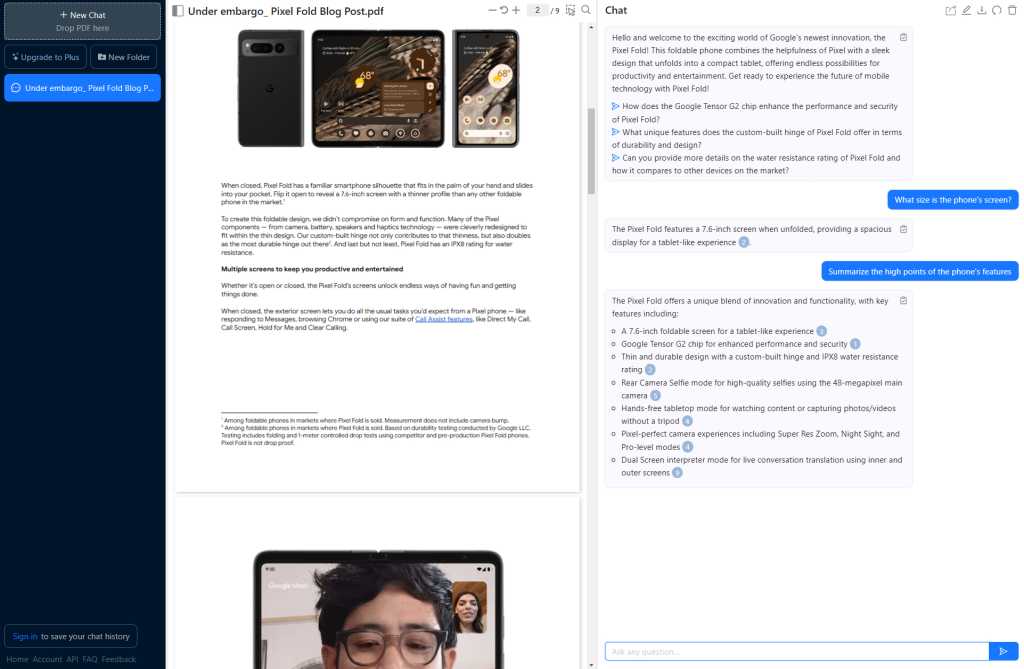
The next time someone sends you a sprawling document that looks about as interesting to read as a tax return, remember the website ChatPDF.
ChatPDF — which notably is a strictly web-based tool and not the same as any mobile apps that share its moniker — does exactly what its name suggests: It lets you upload any PDF or even DOC/DOCX file and then ask questions about the file to get quick ‘n’ simple information.
You can ask for a simple summary, or you can dive into super-specific questions about the material within. You can even upload multiple documents together and then ask questions that pertain to all of them at the same time. However you go about it, it’s a fast and easy way to get the info you need without having to read pages upon pages of monotonous material.
ChatPDF makes it easy to get info from a long document without having to read it in its entirety.
ChatPDF makes it easy to get info from a long document without having to read it in its entirety.
JR Raphael / IDG
ChatPDF makes it easy to get info from a long document without having to read it in its entirety.
JR Raphael / IDG
aria-hidden=”true”>
JR Raphael / IDG
ChatPDF claims to be able to summarize documents in any language and chat in any language worldwide. The service is free for up to two documents a day, with each being as much as 120 pages and up to 10MB in size — a generous limit that’ll probably be plenty for most casual purposes. If you do need more than that, the service offers a premium plan that gives you unlimited uploads with up to 2,000 pages and 32MB per document for $140 a year.
ChatPDF promises that all data is stored securely, easy to delete upon request, and never shared in any way with anyone — but even so, it might be wise to avoid uploading any especially sensitive company-related documents and to use the service only for more casual, non-confidential-material-involving purposes. Better safe than sorry, right?
2. Beautiful.ai
When it comes to professional presentation creation, it simply doesn’t get any better than Beautiful.ai.
Beautiful.ai takes the typically painful process of building a presentation and makes it not only easy but also almost enjoyable. The web-based app relies on artificial intelligence to help you format and design slides and make ’em look polished and professional without any real effort — and with any specific parameters or company brand guidelines you have in mind.
You can claim as much control over the look of your slides as you want, but the best part of Beautiful.ai is how it just intelligently adapts the design for you as you go and makes it look good, no matter what you might be doing. It’s “design AI,” in a sense, and it’s shockingly impressive.
Beautiful.ai does also offer some more typical generative AI elements. You can ask the service to create a specific type of presentation for you, and it’ll not only format and design the thing but also pull in publicly available data and do all the heavy lifting. And while the result likely won’t be exactly what you need (and will require thorough fact-checking along with a fair amount of rewriting), its initial output could eliminate a lot of legwork and give you a time-saving head start for refining.
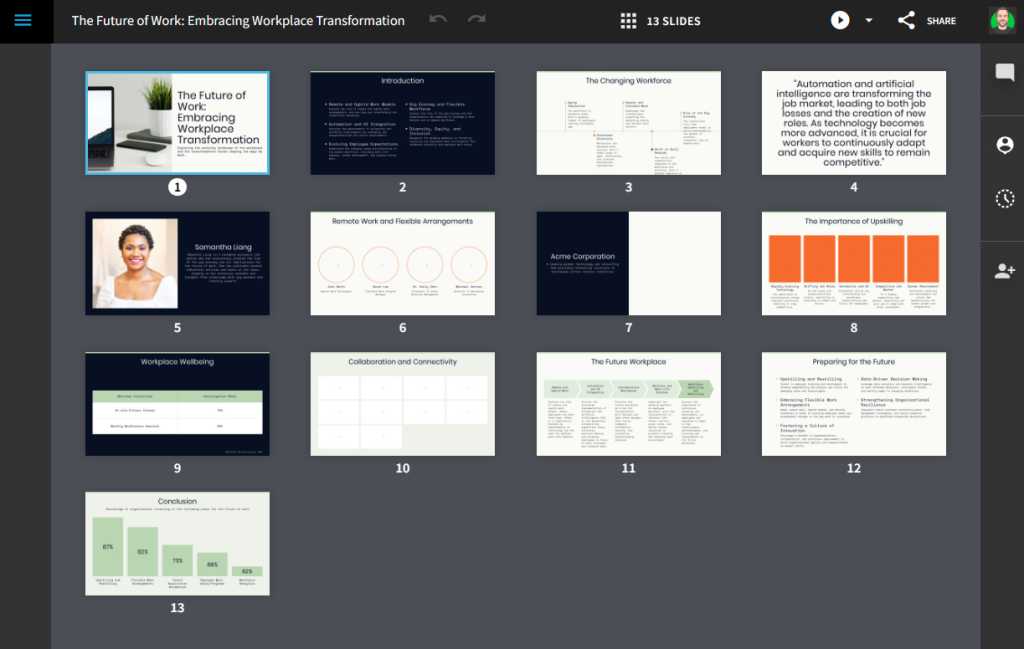
Beautiful.ai created this entire collection of slides in about five seconds, with a prompt to build a presentation about workplace transformation and the future of work.
Beautiful.ai created this entire collection of slides in about five seconds, with a prompt to build a presentation about workplace transformation and the future of work.
JR Raphael / IDG
Beautiful.ai created this entire collection of slides in about five seconds, with a prompt to build a presentation about workplace transformation and the future of work.
JR Raphael / IDG
aria-hidden=”true”>
JR Raphael / IDG
All in all, it’s a recipe that changes the way you think about presentations and will absolutely spoil you for all other such software.
Beautiful.ai costs $144 a year for individuals or $480 per user per year on a collaborative team plan. It also has a $45-per-project a la carte option.
Part II: Email
3. Superhuman
If there’s one AI-oriented tool that’s really struck a chord with me, personally, it’s the newly launched Ask AI feature within the Superhuman email app. No exaggeration: My jaw literally dropped the first few times I tried it and saw what it was capable of accomplishing and how much of a difference it’d make in my own email-centric workflow.
Superhuman, if you aren’t aware, is a cross-platform app that gives you a highly optimized, efficiency-oriented interface for interacting with your email. It’s designed for people who spend tons of time in their inboxes and wade through oceans of email every day.
And its Ask AI feature fits brilliantly within that framing. While using any of the service’s desktop apps — the native Windows or Mac programs or the web-based browser version — you can simply hit the question mark key from anywhere to pull up the new Ask AI prompt.
From there, you can type out any plain-English question or command related to anything in your email. And while you could just use that as a simpler way to search and find specific messages, the real power comes from asking for actual information contained within an email or even a series of emails. It’s a massive time-saver that makes regular ol’ searching seem almost antiquated in comparison.
For example, you might ask:
- When’s my next flight?
- Where’s my Airbnb in San Francisco?
- What did Val tell me about my last feature story idea?
- How much is my last accountant invoice?
- What’s the link for the new Computerworld WordPress site?
- Summarize all the emails from Nvidia this month
- Find some positive feedback about my Android Intelligence newsletter
These are all actual examples I’ve tried in my own inbox. And the results have consistently been fast, accurate, and helpful — noticeably more so than with Google’s own occasionally available Gemini-in-Gmail equivalent.

Superhuman’s new Ask AI feature makes it easy to find specific answers and info from anywhere in your inbox.
Superhuman’s new Ask AI feature makes it easy to find specific answers and info from anywhere in your inbox.
JR Raphael / IDG
Superhuman’s new Ask AI feature makes it easy to find specific answers and info from anywhere in your inbox.
JR Raphael / IDG
aria-hidden=”true”>
JR Raphael / IDG
The Ask AI feature is included as a part of all Superhuman subscriptions, which run $30 a month or $25 a month paid annually. The feature is in the midst of rolling out to all users on the desktop front now and is expected to expand to the service’s mobile apps sometime this summer.
Part III: Calendar
4. Dola
For all the productivity progress tech has brought us in recent years, one simple-seeming task that remains vexingly cumbersome is interacting with your calendar.
Dola does wonders for making that chore easy. In short, it’s an AI chatbot that integrates with your choice of four standard messaging platforms — WhatsApp, Telegram, Line, and Apple Messages (a.k.a. iMessage) — and then connects directly to Google Calendar, Apple Calendar, or any other calendar that supports the CalDAV protocol. (Microsoft Outlook, unfortunately, doesn’t make this easy, though you can use a third-party plugin like the favorably reviewed Caldavsynchronizer to bridge the gap.)
If you aren’t already using one of those messaging services, you can simply fire up a free account explicitly for this purpose. That’s what I did, with Telegram.
Then, once you add Dola into the service and connect it to your calendar, you can send Dola messages right within the regular chat app to accomplish everything from creating new events to canceling or moving existing appointments and also asking conversational questions about anything on your agenda.

Dola lets you interact with your calendar via simple commands in messaging apps you’re already using.
JR Raphael / IDG
Dola can also generate all sorts of information for you and add it into your calendar events — things like lists of popular lunch spots in a specific area or even ideas for company slogans.
Dola is free to use for now, during the service’s early access phase. Its founders say there’ll eventually be some manner of paid, premium option.
Part IV: Notes and transcriptions
5. Fathom
I think we can all agree that Zoom meetings — along with Google Meet meetings, Microsoft Teams meetings, and all other kinds of virtual meetings — are objectively the worst.
And while AI can’t (yet) keep you from having to sit through those virtual torture sessions, an app called Fathom can make ’em much more tolerable.
Fathom runs quietly in the background on your computer and then automatically records, transcribes, and summarizes all of your video calls. You can search through or share its summaries and even sync ’em directly into other productivity tools such as Slack or Asana if you want.
But even if you just stick with the basics, the app lets you relax and stop worrying about taking notes or missing something important — because you know it’s listening along with you and jotting down every last word along with a simple summary of the high points.
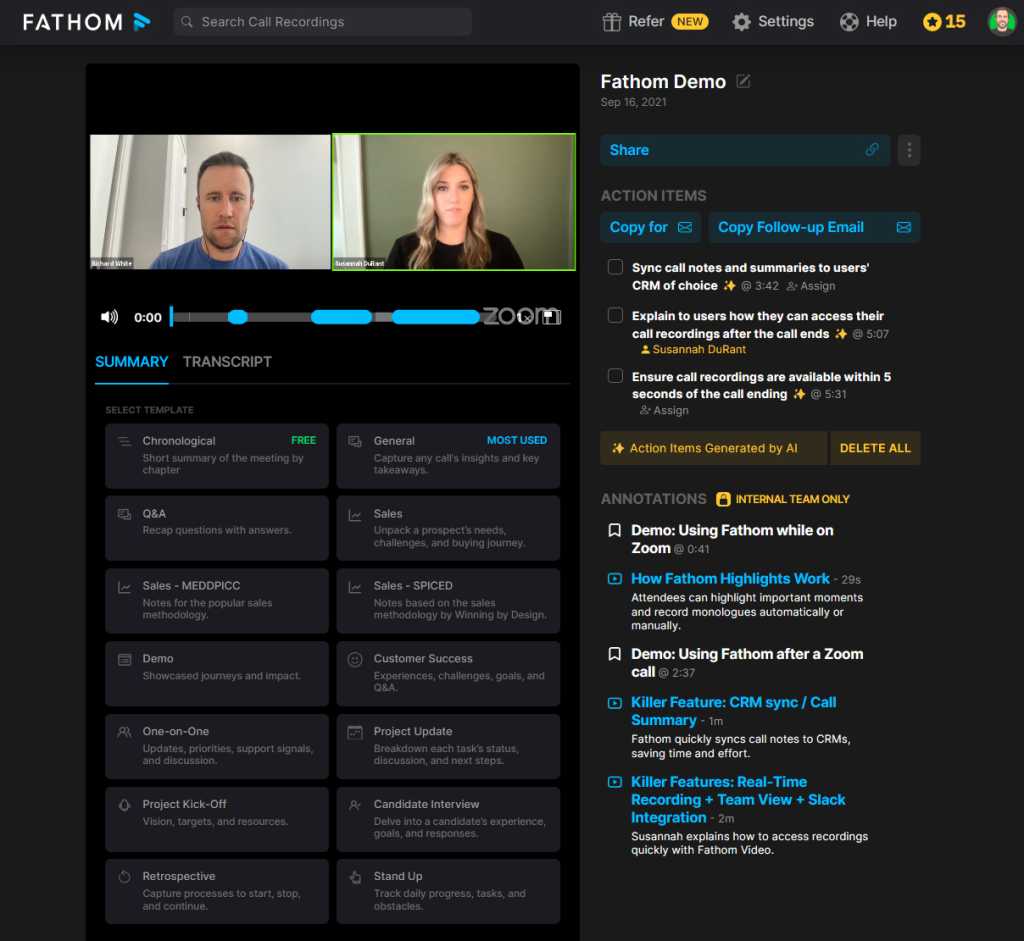
Using Fathom is like having a super-focused personal assistant in all of your virtual meetings.
JR Raphael / IDG
Fathom requires a Windows or Mac computer for its local software, and it currently supports English, French, Spanish, Italian, Dutch, Portuguese, and German. You can either activate its recording manually in each meeting or opt to connect it to your Google or Microsoft calendar and allow it to automatically record any Zoom, Meet, or Teams call on your agenda.
Data is encrypted in transit and at rest, and Fathom says it does not train AI models on customer data. (See more details about the company’s security and compliance practices in its Trust Center.)
Best of all? The service is completely free to use for those core features, with absolutely no limitations around the number or length of calls it’ll record and then store. The company makes its money by selling an optional premium subscription that adds in features like advanced AI summaries, AI-generated action items and follow-up emails, systems for team management, and integrations with HubSpot, Salesforce, Close, and Zapier.
6. Whisper Web
Transcribing a video call is fine and dandy — but what about when you want to turn a regular phone call, an in-person meeting, or an already-recorded conversation into text for simple searching and future referencing?
An open-source web app called Whisper Web is the answer. Whisper Web relies on OpenAI’s Whisper AI system to offer on-demand, real-time transcription right in your browser. It actually downloads the associated generative AI model and runs it right on your own device, which means your data never leaves that computer, phone, or tablet or gets sent to a remote server for processing.
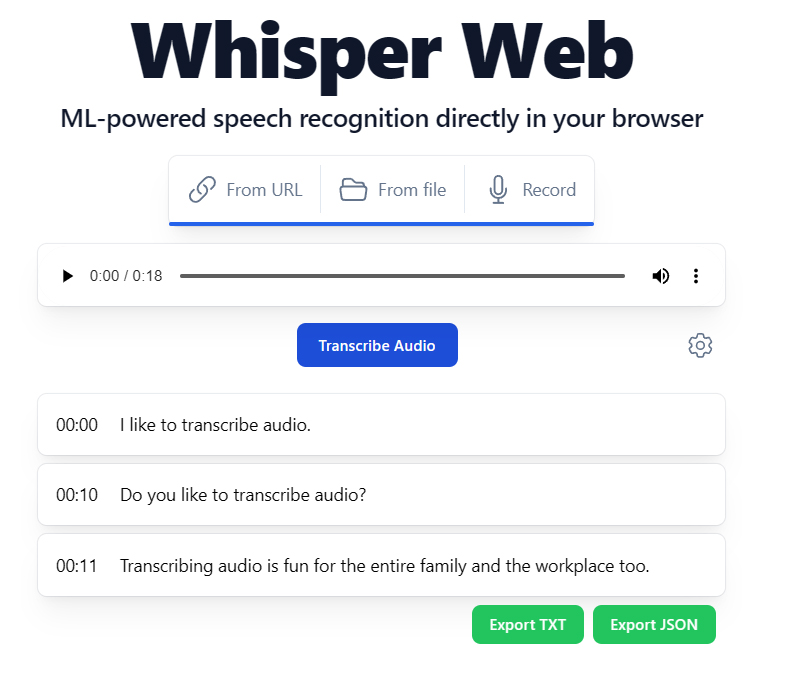
Whisper Web works swiftly and efficiently right on your own device — and right inside your browser.
JR Raphael / IDG
Whisper Web can record audio live from your microphone or import audio from an existing file you already have ready. Its creators say it’s trained on multilingual data and able to support on-the-fly translation from other languages into English, too. And it’s completely free to use, without the need for any accounts or sign-ins.
7. Summarize.tech
When you’ve got YouTube on your to-do list and you have neither the time nor the patience to sit and watch an entire work-related video — say, a presentation of some sort, a marathon company keynote, or maybe a boring-as-can-be board meeting — a splendid site called Summarize.tech will make your life instantly easier.
Summarize.tech takes any YouTube link you feed it and generates an on-demand transcript of the entire clip in seconds. It breaks the video down into broadly summarized sections and lets you click on any section to expand it and dive into deeper, more specific summaries within. It can even take videos in other languages, including Spanish and French, and translate and then summarize them in English for you.
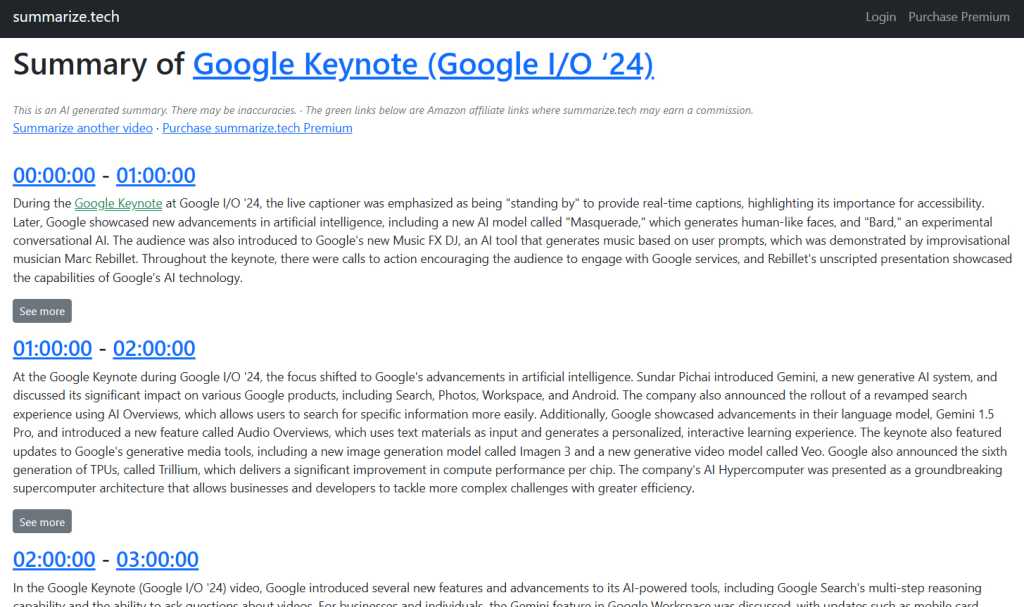
You can save yourself tons of time by letting Summarize.tech summarize and transcribe lengthy videos for you.
You can save yourself tons of time by letting Summarize.tech summarize and transcribe lengthy videos for you.
JR Raphael / IDG
You can save yourself tons of time by letting Summarize.tech summarize and transcribe lengthy videos for you.
JR Raphael / IDG
aria-hidden=”true”>
JR Raphael / IDG
Summarize.tech is free for “a few” videos per day. For anything more than that, the service offers a $10-a-month premium plan that raises the limit to 200 videos a month.
8. AudioPen
Last but not least, if you take lots of notes on the go, an AI-infused app called AudioPen is a tough tool to beat.
AudioPen is kind of like a dumping ground for any and all of your passing thoughts. Whenever something occurs to you — an idea for a client proposal, a potential project for your company’s upcoming quarter, or anything else imaginable — you just hit the record button within the service and yammer away.
AudioPen stores a complete audio recording of your ramblings and also cooks up near-instant plain-text summaries of everything you say, automatically editing out filler words and repetition. Each individual recording then becomes a note in your virtual notebook. You can search through the text, translate it into another language, and interact with it in all sorts of potentially useful ways from there.
AudioPen transforms any manner of rambling into concise, organized notes for ongoing reference.
JR Raphael / IDG
Like many of the other tools in this collection, AudioPen is completely web-based — which means it works on any device, be it a phone, tablet, or computer, and it doesn’t require any downloads or installations. You can, however, opt to install it as a progressive web app if you want a more native-feeling app-like experience.
AudioPen is free for recordings up to three minutes in length and with up to 10 stored notes at a time. An optional $99-a-year (or $159-for-two-years) premium plan eliminates those limitations and adds in a slew of extra features, including customizable styles for your summaries, summaries across multiple notes, and a simple system for sharing any notes you want to make public.
Source:: Computer World


